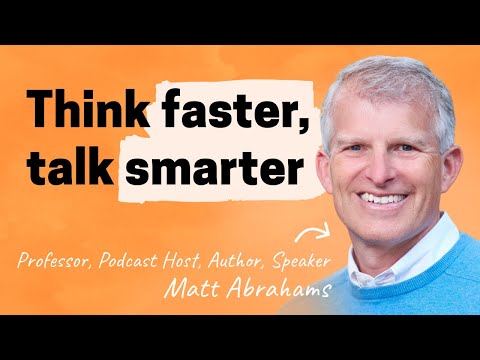
How to speak more confidently and persuasively | Matt Abrahams (professor, speaker, author)
Matt Abrahams (guest), Lenny Rachitsky (host), Narrator
In this episode of Lenny's Podcast, featuring Matt Abrahams and Lenny Rachitsky, How to speak more confidently and persuasively | Matt Abrahams (professor, speaker, author) explores turn Anxiety Into Strength: Practical Tools For Confident Speaking Stanford communication professor Matt Abrahams breaks down how anyone can reduce speaking anxiety and become more effective in spontaneous communication, from small talk to Q&A and toasts. He explains science-backed tools like visualization, breathing, reframing anxiety as excitement, and using mantras to calm nerves. Matt also introduces simple mental structures (e.g., PREP, What–So what–Now what, ADD, four I’s, triple-A) to organize thoughts quickly when speaking on the spot. Throughout, he emphasizes that speaking well is a learnable skill, not an innate talent, and that practice, reflection, and feedback are essential.
Turn Anxiety Into Strength: Practical Tools For Confident Speaking
Stanford communication professor Matt Abrahams breaks down how anyone can reduce speaking anxiety and become more effective in spontaneous communication, from small talk to Q&A and toasts. He explains science-backed tools like visualization, breathing, reframing anxiety as excitement, and using mantras to calm nerves. Matt also introduces simple mental structures (e.g., PREP, What–So what–Now what, ADD, four I’s, triple-A) to organize thoughts quickly when speaking on the spot. Throughout, he emphasizes that speaking well is a learnable skill, not an innate talent, and that practice, reflection, and feedback are essential.
Key Takeaways
Prepare to be spontaneous by having go-to structures and reps.
Most speaking is unplanned, so you need simple mental templates (like PREP or What–So what–Now what) and lots of practice to organize thoughts quickly instead of rambling under pressure.
Get the full analysis with uListen AI
Use visualization and breathing to desensitize anxiety before speaking.
Briefly rehearsing the full experience in your mind (entering the room, speaking, leaving) and doing slow exhales (twice as long as inhales) both reduce the “newness” of the situation and calm your nervous system.
Get the full analysis with uListen AI
Reframe anxiety as excitement and change your self-talk.
Physically, anxiety and excitement look similar; labeling the sensations as “I’m excited to share value” and using mantras like “I have value to add” shifts your mindset and improves performance and audience perception.
Get the full analysis with uListen AI
Strive for connection over perfection by daring to be dull.
Dropping the pressure to be brilliant frees mental bandwidth; simply answering the question, giving the feedback, or contributing to small talk makes you more present, less anxious, and ultimately more effective.
Get the full analysis with uListen AI
Anchor spontaneous speaking in simple, repeatable frameworks.
Tools like PREP (Point–Reason–Example–Point), What–So what–Now what for updates, ADD (Answer–Detailed example–Describe relevance) for Q&A, and four I’s or triple-A for feedback/apologies give you a reliable pattern when put on the spot.
Get the full analysis with uListen AI
Treat small talk and toasts as structured opportunities to connect, not perform.
For small talk, “be interested, not interesting,” balance how much each person discloses, and favor supportive over shifting responses. ...
Get the full analysis with uListen AI
Communication skills grow through repetition, reflection, and feedback.
You get better the same way athletes do: lots of reps (Toastmasters, improv, daily practice), thinking about what worked or not, and seeking honest feedback, rather than just consuming books or podcasts passively.
Get the full analysis with uListen AI
Notable Quotes
“Strive for connection over perfection by daring to be dull.”
— Matt Abrahams
“You actually have to prepare to be spontaneous.”
— Matt Abrahams
“We are often our biggest impediments to good communication because of the anxiety we bring to the party.”
— Matt Abrahams
“The funny thing about common sense is it’s not so common.”
— Matt Abrahams (quoting a psychology professor)
“Everybody can get better at communication… it starts with initiative and is followed by self-compassion.”
— Matt Abrahams
Questions Answered in This Episode
Which one or two techniques from this episode could I realistically commit to practicing before my next high-stakes meeting or presentation?
Stanford communication professor Matt Abrahams breaks down how anyone can reduce speaking anxiety and become more effective in spontaneous communication, from small talk to Q&A and toasts. ...
Get the full analysis with uListen AI
How might my communication change if I genuinely aimed for connection instead of perfection in every interaction for a week?
Get the full analysis with uListen AI
What structure (e.g., PREP, What–So what–Now what, ADD) would be most useful for the specific speaking situations I face most often?
Get the full analysis with uListen AI
In what moments do I experience the most speaking anxiety, and how could visualization or reframing that anxiety as excitement alter those experiences?
Get the full analysis with uListen AI
How can my team or company normalize talking about speaking anxiety and create safe spaces (e.g., internal Toastmasters, practice sessions) to build these skills together?
Get the full analysis with uListen AI
Transcript Preview
Visualization is a really useful technique. And you see yourself not just in the moment of speaking, but getting up to the stage, seeing it being well-received, thinking about how you step off the stage. We see athletes do this kind of thing all the time, and there's good research to say that this desensitizes people.
Most of the public speaking we do is on the spot. It's not often you give a prepared talk.
You actually have to prepare to be spontaneous, and that's counterintuitive, but when you think about it in athletics or jazz music, it's like, of course, you would prepare and practice.
Are there any other techniques that you love, that you find people find really helpful in calming their anxiety?
Strive for connection over perfection by daring to be dull. Just answer the question. Just give the feedback. Just be engaged in the small talk. By doing that, you dial down the volume of self-evaluation, freeing up resources that can be used to really help you succeed.
(Instrumental music) Today, my guest is Matt Abrahams. Matt is a professor at Stanford University's Graduate School of Business, where he teaches a very popular class on communication and public speaking. He's also the host of the incredibly popular podcast, Think Fast, Talk Smart, and the author of the very popular book, Think Faster and Talk Smarter. Matt also coaches people one-on-one on public speaking and communication skills. And in our conversation, we focus on the two areas that people most need help with. One, reducing their anxiety before and during any form of public speaking, and getting better at speaking on the spot, including giving better toasts, giving feedback, doing Q&A, and even apologizing. Like we talk about in the actual conversation, speaking well is a superpower in your career, for interviewing, for being great in meetings, for pitching your manager on ideas, to leading teams. And this skill becomes even more important as you grow in your career. The good news is that you can get better at it with a bit of help. I've worked on this a lot over the course of my career, and I still get really nervous before big talks, and even before every podcast episode. But many of these techniques I actually put into practice, and I share that in our conversation. If you pick just a couple things from this episode to put into practice, you will become a better communicator, you'll be less nervous, and you'll get better at dealing with on-the-spot moments. If you enjoy this podcast, don't forget to subscribe and follow it in your favorite podcasting app or YouTube. It's the best way to avoid missing future episodes, and it helps the podcast tremendously. With that, I bring you Matt Abrahams, after a short word from our sponsors. Let me tell you about a product called Sprig. Next-gen product teams like Figma and Notion rely on Sprig to build products that people love. Sprig is an AI-powered platform that enables you to collect relevant product experience insights from the right users, so you can make product decisions quickly and confidently. Here's how it works. It all starts with Sprig's precise targeting, which allows you to trigger in-app studies based on users' characteristics and actions taken in-product. Then, Sprig's AI is layered on top of all studies to instantly surface your product's biggest learnings. Sprig's surveys enables you to target specific users to get relevant and timely feedback. Sprig Replays enables you to capture targeted session clips to see your product experience firsthand. Sprig's AI is a game-changer for product teams. They're the only platform with product-level AI, meaning it analyzes data across all of your studies to centralize the most important product opportunities, trends, and correlations in one real-time feed. Visit sprig.com/lenny to learn more and get 10% off. That's S-P-R-I-G.com/lenny. This episode is brought to you by Dovetail, the customer insights hub for product teams. Are you working in a feature factory building filler that nobody wants? Probably, because the sad truth is that most SaaS features are rarely or never used, costing the industry billions every year. Let's change that. Product managers, Dovetail is holding their first industry conference. It's called Insight Out, and they want you to come. Over one day in San Francisco, the product community is coming together to learn how to better leverage customer insights and build products that people actually love to use. It's on April 11th, and you can hear from product leaders from Uber, Twitch, Meta, and Netflix, as they share their strategies for driving innovation, thriving in uncertainty, and balancing customer-centered work with business needs. And here's the kicker, it's absolutely free for online tickets. Just go to dovetail.com/lenny to register. This is thanks to Dovetail, the best way for product teams to get the most out of customer insights. Check it out at dovetail.com/lenny. Matt, thank you so much for being here, and welcome to the podcast.
Install uListen to search the full transcript and get AI-powered insights
Get Full TranscriptGet more from every podcast
AI summaries, searchable transcripts, and fact-checking. Free forever.
Add to Chrome