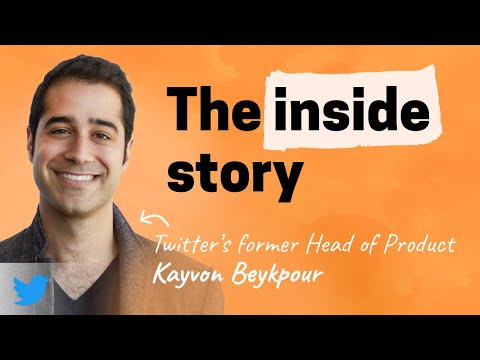
Twitter’s ex-Head of Product on Elon, consumer products, culture, more | Kayvon Beykpour
Kayvon Beykpour (guest), Lenny Rachitsky (host)
In this episode of Lenny's Podcast, featuring Kayvon Beykpour and Lenny Rachitsky, Twitter’s ex-Head of Product on Elon, consumer products, culture, more | Kayvon Beykpour explores inside Twitter’s Product Revolution: Kayvon Beykpour on Elon, Risk, Culture Kayvon Beykpour, former Head of Product and GM of Consumer at Twitter and founder of Periscope, shares candid stories about transforming Twitter from a stagnant, risk‑averse org into a team that shipped ambitious features like Spaces, Twitter Blue, Communities, and Community Notes.
Inside Twitter’s Product Revolution: Kayvon Beykpour on Elon, Risk, Culture
Kayvon Beykpour, former Head of Product and GM of Consumer at Twitter and founder of Periscope, shares candid stories about transforming Twitter from a stagnant, risk‑averse org into a team that shipped ambitious features like Spaces, Twitter Blue, Communities, and Community Notes.
He recounts his surreal interactions with Elon Musk during the Twitter takeover, including a post‑firing strategy session at HQ with Walter Isaacson quietly observing, and explains why he ultimately chose not to return under Elon’s leadership.
Kayvon details the painful way he was fired during paternity leave, his nuanced view of Elon’s later changes, and lessons from Twitter’s structural and cultural flaws—particularly around sacred cows, misaligned incentives, and weak accountability for underperformers.
He also unpacks why Periscope ultimately failed, how to use acqui‑hires and founder‑types to drive big bets, the dangers of over‑religious use of frameworks like Jobs To Be Done and OKRs, and practical advice for building stronger consumer products.
Key Takeaways
Cultural transformation demands top‑level alignment and intolerance for passive resistance.
Kayvon found that you cannot change a company’s product culture from a single function; you need organizational buy‑in from the CEO down, plus the willingness to quickly move out people who don’t believe in the new direction, or they will quietly stall ambitious efforts.
Get the full analysis with uListen AI
“Sacred cows” can be your highest‑leverage roadmap, not taboo areas.
Twitter’s most entrenched assumptions—reverse‑chron feed, strict character limits, reluctance to empower users over moderation—became a deliberate target list; challenging them unlocked some of the company’s most important product shifts, from ranked timelines to tools like Hide Replies.
Get the full analysis with uListen AI
Staff bold bets with true believers, not whoever is available.
High‑risk or speculative initiatives flounder when staffed by skeptics or politically assigned people; Kayvon argues you must put obsessed, conviction‑driven leaders (often founders from acqui‑hires) in charge, or the project will die from lack of will even if the idea is good.
Get the full analysis with uListen AI
Copying competitors can be valid—if you move fast and add your own twist.
Twitter’s Spaces drew heavily on Clubhouse’s model but was built on years of prior audio exploration and tightly integrated into Twitter’s graph; in contrast to Vine and Periscope, Twitter prioritized Spaces company‑wide, showing how inspired copying plus decisive execution can win.
Get the full analysis with uListen AI
Frameworks like Jobs To Be Done and OKRs are tools, not religions.
At Twitter, over‑rigid implementation of Jobs To Be Done and metric‑only OKR thinking led to bad user experiences (e. ...
Get the full analysis with uListen AI
Periscope’s failure shows the limits of “live‑only” consumer products.
Despite explosive top‑line growth, Periscope’s retention was weak and it lacked an asynchronous layer to keep people connected between broadcasts; meanwhile, Facebook/Instagram integrated live into richer ecosystems and out‑executed Periscope both technically and with creator incentives.
Get the full analysis with uListen AI
Deep product sense comes from voraciously using and dissecting other products.
Kayvon attributes much of his product craft to constantly trying new apps, tools, books, and games—as a user first—then analyzing what feels good or bad; this broad exposure trains intuition and sparks ideas in a way no theoretical framework can match.
Get the full analysis with uListen AI
Notable Quotes
“The sacred cows are like their own roadmap. What are all the things that you think we're not allowed to change? Let's start there.”
— Kayvon Beykpour
“It's very difficult to change culture with one hand tied behind your back.”
— Kayvon Beykpour
“When you've got nothing to do, sweep. Never sit around.”
— Kayvon Beykpour (quoting his first boss, Fred)
“Elon’s gonna Elon in his way.”
— Kayvon Beykpour
“You need a special type of person to be able to both operate within the existing structure and change the structure—to know when to use the system and to know when to fuck the system.”
— Kayvon Beykpour
Questions Answered in This Episode
How do you practically identify and deal with influential leaders who aren’t on board with a new product culture—especially if you don’t have formal power?
Kayvon Beykpour, former Head of Product and GM of Consumer at Twitter and founder of Periscope, shares candid stories about transforming Twitter from a stagnant, risk‑averse org into a team that shipped ambitious features like Spaces, Twitter Blue, Communities, and Community Notes.
Get the full analysis with uListen AI
If you were running today’s Twitter/X, which remaining sacred cows would you target next and why?
He recounts his surreal interactions with Elon Musk during the Twitter takeover, including a post‑firing strategy session at HQ with Walter Isaacson quietly observing, and explains why he ultimately chose not to return under Elon’s leadership.
Get the full analysis with uListen AI
What early retention signals would you watch now to avoid repeating Periscope’s trajectory when building a new live or social product?
Kayvon details the painful way he was fired during paternity leave, his nuanced view of Elon’s later changes, and lessons from Twitter’s structural and cultural flaws—particularly around sacred cows, misaligned incentives, and weak accountability for underperformers.
Get the full analysis with uListen AI
How can a product leader decide when it’s ethically and strategically acceptable to copy a competitor’s idea, versus when it crosses a line?
He also unpacks why Periscope ultimately failed, how to use acqui‑hires and founder‑types to drive big bets, the dangers of over‑religious use of frameworks like Jobs To Be Done and OKRs, and practical advice for building stronger consumer products.
Get the full analysis with uListen AI
In a metrics‑driven company, how do you safeguard space for long‑term, user‑loving bets that may hurt short‑term KPIs like DAU or revenue?
Get the full analysis with uListen AI
Transcript Preview
(instrumental music) The first time I ever met Elon was over FaceTime. He was just like, "Do you want to just, like, come, like hang out? You can swipe left or swipe right."
You're kind of known for, at Twitter, someone that turned the culture of the product team, and Twitter in general, from a very stagnant, nothing is changing product, to shipping all the time.
We wanted to change the lack of ambition, the lack of creativity, the lack of customers feeling that the product had changed at all.
So here's a list of stuff that you, or your team shipped while you were there. Super Follows, communities, newsletters, topics, fleets, testing reactions, edge to edge photos, Twitter Blue, Spaces, and obviously live video.
The sacred cows are like their own roadmap. What are all the things that you think we're not allowed to change? Let's start there.
And this was all relatively quickly.
I was like, "I might flame out completely, but hell if I don't try."
(instrumental music) Today my guest is Kayvon Beykpour. Kayvon was the beloved and longest tenured head of product at Twitter, and also GM of the consumer business at Twitter, up until the day that it was sold to Elon Musk. He landed at Twitter through an acquisition of his company Periscope, which was the world's largest live streaming platform, which ended up inspiring Instagram Live, TikTok Live, Facebook Live, and basically every other social network getting into live video. He sold the company to Twitter in 2015, continued leading Periscope for a number of years, and then moved into leading product, and then the entire consumer business. In our wide ranging conversation, Kayvon shares what it was like getting Elon up to speed at Twitter, what it was like to be fired from Twitter, which actually happened during his pat leave. He also shares all kinds of lessons and stories from transforming Twitter's internal culture from a risk averse, stagnant product org, to one that was shipping major features regularly. We talk about how they used acqui-hires and up and coming hungry product leaders to lead new initiatives and break through many of their sacred cows. We also get into jobs to be done, Elon's layoffs of most of Twitter's staff after the acquisition, his lessons from building and shutting down Periscope, and also building consumer products in general, and so much more. This episode is full of stories and lessons, and a bunch of stuff that you haven't heard anywhere else. With that, I bring you Kayvon Beykpour after a short word from our sponsors. And if you enjoy this podcast, don't forget to subscribe and follow it in your favorite podcasting app or YouTube. It's the best way to avoid missing future episodes, and it helps the podcast tremendously. This episode is brought to you by Interpret. Interpret unifies all of your customer interactions from Gong calls to Zendesk tickets to Twitter threads to App Store reviews, and makes it available for your product team. It's used by leading product orgs like Canva, Notion, Loom, Linear and Descript to accurately integrate the voice of the customer into your product development process, helping you build best in class products. What makes Interpret special is its ability to build customer specific adaptive AI models that provide the most granular and accurate categorization of all your customer feedback, and also connect customer feedback to revenue impact to help product leaders confidently prioritize things that will actually move the needle for your business. If you want a custom model built for your organization so that you can automate your feedback loops and prioritize your roadmap with confidence, get in touch with the team at interpret.com/lenny. That's E-N-T-E-R-P-R-E-T.com/lenny. Today's episode is brought to you by OneSchema, the embeddable CSV importer for SaaS. Customers always seem to want to give you their data in the messiest possible CSV file, and building a spreadsheet importer becomes a never-ending sink for your engineering and support resources. You keep adding features to your spreadsheet importer, but customers keep running into issues. Six months later you're fixing yet another date conversion edge case bug. Most tools aren't built for handling messy data, but OneSchema is. Companies like Scale AI and Pave are using OneSchema to make it fast and easy to launch delightful spreadsheet import experiences, from embeddable CSV import to importing CSVs from an SFTP folder on a recurring basis. Spreadsheet import is such an awful experience in so many products. Customers get frustrated by useless messages like error on line 53 and never end up getting started with your product. OneSchema intelligently corrects messy data so that your customers don't have to spend hours in Excel just to get started with your product. For listeners of this podcast, OneSchema is offering a $1000 discount. Learn more at oneschema.co/lenny. Kayvon, thank you so much for being here and welcome to the podcast.
Install uListen to search the full transcript and get AI-powered insights
Get Full TranscriptGet more from every podcast
AI summaries, searchable transcripts, and fact-checking. Free forever.
Add to Chrome