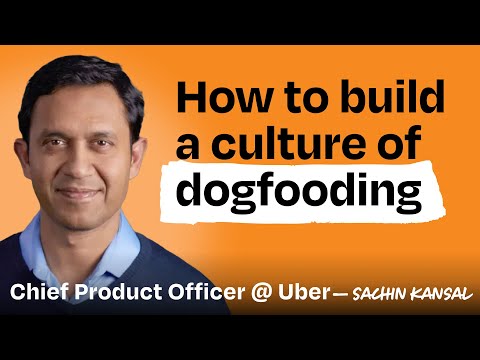
Why Uber’s CPO delivers food on weekends | Sachin Kansal
Lenny Rachitsky (host), Sachin Kansal (guest), Narrator
In this episode of Lenny's Podcast, featuring Lenny Rachitsky and Sachin Kansal, Why Uber’s CPO delivers food on weekends | Sachin Kansal explores uber’s CPO on extreme dogfooding, speed, and product judgment Uber CPO Sachin Kansal describes how he personally completes hundreds of Uber rides and Uber Eats deliveries to deeply ‘dogfood’ the product, turning real-world pain points into prioritized fixes and cultural norms. He explains his “ship, ship, ship” philosophy: once you understand a problem, the only thing that matters is how fast you can get real code into customers’ hands. Kansal shares career advice for PMs (optimize for reps and micro-decisions), his view that end-user understanding and judgment will matter even more in an AI world, and how Uber balances qualitative dogfooding with hard metrics, OKRs, and profitability. The conversation also covers Uber’s hybrid strategy for autonomous vehicles, the company’s shift to efficiency, and practical tips for being a better Uber rider and Eats customer.
Uber’s CPO on extreme dogfooding, speed, and product judgment
Uber CPO Sachin Kansal describes how he personally completes hundreds of Uber rides and Uber Eats deliveries to deeply ‘dogfood’ the product, turning real-world pain points into prioritized fixes and cultural norms. He explains his “ship, ship, ship” philosophy: once you understand a problem, the only thing that matters is how fast you can get real code into customers’ hands. Kansal shares career advice for PMs (optimize for reps and micro-decisions), his view that end-user understanding and judgment will matter even more in an AI world, and how Uber balances qualitative dogfooding with hard metrics, OKRs, and profitability. The conversation also covers Uber’s hybrid strategy for autonomous vehicles, the company’s shift to efficiency, and practical tips for being a better Uber rider and Eats customer.
Key Takeaways
Dogfooding must go beyond casual use and be systematized.
Kansal regularly spends half-days driving and delivering, takes extensive screenshots, writes long feedback docs, tags owners, and follows through until fixes ship—turning anecdotal experience into structured product improvements.
Get the full analysis with uListen AI
Leadership has to model user empathy, not just demand it.
He expects not only PMs but senior leaders to dogfood, run driver/merchant roundtables, and physically sit with users (e. ...
Get the full analysis with uListen AI
“Ship, ship, ship” means obsessing over cycle time, not recklessness.
Once a problem is validated, the bottleneck is usually slow decisions and alignment—not building; he attacks this with tightly run product reviews, clear one-way vs two-way door decisions, and, when needed, hands-on unblocking (like writing PRDs or running daily standups).
Get the full analysis with uListen AI
Great PMs are built by many reps and micro-decisions, not a few big ideas.
Kansal urges early PMs to join environments where they can ship multiple products quickly; thousands of small calls (copy, button placement, rollout markets) compound into strong judgment and product sense.
Get the full analysis with uListen AI
Qualitative emotion plus quantitative data is more powerful than either alone.
He uses a spectrum from telemetry to surveys to focus groups to one-on-one conversations—and finally his own visceral experience behind the wheel—to detect issues that metrics alone would never surface or properly prioritize.
Get the full analysis with uListen AI
System-level rituals keep “fixing what sucks” from getting deprioritized.
Uber runs company-wide driving/delivery weeks, gamifies feedback collection, and bakes “fix-its” into team OKRs (e. ...
Get the full analysis with uListen AI
In an AI world, judgment and end-user understanding become even more critical.
While AI accelerates research, PRDs, design drafts, and analysis, Kansal argues the enduring edge for PMs will be nuanced user empathy and the ability to exercise sound product judgment on top of AI-generated options.
Get the full analysis with uListen AI
Notable Quotes
“You don't ship documents. You don't ship brainstorming meetings. What you ship is code in your product.”
— Sachin Kansal
“What makes a great product manager is not five amazing strategic ideas. It's the thousand micro decisions that you made.”
— Sachin Kansal
“Until I get behind the wheel, what I miss is the visceral reaction that you get when something happens.”
— Sachin Kansal
“My biggest enemy is the cycle time from ‘we know this is a good thing’ to users actually seeing it.”
— Sachin Kansal
“Our relationship with our end users is not reciprocal. You think about them all day. They think about you for maybe 15 minutes—if that.”
— Sachin Kansal
Questions Answered in This Episode
How can smaller or B2B companies realistically emulate Uber’s level of dogfooding and user immersion without consumer-scale products?
Uber CPO Sachin Kansal describes how he personally completes hundreds of Uber rides and Uber Eats deliveries to deeply ‘dogfood’ the product, turning real-world pain points into prioritized fixes and cultural norms. ...
Get the full analysis with uListen AI
What mechanisms can product teams adopt to rigorously track and close the loop on qualitative feedback so it reliably turns into shipped product changes?
Get the full analysis with uListen AI
Where is the line between using AI as a powerful assistant in product work and over-relying on it at the expense of human judgment and product sense?
Get the full analysis with uListen AI
How should PMs decide when to override the data and follow their gut, especially on high-risk or brand-sensitive bets like safety and teens?
Get the full analysis with uListen AI
What specific organizational or cultural changes are needed to shift a company from growth-at-all-costs to efficiency and profitability without killing innovation?
Get the full analysis with uListen AI
Transcript Preview
Everyone's always promoting dogfooding. It feels though that you take this to a whole other level.
Either once or twice a month, I will set aside half a day and then I'll go out and I'll drive and deliver. My team and I, we design these amazing features, they look so good. And then you get in the car and you have a phone which is sitting three feet away from you, you're driving at 45 miles per hour, the world just changes. This thing that was looking so great in an office setting now maybe makes no sense.
When I was asking people about you and what you're amazing at, a motto came up again and again. It was, "Ship, ship, ship."
If we are going to go dogfood and experience this pain and we're gonna document it, what's next? You have to ship this. You don't ship documents. You don't ship brainstorming meetings. What you ship is code in your product.
What are some of the most impactful pieces of advice that you share with early career product people?
What makes a great product manager is not five amazing strategic ideas. It's the house and micro decisions that you made. Where should I put the button? Should I put the screen there or not? What should the copy say? Go to a job where you can ship multiple products as fast as possible.
Today my guest is Sachin Kansal. Sachin is Chief Product Officer at Uber, where he's been for over eight years and where he leads product management, design and product operations. Prior to Uber, Sachin was Chief Product Officer at Flywheel, a VP of product at Lookout. He also spent the early part of his career at Palm where he was Director of Product Management, focused on Palm's mobile operating system, webOS, and their mobile apps. In our conversation, we go deep into his passion for dogfooding, and how he makes this a big part of the product culture at Uber. He's personally done hundreds and hundreds of drives as an Uber driver and also as an Uber Eats delivery person. I have had a lot of people come on this podcast talk about dogfooding. I've never met anyone that takes it to the extreme that Sachin does. Much of what the product team works on at Uber comes from what he and his team discover from these experiences. We also talk about why it's important to always have a ship, ship, ship mentality, PM career advice for early career PMs, how Uber is planning for a future with increasingly autonomous cars and what changes over time, what he's learned from Uber's shift to efficiency and profitability. Also, a bunch of really good tips for how to avoid annoying your Uber driver and Uber Eats delivery person. This episode is full of wisdom for anyone who wants to build better products, teams and cultures. If you enjoy this podcast, don't forget to subscribe and follow it in your favorite podcasting app or YouTube. Also, if you become an annual subscriber of my newsletter, you get a year free of a bunch of world-class products, including Linear, Superhuman, Notion, Perplexity, Granola and more. Check it out at lennysnewsletter.com and click bundle. With that, I bring you Sachin Kansal. Many of you are building AI products, which is why I am very excited to chat with Brandon Fu, founder and CEO of Paragon. Hey, Brandon.
Install uListen to search the full transcript and get AI-powered insights
Get Full TranscriptGet more from every podcast
AI summaries, searchable transcripts, and fact-checking. Free forever.
Add to Chrome