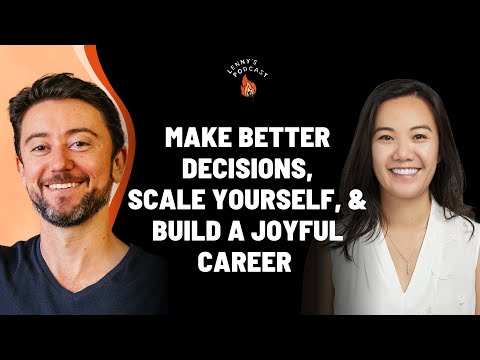
How to make better decisions and build a joyful career | Ada Chen Rekhi (Notejoy, LinkedIn)
Ada Chen Rekhi (guest), Lenny Rachitsky (host)
In this episode of Lenny's Podcast, featuring Ada Chen Rekhi and Lenny Rachitsky, How to make better decisions and build a joyful career | Ada Chen Rekhi (Notejoy, LinkedIn) explores designing joyful careers with curiosity loops, values, and intention Ada Chen Rekhi shares frameworks for making better life and career decisions, centering on “curiosity loops” and a clear understanding of personal values.
Designing joyful careers with curiosity loops, values, and intention
Ada Chen Rekhi shares frameworks for making better life and career decisions, centering on “curiosity loops” and a clear understanding of personal values.
She explains how to use structured input from others to get contextual advice, and demonstrates applying a values hierarchy to real decisions, like which projects to pursue or decline.
Ada outlines her “explore vs. exploit” approach to early career design, warns against becoming the ‘boiled frog’ in misaligned roles, and emphasizes optimizing for inner values over external status.
She also covers when coaching is actually useful, challenges of being a woman in Silicon Valley (including unspoken ‘rules of the game’), and the importance of “eating your vegetables” by deliberately practicing hard but important skills.
Key Takeaways
Use curiosity loops to get better, contextual advice for big decisions.
Instead of asking vague questions like “What should I do with my career? ...
Get the full analysis with uListen AI
Anchor major decisions in a clear, written values hierarchy.
A simple exercise—selecting and ranking 3–5 core values—gives you an “inner scorecard” to weigh tradeoffs (e. ...
Get the full analysis with uListen AI
In your early career, intentionally alternate between exploring and exploiting.
Early on, try different roles, company stages, and domains with a hypothesis in mind (“Do I like marketing? ...
Get the full analysis with uListen AI
Regularly check if you’re the ‘frog being boiled’ in your job.
Pay attention to whether learning, alignment with company direction, and energy are trending up or down; if you’re stagnating or misaligned, either redesign your role (projects, responsibilities, learning goals) through proactive conversations or start planning a move.
Get the full analysis with uListen AI
Most people don’t need a coach; be precise about the job-to-be-done before hiring one.
First ask what you want to accomplish in six months and whether cheaper/faster alternatives (courses, mentors, curiosity loops, peer communities) might do the job; if you do hire a coach, talk to multiple candidates and optimize for trust, vibe, and how you learn—not just their credentials.
Get the full analysis with uListen AI
Understand and tactically navigate the unspoken ‘rules of the game,’ especially around perception.
Because colleagues often won’t give appearance- or identity-related feedback (too risky), seek honest input from trusted people on how you come across (e. ...
Get the full analysis with uListen AI
Deliberately ‘eat your vegetables’ by practicing uncomfortable but critical skills many times.
Distinguish “I dislike this because I’m bad at it” from “this truly isn’t for me” by forcing yourself through 10–12 reps (e. ...
Get the full analysis with uListen AI
Notable Quotes
“It’s a terrible outcome to wake up late in your career and feel trapped in a job that makes you unhappy.”
— Ada Chen Rekhi
“Curiosity loops are more about looking around the corner to see if there’s anything you missed in your decision-making process.”
— Ada Chen Rekhi
“You have to decide whether you’re exploring or exploiting in your career—are you testing hypotheses or going deeper on what you’ve already found?”
— Ada Chen Rekhi
“Who am I trying to please and optimize for—the outer scorecard or my own inner scorecard?”
— Ada Chen Rekhi
“This game is rigged, but we’re not powerless. We can study the game, help each other, and find ways around the rules.”
— Ada Chen Rekhi
Questions Answered in This Episode
How could I design a personal curiosity loop around a decision I’m currently stuck on, and who should I include?
Ada Chen Rekhi shares frameworks for making better life and career decisions, centering on “curiosity loops” and a clear understanding of personal values.
Get the full analysis with uListen AI
If I wrote down my top five values today, what recent or upcoming decisions would they actually change?
She explains how to use structured input from others to get contextual advice, and demonstrates applying a values hierarchy to real decisions, like which projects to pursue or decline.
Get the full analysis with uListen AI
Looking at my current role, am I in explore or exploit mode—and is that the right mode for this stage of my career?
Ada outlines her “explore vs. ...
Get the full analysis with uListen AI
Where might I be the ‘boiled frog’—slowly accepting misalignment or stagnation because the temperature is rising so gradually?
She also covers when coaching is actually useful, challenges of being a woman in Silicon Valley (including unspoken ‘rules of the game’), and the importance of “eating your vegetables” by deliberately practicing hard but important skills.
Get the full analysis with uListen AI
Which uncomfortable but high-impact skill am I avoiding, and what would a concrete 10–12 repetition ‘eat your vegetables’ plan look like for it?
Get the full analysis with uListen AI
Transcript Preview
You know, it's a terrible outcome to wake up one day and be sort of late career and feel trapped because you have a certain lifestyle or a certain expectation that the people around you, that you have to go work this job, but then you look at yourself in the mirror and you're not happy going in there. I think that's a terrible trap that we should all try to avoid as we kind of navigate our career paths, and find the thing that's sort of most optimal for us, which is usually a mix of career success but also meaningfulness and sort of alignment in the work that we're doing with our values. (instrumental music)
Welcome to Lenny's Podcast, where I interview world-class product leaders and growth experts to learn from their hard-won experiences building and growing today's most successful products. Today my guest is Ada Chen Rekhi. Ada is an executive coach and also the co-founder of a product called Notejoy. In her coaching practice, she focuses on helping founders scale themselves. Before starting her company, she was senior vice president of marketing at SurveyMonkey. Before that, she started a contact management startup that was acquired by LinkedIn, where she ended up leading LinkedIn's marketing efforts for their growth team. Two fun facts about Ada. One, she started her current company with her husband, which we chat about whether that's a good idea or not. Also, her brother is Andrew Chen of A16Z fame. In our conversation, Ada explains how to make better decisions with a framework she calls curiosity loops. We do a live exercise around my own personal values. She shares a bunch of advice on how to intentionally and proactively build your early career path, how to thrive as a woman in Silicon Valley, when to get a coach and what you can do on your own without one, and a ton more. Enjoy this episode with Ada Chen Rekhi after a short word from our sponsors. (instrumental music) This episode is brought to you by Sprig. Next-generation product teams like Robinhood, Notion, and Loom rely on Sprig to uncover blind spots in their product development process. Sprig lets product teams collect user insights fast, allowing you to better understand why users take certain actions and how they feel about the experience. One of the things I love most about Sprig is that they're all about getting product teams the specific insights they need in the timeframe that they need it. And as of today, Sprig is making that even easier with a new and improved templates library. On this podcast, you've heard a lot about how useful templates are for companies as they grow. Sprig partnered with some of the top product teams and product thinkers to build proven playbooks specifically to solve the biggest challenges facing product teams today. From how to optimize an existing feature, to improving a conversion flow, to troubleshooting drop-off, Sprig helps you build better products. Sprig now has a library of more than 85 templates that you can use to get started collecting user insights quickly, right in your app. I especially love that Sprig builds templates specifically for product teams, and I was really excited when they asked me to create a template around product sense. One of the questions I get most is how to develop your product sense, and so I decided to build a playbook along with Sprig on how to do that based on my experience at Airbnb and from what I've learned interviewing top product folks like Jules Walter, who wrote a whole guest post on how to build your product sense. Explore my product sense playbook and the entire Sprig templates library and build better products faster. Check it out today at sprig.com/templates. That's S-P-R-I-G.com/templates. (instrumental music) Ada, welcome to the podcast.
Install uListen to search the full transcript and get AI-powered insights
Get Full TranscriptGet more from every podcast
AI summaries, searchable transcripts, and fact-checking. Free forever.
Add to Chrome