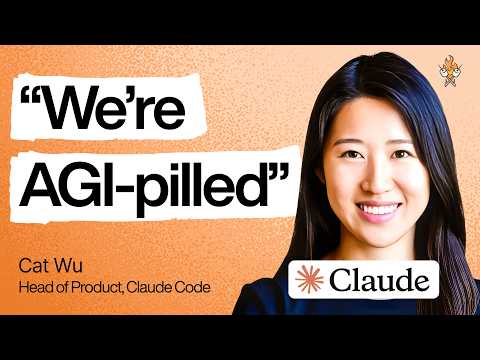
How Anthropic’s product team moves faster than anyone else | Cat Wu (Head of Product, Claude Code)
Cat Wu (guest), Lenny Rachitsky (host)
In this episode of Lenny's Podcast, featuring Cat Wu and Lenny Rachitsky, How Anthropic’s product team moves faster than anyone else | Cat Wu (Head of Product, Claude Code) explores how Anthropic ships weekly: taste, lightweight process, action-based AI tools Anthropic compresses product timelines from months to weeks or days by removing barriers to shipping and standardizing fast launch coordination across engineering, docs, marketing, and devrel.
How Anthropic ships weekly: taste, lightweight process, action-based AI tools
Anthropic compresses product timelines from months to weeks or days by removing barriers to shipping and standardizing fast launch coordination across engineering, docs, marketing, and devrel.
The PM role is rapidly morphing into a hybrid of goal-setting, systems design for execution, and model-capability elicitation, with engineers, PMs, and designers increasingly overlapping.
Instead of heavy PRDs and long roadmaps, teams rely on rigorous weekly metrics readouts plus explicit team principles so individuals can make decisions independently.
New model releases both eliminate prior “harness crutches” (like heavy prompting or rigid to-do forcing) and unlock entirely new reliable features (like multi-agent code review) that were previously not shippable.
Cowork and Claude Code represent a shift from chat-based AI to action-based agents that automate real work (decks, customer dossiers, prototypes), but only deliver leverage when users push automations to near-100% reliability.
Anthropic attributes its organizational success to mission-driven alignment (safe AGI) and focus that allows fast cross-org trade-offs, even at the expense of individual product goals.
Shipping at high velocity creates downsides—overlapping features, reduced product consistency, and user “treadmill” fatigue—driving new onboarding aids like /powerup to help users find the golden path.
Key Takeaways
Speed comes more from expectations and process than from a single breakthrough model.
Wu says Anthropic was already shipping fast before “Mythos”; frontier models help, but the bigger driver is a low-friction environment where anyone can take an idea to users in under a week (sometimes a day).
Get the full analysis with uListen
Replace multi-quarter alignment with clear near-term goals and a repeatable shipping loop.
AI-native PMing emphasizes defining the user, problem, and success criteria, then using a consistent handoff mechanism (e. ...
Get the full analysis with uListen
Use “research preview” branding to safely iterate in public.
Labeling features as early reduces the long-term support burden and makes it culturally acceptable to ship faster, learn, and revise based on real usage rather than internal debate.
Get the full analysis with uListen
PRDs still exist, but they’re reserved for ambiguity and long-lead infrastructure work.
Instead of defaulting to comprehensive documents, Anthropic leans on weekly metrics and explicit principles so teams can self-serve decisions; one-pagers appear when clarity is genuinely needed.
Get the full analysis with uListen
Product taste becomes the primary competitive advantage as code becomes cheap.
When building is faster, deciding what to build—and what UX is truly delightful—dominates; Anthropic favors hiring engineers with strong taste who can ship end-to-end from user feedback to release.
Get the full analysis with uListen
Evals are an underused product tool—start small but make them high quality.
Wu argues you don’t need hundreds; ~10 strong evals can define success, expose gaps, and make progress measurable, especially for behaviors like memory and agent reliability.
Get the full analysis with uListen
Model upgrades should trigger both subtraction and expansion.
Teams should remove harness “crutches” that smarter models no longer need (simplifying prompts/features) while also retesting previously impossible features (e. ...
Get the full analysis with uListen
Automation must reach near-100% reliability to create real leverage.
Wu warns that 90–95% “automations” are still work because they require vigilance; the last 5–10% takes effort but is what converts tinkering into dependable delegation.
Get the full analysis with uListen
Notable Quotes
“We wanna remove every single barrier to shipping things.”
— Cat Wu
“The timelines for a lot of our product features have gone down from six months to one month and sometimes to even one day.”
— Cat Wu
“As code becomes much cheaper to write, the thing that becomes more valuable is deciding what to write.”
— Cat Wu
“It is very hard to be the right amount of AGI pilled.”
— Cat Wu
“If an automation doesn't work 100% of the time, it's not really an automation.”
— Cat Wu
Questions Answered in This Episode
What are the specific weekly metrics Claude Code/Cowork review, and which ones most reliably predict whether a new feature will succeed?
Anthropic compresses product timelines from months to weeks or days by removing barriers to shipping and standardizing fast launch coordination across engineering, docs, marketing, and devrel.
Get the full analysis with uListen AI
How does Anthropic decide the threshold for shipping something in “research preview” versus holding it back—what are the risk and quality gates?
The PM role is rapidly morphing into a hybrid of goal-setting, systems design for execution, and model-capability elicitation, with engineers, PMs, and designers increasingly overlapping.
Get the full analysis with uListen AI
Can you share a concrete example of a “team principle” that prevented a bad feature decision or sped up execution without PM involvement?
Instead of heavy PRDs and long roadmaps, teams rely on rigorous weekly metrics readouts plus explicit team principles so individuals can make decisions independently.
Get the full analysis with uListen AI
What does a “tight process” between engineering, docs, PMM, and devrel look like in practice (templates, Slack rituals, owners, SLAs)?
New model releases both eliminate prior “harness crutches” (like heavy prompting or rigid to-do forcing) and unlock entirely new reliable features (like multi-agent code review) that were previously not shippable.
Get the full analysis with uListen AI
In the Claude Code leak incident, what specific safeguards were added (tooling, permissions, reviews) to reduce recurrence without slowing shipping?
Cowork and Claude Code represent a shift from chat-based AI to action-based agents that automate real work (decks, customer dossiers, prototypes), but only deliver leverage when users push automations to near-100% reliability.
Get the full analysis with uListen AI
Transcript Preview
I think it is very hard to be the right amount of AGI pilled. It's very easy to build a product for the super AGI strong model. The hard thing is figuring out, for the current model, how do you elicit the maximum capability?
I've never seen anything like the pace you folks at Anthropic are shipping at.
We wanna remove every single barrier to shipping things. The timelines for a lot of our product features have gone down from six months to one month and sometimes to even one day.
You're interviewing hundreds of PMs, and you just keep feeling like they're approaching it very incorrectly.
The PM role is changing a lot. It's changing really quickly. The thing that is extremely important for building AI-native products is iterating so quickly, figuring out a way for you to actually launch features every single week.
What do you think are the emerging skills PMs need to develop?
It comes back to product taste. As code becomes much cheaper to write, the thing that becomes more valuable is deciding what to write.
Today, my guest is Cat Wu, head of product for Claude Code and Cowork at Anthropic. Cat is at the center of everything that is changing in AI and product and building, and she and her team are building the product that is most changing the way that we all build our products. She is so full of insights and wisdom and lessons. This is an episode you cannot miss. Before we get into it, don't forget to check out lennysproductpass.com for an insane set of deals available exclusively to Lenny's newsletter subscribers. With that, I bring you Cat Wu. [gentle music] Cat, welcome to the podcast.
Thanks for having me.
I have so many questions. I'm so excited to have you on this podcast. I wanna start with giving people an understanding of your role alongside Boris. Uh, everybody knows Boris. This... He's... His episode is the number one most popular episode on this podcast. No pressure. He, uh, created Claude Code. He leads the Eng team, ships, uh, a, a bazillion PRs a day from his phone, just, like, I don't even know what the number is anymore. I think people don't give you enough credit for the success that Claude Code has had and Cowork and all the things y'all are building. Help us understand your role on the team, how you work with Boris, how you split responsibilities, just, like, what does the PM role look like on, on the Claude Code team?
I feel very lucky to work with Boris. He's been an amazing thought partner. He's our tech lead. He's very much the product visionary, and he is great at setting, like, this is what the product needs to be in, like, three months, six months from now. This is, like, what the AGI-pilled version of the product is. And a lot of my role is figuring out, okay, what is the path from where we are today to, like, that vision three to six months from now? And I, I spend more of my time on the cross-functional, so making sure that our marketing team, sales team, finance, capacity, et cetera, are, like, bought in on the plan and that we're all rowing the same direction and that once the feature is ready, that there aren't any blockers to shipping it. I think in many ways it works well because we kind of, like, mind meld, but it is actually, like, remarkably blurry of a line. Like, I think we're, like, eighty percent mind meld, and then there's, like, this twenty percent of things that, like, maybe I care a lot more about than Boris, so, like, I'll drive those, and then, like, twenty percent where he cares a lot more than me, and he just, like, drives those.
Install uListen to search the full transcript and get AI-powered insights
Get Full TranscriptGet more from every podcast
AI summaries, searchable transcripts, and fact-checking. Free forever.
Add to Chrome