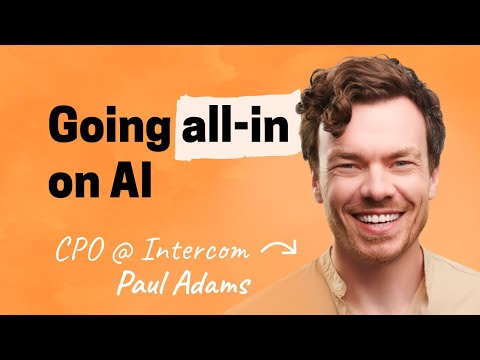
What AI means for your product strategy | Paul Adams (CPO of Intercom)
Paul Adams (guest), Lenny Rachitsky (host), Narrator, Narrator
In this episode of Lenny's Podcast, featuring Paul Adams and Lenny Rachitsky, What AI means for your product strategy | Paul Adams (CPO of Intercom) explores cPO Paul Adams on AI’s Meteoric Impact on Product Strategy, Teams Intercom CPO Paul Adams reflects on major career failures at Google and Facebook, how they shaped his views on leadership, risk, and company-building, and why embracing failure is essential to doing meaningful work.
CPO Paul Adams on AI’s Meteoric Impact on Product Strategy, Teams
Intercom CPO Paul Adams reflects on major career failures at Google and Facebook, how they shaped his views on leadership, risk, and company-building, and why embracing failure is essential to doing meaningful work.
He argues that modern AI is a “meteor” headed straight for many products and industries, and explains how Intercom effectively “ripped up” its strategy post-ChatGPT to go all-in on AI, especially in customer support.
Adams outlines practical ways to evaluate how AI affects your product, when it replaces vs. augments workflows, and how to reorganize teams and roadmaps without treating AI as a bolt-on feature.
He also shares several product frameworks—differentiation vs. table stakes, swinging the pendulum, product/market/story fit, and pragmatic Jobs to Be Done—that guide how Intercom builds and positions products over time.
Key Takeaways
Treat AI as a fundamental strategic shift, not a bolt-on feature.
Adams likens AI to a meteor that will reshape entire categories; Intercom effectively restarted its strategy after ChatGPT, concluding that customer support is directly in AI’s path and required a ‘bet-the-farm’ response.
Get the full analysis with uListen AI
Start AI strategy from first principles: what problem does your product truly solve?
Strip your product back to its core job, then map that against what AI can currently and soon do (writing, summarizing, reasoning, acting, interpreting images/voice) to see where AI can fully replace, partially automate, or simply augment your value.
Get the full analysis with uListen AI
Invest in both machine learning specialists and broadly AI-literate product teams.
You need deep ML experts to adapt foundational models to your domain, but you also want generalist PMs, designers, and engineers on every team learning to use AI, rather than isolating AI capability on a single ‘AI team’.
Get the full analysis with uListen AI
Use differentiation vs. table stakes to balance your roadmap.
Winning products must both do something meaningfully better/different and meet basic expectations; Intercom learned the hard way that over-indexing on innovation without building ‘boring’ essentials (permissions, reports) blocks adoption.
Get the full analysis with uListen AI
Recognize and manage ‘pendulum swings’ in strategy and org decisions.
Teams often over-correct from one undesirable state to another (e. ...
Get the full analysis with uListen AI
Product/market fit is not enough—aim for product/market/story fit.
Even good products in good markets can fail if their story is convoluted or mispositioned; product teams should treat clear, compelling explanation of “why this is better in ways customers care about” as core work, not just marketing’s job.
Get the full analysis with uListen AI
Keep frameworks simple and grounded; avoid over-intellectualizing.
Whether with Jobs to Be Done or AI hype, Adams pushes teams to use just the practical parts (e. ...
Get the full analysis with uListen AI
Notable Quotes
“This is a meteor coming towards you… bigger than mobile, maybe bigger than the internet.”
— Paul Adams
“We literally ripped up our strategy almost entirely and started again from first principles.”
— Paul Adams
“Start with what your product does, then ask, ‘Can AI do that?’”
— Paul Adams
“We were different and better in ways people didn’t care about.”
— Paul Adams
“Only work on what matters most… and stop worrying about things you can’t control.”
— Paul Adams
Questions Answered in This Episode
Given my product’s core job, where is AI most likely to fully replace existing workflows versus merely augment them?
Intercom CPO Paul Adams reflects on major career failures at Google and Facebook, how they shaped his views on leadership, risk, and company-building, and why embracing failure is essential to doing meaningful work.
Get the full analysis with uListen AI
How can I reorganize my teams so that AI capability is embedded across product squads instead of siloed in a single ‘AI team’?
He argues that modern AI is a “meteor” headed straight for many products and industries, and explains how Intercom effectively “ripped up” its strategy post-ChatGPT to go all-in on AI, especially in customer support.
Get the full analysis with uListen AI
Where is my roadmap currently over-weighted—on differentiation or on table stakes—and how should that change in the next 12–18 months?
Adams outlines practical ways to evaluate how AI affects your product, when it replaces vs. ...
Get the full analysis with uListen AI
If my product has decent product/market fit but sluggish growth, is the real problem our story and positioning rather than the product itself?
He also shares several product frameworks—differentiation vs. ...
Get the full analysis with uListen AI
What ‘pendulum swings’ has my company already gone through (hiring, strategy, tech bets), and how can we avoid the next over-correction as we embrace AI?
Get the full analysis with uListen AI
Transcript Preview
This is a, like, meteor coming towards you. This is going to radically transform society, and I think if people don't explore AI properly, it will leave them behind. I'd start with the thing your product does. What's the core premise behind it? Why do people use it? You know, what problem does it solve for them? That kind of thing. So, go back to basics, and then ask, "Can AI do that?" And for a lot, it's, the answer is gonna be yes, it can. For some, it might be, it can partially do it, and then maybe for others, it, mm, you know, it can't do that, at least not yet. And then, for some of it, it'll be like kind of replacement, AI will replace, it'll just do it. And then, you know, in other places, it'll be augmentation, it'll augment, like it'll help people. But yeah, I think that you gotta map your product and what AI can do, and what it will d- be able to do, and then ask yourself, "Okay, what are we gonna do?"
(instrumental music) Today, my guest is Paul Adams. Paul is chief product officer at Intercom, a role that he's held for over 10 years. Prior to this role, he was global head of brand design at Facebook, a user researcher at Google, a product designer at Dyson, and his first job was an automotive interior designer. In our conversation, Paul shares some amazing stories of failure, including the story of him giving a huge presentation where he froze on stage and had to walk off, and what he learned from these experiences of failure. We then get deep into how to think about AI as a part of your product strategy, including a ton of great examples from Intercom's experience going all in on AI. Paul also shares some of his favorite frameworks, and product lessons, and so much more. This is the first recording I've ever done not from my home studio, instead from a hotel room, so this is a fun experiment for us all. With that, I bring you Paul Adams after a short word from our sponsors. This episode is brought to you by Eppo. Eppo is a next generation A/B testing and feature management platform built by alums of Airbnb and Snowflake for modern growth teams. Companies like Twitch, Miro, ClickUp, and DraftKings rely on Eppo to power their experiments. Experimentation is increasingly essential for driving growth, and for understanding the performance of new features, and Eppo helps you increase experimentation velocity while unlocking rigorous deep analysis in a way that no other commercial tool does. When I was at Airbnb, one of the things that I loved most was our experimentation platform, where I could set up experiments easily, troubleshoot issues, and analyze performance all on my own. Eppo does all that and more with advanced statistical methods that can help you shave weeks off experiment time, an accessible UI for diving deeper into performance, and out-of-the-box reporting that helps you avoid annoying prolonged analytic cycles. Eppo also makes it easy for you to share experiment insights with your team, sparking new ideas for the A/B testing flywheel. Eppo powers experimentation across every use case, including product, growth, machine learning, monetization, and email marketing. Check out Eppo at geteppo.com/lenny and 10X your experiment velocity. That's geteppo.com/lenny. This episode is brought to you by Hex. If you're a data person, you probably have to jump between different tools to run queries, build visualizations, write Python, and send around a lot of screenshots and CSV files. Hex brings everything together. Its powerful notebook UI lets you analyze data in SQL, Python, or no code, in any combination, and work together with live multiplayer and version control. And now, Hex's AI tools can generate queries and code, create visualizations, and even kickstart a whole analysis for you, all from natural language prompts. It's like having an analytics copilot built right into where you're already doing your work. Then, when you're ready to share, you can use Hex's drag and drop app builder to configure beautiful reports or dashboards that anyone can use. Join the hundreds of data teams like Notion, AllTrails, Loom, Mixpanel, and Algolia using Hex every day to make their work more impactful. Sign up today at hex.tech/lenny to get a 60-day free trial of the Hex team plan. That's hex.tech/lenny. Paul, thank you so much for being here and welcome to the podcast.
Install uListen to search the full transcript and get AI-powered insights
Get Full TranscriptGet more from every podcast
AI summaries, searchable transcripts, and fact-checking. Free forever.
Add to Chrome