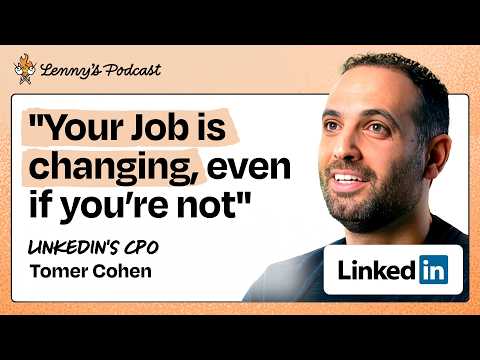
Why AI is disrupting traditional product management | Tomer Cohen (LinkedIn CPO)
Tomer Cohen (guest), Lenny Rachitsky (host), Narrator
In this episode of Lenny's Podcast, featuring Tomer Cohen and Lenny Rachitsky, Why AI is disrupting traditional product management | Tomer Cohen (LinkedIn CPO) explores linkedIn reboots product roles with AI-driven full stack builders LinkedIn’s CPO Tomer Cohen explains a radical shift from traditional, highly specialized product development to an AI-first “Full Stack Builder” (FSB) model. In response to rapidly changing job skills and rising organizational complexity, LinkedIn is collapsing processes and org structures so individual builders (and small pods) can take ideas from insight to launch, aided heavily by custom AI agents. They’ve sunset their APM program, introduced a new Associate Product Builder track, created an official Full Stack Builder title and ladder, and are re-architecting their platforms so AI can reason over LinkedIn’s systems. Cohen stresses that tools alone aren’t enough: cultural change, incentives, and deliberate change management are critical for companies that want to match the pace of technological change.
LinkedIn reboots product roles with AI-driven full stack builders
LinkedIn’s CPO Tomer Cohen explains a radical shift from traditional, highly specialized product development to an AI-first “Full Stack Builder” (FSB) model. In response to rapidly changing job skills and rising organizational complexity, LinkedIn is collapsing processes and org structures so individual builders (and small pods) can take ideas from insight to launch, aided heavily by custom AI agents. They’ve sunset their APM program, introduced a new Associate Product Builder track, created an official Full Stack Builder title and ladder, and are re-architecting their platforms so AI can reason over LinkedIn’s systems. Cohen stresses that tools alone aren’t enough: cultural change, incentives, and deliberate change management are critical for companies that want to match the pace of technological change.
Key Takeaways
Collapse process and organizational complexity around empowered builders.
LinkedIn observed that product work itself isn’t inherently complex, but years of sub-steps, reviews, and micro-specialization slowed everything down; the FSB model pulls work back into fewer hands so builders (and small pods) can own problems end-to-end.
Get the full analysis with uListen AI
Redefine what humans uniquely own: vision, empathy, communication, creativity, judgment.
Cohen’s goal is to automate as much of the mechanical work as possible and focus human builders on high-leverage traits—especially judgment in ambiguous situations—while AI handles research, analysis, maintenance, and much of the execution.
Get the full analysis with uListen AI
Invest heavily in AI-ready platforms and custom agents, not just off-the-shelf tools.
LinkedIn is re-architecting UI and backend systems so AI can reason over them, and has built bespoke agents (trust, growth, research, analyst, coding, maintenance, QA) tuned to LinkedIn’s data, patterns, and standards; they found generic tools rarely work “out of the box.”
Get the full analysis with uListen AI
Curate and structure your knowledge base; don’t just expose everything to AI.
Naively giving agents access to all internal docs and code led to hallucinations and poor prioritization; LinkedIn now builds curated “golden” datasets and carefully designed context windows so agents can provide reliable, high-quality guidance.
Get the full analysis with uListen AI
Use pilots, pods, and internal success stories to drive cultural adoption.
LinkedIn seeded FSB practices in select pods and leadership teams, celebrated wins (e. ...
Get the full analysis with uListen AI
Align incentives and performance systems with AI fluency and full-stack behavior.
Hiring, evaluations, and 360 reviews are being updated to measure AI agency/fluency and cross-functional capability, signaling that using these tools and working full-stack is now part of expectations and career progression.
Get the full analysis with uListen AI
Accept that not everyone will be (or should be) a full stack builder.
Cohen emphasizes that while FSBs are central, there remains a place for specialized “system builders”; the shift is about reducing unnecessary specialization, not eliminating expert roles entirely.
Get the full analysis with uListen AI
Notable Quotes
“When we look at the skills required to do your job, by 2030 it will change by 70%. So whether or not you're looking to change your job, your job is changing.”
— Tomer Cohen
“The goal is to empower great builders to take their idea and to take it to market, regardless of their role in the stack and which team they're on.”
— Tomer Cohen
“Everything else I'm working really hard to automate.”
— Tomer Cohen
“It's not enough to give them the tools. You have to build the incentives programs, the motivation, the examples to how you do it.”
— Tomer Cohen
“If you're looking for a formal reorg or declaration to start building differently, you are waiting too long.”
— Tomer Cohen
Questions Answered in This Episode
How should a mid-sized company without LinkedIn’s resources practically start building its own AI agents and FSB-like capabilities?
LinkedIn’s CPO Tomer Cohen explains a radical shift from traditional, highly specialized product development to an AI-first “Full Stack Builder” (FSB) model. ...
Get the full analysis with uListen AI
What concrete signals distinguish someone who’s ready to be a Full Stack Builder versus better suited to remain a specialist?
Get the full analysis with uListen AI
How do you prevent AI-generated specs, research, or designs from creating a ‘lowest-common-denominator’ product culture?
Get the full analysis with uListen AI
What new failure modes or risks (e.g., trust, safety, technical debt) arise when small pods and individuals can ship so quickly with AI?
Get the full analysis with uListen AI
How will this Full Stack Builder model change hiring profiles and career paths for PMs, designers, and engineers over the next five years?
Get the full analysis with uListen AI
Transcript Preview
(instrumental music plays) When we look at the skills required to do your job, by 2030, it will change by 70%. So whether or not you're looking to change your job, your job is changing. In order to stay competitive, you actually have to go back to some first principles, go back to the drawing board and reimagine what it means to be building.
You're experimenting with a very different way of building product at LinkedIn that fully embraces what AI unlocks.
We call it the Full Stack Builder model. The goal itself is to empower great builders to take their idea and to take it to market, regardless of their role in the stack and which team they're on. It's really a fluid interaction between human and machine.
So this feels like this could be a model for how a lot of companies operate and how product ends up being built in the future.
Change management here is gonna be a critical part. It's not enough to give them the tools. You have to build the incentives programs, the motivation, the examples to how you do it. I see a lot of companies roll out their agents and just expecting companies to adopt. It doesn't work this way.
There's always been this question, is AI gonna just make people that are not amazing more amazing or is it gonna make amazing people even more amazing?
Top talent has this tendency of continuously trying to get better at their craft. The key trait that I'm emphasizing for builders is... (music fades)
(instrumental music plays) Today, my guest is Tomer Cohen, longtime chief product officer at LinkedIn, who is piloting a new way of building that I think will become a model for how companies operate in the future. It's called the Full Stack Builder program, and essentially the idea is to enable anyone, no matter their function, to take products from idea to launch. They've scrapped their APM program and replaced it with an associate Full Stack Builder program, they've introduced a new career path with the title Full Stack Builder that anyone from any function can become. And as you'll hear in the conversation, they've built a bunch of internal tools and agents and processes to basically build a human plus AI product team that can move really fast, adjust to change quickly, and do a lot more with a lot less. If you're looking for inspiration for how to rethink how your team operates, and to lean into what AI is unlocking for teams and companies, this episode is for you. A huge thank you to Sheara Gestarch for suggesting topics for this conversation. If you enjoy this podcast, don't forget to subscribe and follow it in your favorite podcasting app or YouTube. It helps tremendously. And if you become an annual subscriber of my newsletter, you get a year free of a bunch of incredible products, including a year free of Devin, Lovable, Replit, Bolt, Innit, and Linear, Superhuman, Descript, Whisperflow, Gamma, Perplexity, Warp, Granola, Magic Patterns, Raycast, ChatBD, Mobbin, and Stripe Atlas. Head on over to lennysnewsletter.com and click Product Pass. With that, I bring you Tomer Cohen after a short word from our sponsors. My podcast guests and I love talking about craft and taste and agency and product market fit. You know what we don't love talking about? SOC 2. That's where Vanta comes in. Vanta helps companies of all sizes get compliant fast and stay that way with industry leading AI, automation, and continuous monitoring. Whether you're a startup tackling your first SOC 2 or ISO 27001, or an enterprise managing vendor risk, Vanta's Trust Management Platform makes it quicker, easier, and more scalable. Vanta also helps you complete security questionnaires up to five times faster so that you can win bigger deals sooner. The result? According to a recent IDC study, Vanta customers slashed over $500,000 a year and are three times more productive. Establishing trust isn't optional. Vanta makes it automatic. Get $1,000 off at vanta.com/lenny. This episode is brought to you by Figma, makers of Figma Make. When I was a PM at Airbnb, I still remember when Figma came out and how much it improved how we operated as a team. Suddenly, I could involve my whole team in the design process, give feedback on design concepts really quickly, and it just made the whole product development process so much more fun. But Figma never felt like it was for me. It was great for giving feedback and designs, but as a builder, I wanted to make stuff. That's why Figma built Figma Make. With just a few prompts, you can make any idea or design into a fully functional prototype or app that anyone can iterate on and validate with customers. Figma Make is a different kind of vibe coding tool. Because it's all in Figma, you can use your team's existing design building blocks, making it easy to create outputs that look good and feel real and are connected to how your team builds. Stop spending so much time telling people about your product vision, and instead show it to them. Make code-backed prototypes and apps fast with Figma Make. Check it out at figma.com/lenny. Tomer, thank you so much for being here and welcome to the podcast.
Install uListen to search the full transcript and get AI-powered insights
Get Full TranscriptGet more from every podcast
AI summaries, searchable transcripts, and fact-checking. Free forever.
Add to Chrome