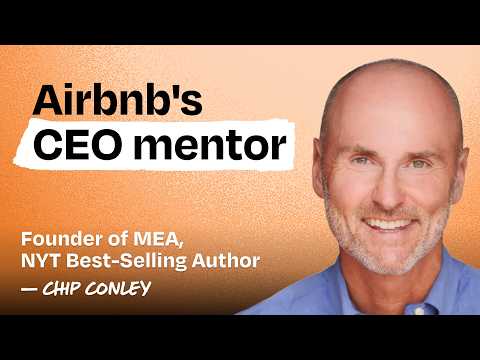
Brian Chesky's secret mentor who scaled Airbnb (after dying 9 times & building a hotel empire)
Lenny Rachitsky (host), Chip Conley (guest)
In this episode of Lenny's Podcast, featuring Lenny Rachitsky and Chip Conley, Brian Chesky's secret mentor who scaled Airbnb (after dying 9 times & building a hotel empire) explores modern elder wisdom: aging, leadership, and reinvention from Chip Conley The conversation centers on Chip Conley’s journey from founding Joie de Vivre hotels, to becoming Brian Chesky’s mentor and hospitality lead at Airbnb, to building the Modern Elder Academy (MEA), a “midlife wisdom school.” Conley shares candid stories about joining a hyper-growth tech company in his 50s, what it’s really like working for a founder in intense “founder mode,” and how intergenerational teams can be a superpower. He unpacks the realities of ageism in tech, practical ways older professionals can stay relevant, and how companies can better leverage age diversity. The episode closes with his near‑death experience, rethinking midlife as a transformative “chrysalis,” and concrete tools for finding meaning and wisdom as we age.
Modern elder wisdom: aging, leadership, and reinvention from Chip Conley
The conversation centers on Chip Conley’s journey from founding Joie de Vivre hotels, to becoming Brian Chesky’s mentor and hospitality lead at Airbnb, to building the Modern Elder Academy (MEA), a “midlife wisdom school.” Conley shares candid stories about joining a hyper-growth tech company in his 50s, what it’s really like working for a founder in intense “founder mode,” and how intergenerational teams can be a superpower. He unpacks the realities of ageism in tech, practical ways older professionals can stay relevant, and how companies can better leverage age diversity. The episode closes with his near‑death experience, rethinking midlife as a transformative “chrysalis,” and concrete tools for finding meaning and wisdom as we age.
Key Takeaways
Intergenerational teams are uniquely powerful when each age group leans into its strengths.
Younger colleagues often bring speed, focus, and technical fluency (fluid intelligence), while older colleagues contribute pattern recognition, systemic thinking, and emotional intelligence (crystallized intelligence). ...
Get the full analysis with uListen AI
To work effectively with intense founders, set clear alignment upfront and build unique credibility.
Conley advises starting key meetings by explicitly agreeing on goals and success metrics so feedback stays anchored. ...
Get the full analysis with uListen AI
Older professionals in tech must double down on curiosity, energy, and being both mentor and learner.
Conley argues that if you show up with passionate engagement, positive energy, and a willingness to learn new tools (even from younger “reverse mentors”), people notice your contribution more than your age. ...
Get the full analysis with uListen AI
Companies underutilize older talent and should deliberately design for age diversity.
Ageism remains real in tech, often justified by cost and perceived slowness. ...
Get the full analysis with uListen AI
Culture is a strategic asset: it guides decisions when leaders aren’t in the room.
Conley defines culture as “what happens around here when the boss isn’t around” and stresses its importance in distributed and remote companies. ...
Get the full analysis with uListen AI
Meaning heavily buffers suffering; how you frame midlife and aging directly affects your well-being.
Using his equation “despair = suffering − meaning,” Conley notes you can’t eliminate suffering, but you can increase meaning through purpose and reframing. ...
Get the full analysis with uListen AI
Midlife is better seen as a “chrysalis” for transformation than a crisis to fear.
Drawing on his near-death experience and burnout as a founder, Conley reframes midlife (roughly 35–75) as a cocoon phase where identities liquefy and reform into something more authentic. ...
Get the full analysis with uListen AI
Notable Quotes
“When you have older brains connecting the dots, younger team members being really fast and focused, it's brilliant, and people won't notice your wrinkles as much as they'll notice your energy.”
— Chip Conley
“Culture is what happens around here when the boss is not around.”
— Chip Conley
“Your painful life lessons are the raw material for your future wisdom.”
— Chip Conley
“Despair equals suffering minus meaning.”
— Chip Conley
“Midlife is not crisis. If you think about the caterpillar to butterfly journey, midlife is the chrysalis.”
— Chip Conley
Questions Answered in This Episode
How can a mid-career professional in tech practically demonstrate both curiosity and wisdom so they’re seen as an asset rather than a liability of age?
The conversation centers on Chip Conley’s journey from founding Joie de Vivre hotels, to becoming Brian Chesky’s mentor and hospitality lead at Airbnb, to building the Modern Elder Academy (MEA), a “midlife wisdom school. ...
Get the full analysis with uListen AI
If you’re a younger manager leading older reports, what specific practices can foster mutual respect and leverage their experience instead of triggering defensiveness on both sides?
Get the full analysis with uListen AI
For founders in “founder mode,” how do you know when your high standards and aggressive goals are motivating the team versus burning them out and damaging trust?
Get the full analysis with uListen AI
How might companies redesign hiring, performance, and promotion systems to explicitly value “invisible productivity” like mentorship, culture-building, and process knowledge?
Get the full analysis with uListen AI
On a personal level, what reframes or practices could help you shift from fearing midlife to treating it as a chrysalis for reinvention and deeper meaning?
Get the full analysis with uListen AI
Transcript Preview
Let's paint a picture of just what it was like to join Airbnb in your 50s.
I was mentoring Brian, but he was also my boss. I was 52, the average age was 26. I had to be both wise and curious, and often the dumbest person in the room.
So it's great to be in founder mode. It's not as great to be working for someone in founder mode.
Brian assumed everybody else was going to work at the same pace and duration. His point of view is like, "Hey, we're having a meeting in the office tonight at 10 o'clock. You know, be there."
Everyone's talking about, "We got to make the product better. We got to optimize this button and improve conversion."
"Isn't the product the homes and the apartments?" Joe Bhatt said, "No, product in the tech industry is something different." I just said, "Listen, let's get some older people who are hosts in here."
This whole story is a really good example of the value of having folks that are older.
When you have older brains connecting the dots, younger team members being really fast and focused, it's brilliant, and people won't notice your wrinkles as much as they'll notice your energy.
The Airbnb experience led you to starting something called the Modern Elder Academy.
So if you think about the caterpillar to butterfly journey, midlife is the chrysalis. Midlife is not crisis. I'm happier today at 64 than I was at 47 when I was going through my flatline experience.
Well, let's back up a little bit, this near-death experience. Today my guest is Chip Conley. Chip is one of the most extraordinary and interesting people that you will ever meet. He was a founding member of the board of Burning Man. He was on the board of the Esalen Institute in Big Sur. At 26, he started a hotel chain called Joie de Vivre, which went on to become the second-largest boutique hotel chain in the US. After selling it, Brian Chesky personally recruited Chip to join Airbnb, to help Brian and the company transform from a fast-growing startup to the world's most valuable hospitality brand. After leaving Airbnb, where he was known as the Modern Elder, Chip started the Modern Elder Academy, now known as MEA, the world's first midlife wisdom school, with large, sprawling, beautiful campuses in Baja and Santa Fe. He's also written seven books, given a TED Talk, and is just a genuinely interesting and amazing human and friend. In our conversation, we explore how to be successful in tech as you age, what he's learned working with and for Brian Chesky, including a lot of real talk, how to build a great culture at your company, his near-death experience and how it changed the trajectory of his life, and so much more. If you enjoy this podcast, don't forget to subscribe and follow it in your favorite podcasting app or YouTube. Also, if you become an annual subscriber of my newsletter, you get a year free of a bunch of incredible products, including Replit, Lovable, Bolt, n8n, Linear, Superhuman, Descript, Whisperflow, Gamma, Perplexity, Warp, Granola, Magic Patterns, Raycast, ChatPR, DeMob and more. Check it out at lennysnewsletter.com and click bundle. With that, I bring you Chip Conley. This episode is brought to you by Great Question, the all-in-one UX research platform loved by teams at Brex, Canva, Intuit, and more. One of the most common things I hear from PMs and founders that I talk to is, "I know I should be speaking to customers more, but I just don't have the time or the tools." That's exactly the gap Great Question fills. Great Question makes it easy for anyone on your team, not just researchers, to recruit participants, run interviews, send surveys, test prototypes, and then share it all with powerful video clips. It's everything you need to put your customers at the center of your product decisions. With a prompt as simple as, "Why did users choose us over competitors?" Great Question not only reveals what your customers have already shared, but it also makes it incredibly easy to ask them in the moment for fresh insights from the right segment. Picture this, your roadmap's clear, your team's aligned, you're shipping with confidence, and you're building exactly what your customers need. Head to greatquestion.com/lenny to get started. This episode is brought to you by Vanta. When it comes to ensuring your company has top-notch security practices, things get complicated fast. Now you can assess risk, secure the trust of your customers, and automate compliance for SOC 2, ISO 27001, HIPAA, and more with a single platform, Vanta. Vanta's market-leading trust management platform helps you continuously monitor compliance, alongside reporting and tracking risks. Plus, you can save hours by completing security questionnaires with Vanta AI. Join thousands of global companies that use Vanta to automate evidence collection, unify risk management, and streamline security reviews. Get $1,000 off Vanta when you go to vanta.com/lenny. That's V-A-N-T-A dot com slash Lenny. Chip, thank you so much for being here, and welcome to the podcast.
Install uListen to search the full transcript and get AI-powered insights
Get Full TranscriptGet more from every podcast
AI summaries, searchable transcripts, and fact-checking. Free forever.
Add to Chrome