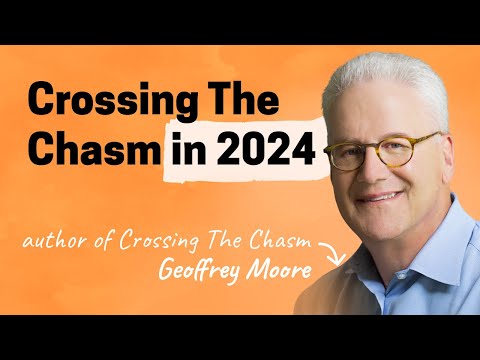
Geoffrey Moore on finding your beachhead, crossing the chasm, and dominating a market
Geoffrey Moore (guest), Lenny Rachitsky (host), Narrator
In this episode of Lenny's Podcast, featuring Geoffrey Moore and Lenny Rachitsky, Geoffrey Moore on finding your beachhead, crossing the chasm, and dominating a market explores geoffrey Moore explains how startups truly cross the market chasm Geoffrey Moore, author of Crossing the Chasm, lays out why early-stage B2B startups must begin with an extremely narrow “beachhead” market and a single compelling use case, rather than chasing all possible customers and segments.
Geoffrey Moore explains how startups truly cross the market chasm
Geoffrey Moore, author of Crossing the Chasm, lays out why early-stage B2B startups must begin with an extremely narrow “beachhead” market and a single compelling use case, rather than chasing all possible customers and segments.
He walks through the four distinct go-to-market playbooks across the technology adoption lifecycle—early market, bowling alley (chasm-crossing), tornado, and Main Street—and explains how using the wrong playbook at the wrong time stalls growth.
Moore stresses the importance of securing a visionary marquee customer first, then winning a concentrated segment of pragmatic buyers by focusing relentlessly on their urgent problem and building an ecosystem around that segment.
He also highlights common mistakes (like discounting, vague ICPs, and focusing on your product rather than the customer’s pain), offers guidance for AI and PLG companies, and closes with broader life advice about building meaningful, ethical companies.
Key Takeaways
Start with an ultra-focused beachhead segment to build power
Your initial target must be “big enough to matter, small enough to lead, and a good fit with your crown jewels. ...
Get the full analysis with uListen AI
Secure a visionary marquee customer before trying to cross the chasm
First win a high-profile, visionary sponsor at a well-known company who will go all-in on your disruptive tech and talk about it. ...
Get the full analysis with uListen AI
In the chasm, sell the problem, not your product or vision
Pragmatists don’t care about your demo or your roadmap; they care about a painful, deteriorating business problem. ...
Get the full analysis with uListen AI
Match your go-to-market playbook to the lifecycle stage
Early market requires visionary project selling; the bowling alley requires solution selling around a narrow use case; the tornado is about land-grab horizontal coverage; Main Street is about services, expansion, and product-led growth. ...
Get the full analysis with uListen AI
Do not discount or broad-brush your ICP when crossing the chasm
Discounting doesn’t reduce risk for pragmatists; it just undermines trust in a risk-bearing decision. ...
Get the full analysis with uListen AI
Treat ecosystem formation as a core objective, not an afterthought
Ecosystems only form around market leaders. ...
Get the full analysis with uListen AI
Aim for cash-flow break-even to truly ‘cross’ the chasm
You know you’ve crossed when your company becomes a going concern—able to survive without new venture capital. ...
Get the full analysis with uListen AI
Notable Quotes
“It's like taking a match and running it back and forth under a log. It’s not gonna light the log.”
— Geoffrey Moore
“You want a target segment that is big enough to matter, small enough to lead, and a good fit with your crown jewels.”
— Geoffrey Moore
“Before the chasm, customers say, ‘We believe what you believe.’ After the chasm, they say, ‘We need what you have.’”
— Geoffrey Moore
“In the bowling alley, it’s never about you. They don’t want your demo. They want to talk about their problem.”
— Geoffrey Moore
“If you’re gifted enough to start a software company and do something original, you’re a scarce resource. So don’t waste it.”
— Geoffrey Moore
Questions Answered in This Episode
How narrow is my current ICP compared to Moore’s definition of a true beachhead, and what would it look like if I constrained it by geography, industry, profession, and use case?
Geoffrey Moore, author of Crossing the Chasm, lays out why early-stage B2B startups must begin with an extremely narrow “beachhead” market and a single compelling use case, rather than chasing all possible customers and segments.
Get the full analysis with uListen AI
Do I actually have a marquee visionary customer who puts my company on the map, or am I trying to cross the chasm without that credibility?
He walks through the four distinct go-to-market playbooks across the technology adoption lifecycle—early market, bowling alley (chasm-crossing), tornado, and Main Street—and explains how using the wrong playbook at the wrong time stalls growth.
Get the full analysis with uListen AI
For my product today, which adoption stage am I really in (early market, bowling alley, tornado, Main Street), and is my current go-to-market playbook aligned with that stage?
Moore stresses the importance of securing a visionary marquee customer first, then winning a concentrated segment of pragmatic buyers by focusing relentlessly on their urgent problem and building an ecosystem around that segment.
Get the full analysis with uListen AI
What is the single, concrete “compelling reason to buy” that would make a pragmatic buyer act now, and how would my sales conversations change if I centered everything on that pain?
He also highlights common mistakes (like discounting, vague ICPs, and focusing on your product rather than the customer’s pain), offers guidance for AI and PLG companies, and closes with broader life advice about building meaningful, ethical companies.
Get the full analysis with uListen AI
If I stopped raising money tomorrow, how far am I from becoming a cash-flow-positive ‘going concern,’ and what changes would I need to make to get there within 18–24 months?
Get the full analysis with uListen AI
Transcript Preview
... the tendency when you're in the chasm is, "I just need more customers. I should take any customer I could find," right? And because I, we need, we need revenue, right? It's like taking a match and running it back and forth under a log. (laughs) I mean, it's just... It's not gonna light the log. So how do you start a fire? Well, you start it by putting a little kindling, a little crumpled-up paper, and you hold the match one place until some- the fire starts. And that's why adjacency is so important. If you light the fire and the piece of kindling is here, but the log is, you know, in the other room, that, that doesn't work.
(instrumental music) Today my guest is Geoffrey Moore. Geoffrey is the author of maybe the most influential and important book on go-to-market ever written, Crossing the Chasm. Even though it's sold over a million copies, still feels like people continue to reinvent many of the lessons that Geoffrey uncovered and shared in his seminal book. In our conversation, we discuss why it's so important to get very narrow with your initial audience, how the bowling pin strategy helps you get past early adopters, what the specific go-to-market playbook is for every stage of the adoption life cycle, why using the wrong playbook during the wrong phase will slow you down, also the seven deadly sins of trying to cross the chasm incorrectly, also how to sell your product to different personas, why you don't need to focus on the problem and the pain when you're selling to early adopters, plus some real good life advice that I didn't expect. Geoffrey has so much wisdom to share if you're building a B2B company, and I'm really excited to bring you this episode. With that, I bring you Geoffrey Moore after a short word from our sponsors. Let me tell you about CommandBar. If you're like me and most users I've built product for, you probably find those little in-product pop-ups really annoying. "Want to take a tour?" "Check out this new feature!" And these pop-ups are becoming less and less effective since most users don't read what they say. They just want to close them as soon as possible. But every product builder knows that users need help to learn the ins and outs of your product. We use so many products every day, and we can't possibly know the ins and outs of every one. CommandBar is an AI-powered toolkit for product, growth, marketing, and customer teams to help users get the most out of your product without annoying them. They use AI to get closer to user intent, so they have search and chat products that let users describe what they're trying to do in their own words and then see personalized results, like customer walkthroughs or actions. And they do pop-ups too, but their nudges are based on in-product behaviors, like confusion or intent classification, which makes them much less annoying and much more impactful. This works for web apps, mobile apps, and websites. And they work with industry-leading companies like Gusto, Freshworks, HashiCorp, and LaunchDarkly. Over 15 million end users have interacted with CommandBar. To try out CommandBar, you can sign up at commandbar.com/lenny, and you can unlock an extra 1,000 AI responses per month for any plan. That's commandbar.com/lenny. This episode is brought to you by WorkOS. If you're building a SaaS app, at some point, your customers will start asking for enterprise features, like SAML authentication and SCIM provisioning. That's where WorkOS comes in, making it fast and painless to add enterprise features to your app. Their APIs are easy to understand so that you can ship quickly and get back to building other features. And hundreds of other companies are already powered by WorkOS, including ones you probably know, like Vercel, Webflow, and Loom. WorkOS also recently launched AuthKit, a complete authentication and user management service. It's essentially a modern alternative to Auth0, but with better pricing and more flexible APIs. AuthKit's design is stunning out of the box, and you can also fully customize it to fit your app's brand. It's an effortless experience from your first user all the way to your largest enterprise customer. Best of all, AuthKit is free for any developer up to one million users. Check it out at workos.com to learn more. That's workos.com. Geoffrey Moore, thank you so much for being here, and welcome to the podcast.
Install uListen to search the full transcript and get AI-powered insights
Get Full TranscriptGet more from every podcast
AI summaries, searchable transcripts, and fact-checking. Free forever.
Add to Chrome