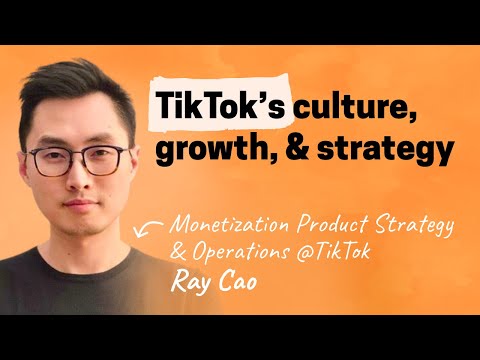
Inside TikTok: Culture, strategy, monetization, and more | Ray Cao
Lenny Rachitsky (host), Ray (Jiayi) Cao (guest)
In this episode of Lenny's Podcast, featuring Lenny Rachitsky and Ray (Jiayi) Cao, Inside TikTok: Culture, strategy, monetization, and more | Ray Cao explores inside TikTok: Culture, speed, and winning with ads at scale Lenny chats with Ray Cao, TikTok’s Global Head of Monetization Product Strategy and Operations, about how TikTok operates internally and how businesses can succeed on the platform. They dive into TikTok’s core cultural principles—especially “context, not control” and “always day one”—and how those values shape hiring, org design, and cross-functional collaboration. Ray contrasts TikTok with Google and US-born tech companies, emphasizing global-first product strategy and tight alignment between product, engineering, and sales. The conversation then shifts to practical advice for creators and advertisers on TikTok, including creative strategy, testing cadence, common mistakes, and why TikTok should be treated differently from Meta and Google.
Inside TikTok: Culture, speed, and winning with ads at scale
Lenny chats with Ray Cao, TikTok’s Global Head of Monetization Product Strategy and Operations, about how TikTok operates internally and how businesses can succeed on the platform. They dive into TikTok’s core cultural principles—especially “context, not control” and “always day one”—and how those values shape hiring, org design, and cross-functional collaboration. Ray contrasts TikTok with Google and US-born tech companies, emphasizing global-first product strategy and tight alignment between product, engineering, and sales. The conversation then shifts to practical advice for creators and advertisers on TikTok, including creative strategy, testing cadence, common mistakes, and why TikTok should be treated differently from Meta and Google.
Key Takeaways
Emphasize context over control to move fast and break silos.
TikTok gives teams rich context about goals and problems, then expects proactive thinking rather than top-down tasking. ...
Get the full analysis with uListen AI
Maintain an “always day one” mindset, even at massive scale.
TikTok deliberately operates like a hungry startup—encouraging direct access to leadership, frequent re-orgs, and constant iteration. ...
Get the full analysis with uListen AI
Treat global expansion as on-the-ground work, not just an algorithm problem.
While TikTok’s recommendation system is powerful, Ray stresses that real global success comes from hiring local teams, deeply understanding culture and behavior, and fine-tuning product and content strategies market by market (e. ...
Get the full analysis with uListen AI
Hire for curiosity, discipline, and prioritization—and don’t compromise on quality.
Ray candidly admits that early pressure to hire fast led to lowering the hiring bar, which ultimately slowed the org. ...
Get the full analysis with uListen AI
Keep product, engineering, and sales tightly coupled through shared rituals.
TikTok runs large cross-functional “doc-reading” meetings (up to ~180 people) where PMs, engineers, data scientists, and sales review the same documents, comment in-line, and align on decisions. ...
Get the full analysis with uListen AI
On TikTok, authenticity and cultural fluency beat polished perfection.
Creators and brands that perform best are unfiltered, lean into trends, and adapt to TikTok’s community norms rather than repurposing generic, highly produced content. ...
Get the full analysis with uListen AI
Advertisers must treat TikTok as a content graph and test aggressively.
TikTok’s ad system behaves differently from Meta (people graph) and Google (intent graph). ...
Get the full analysis with uListen AI
Notable Quotes
“The number one thing is context, not control.”
— Ray Cao
“We always have this mentality we are a startup, we are a young company, we’re always hungry for growth.”
— Ray Cao
“If you don’t understand the culture, you won’t be able to understand the behavior over there.”
— Ray Cao
“Join a startup and join a rocket ship is a lifestyle. It is not necessarily a job you’re working on from 9 to 5.”
— Ray Cao
“TikTok is the content graph. It’s very different from the other two, and it requires a different way to optimize.”
— Ray Cao
Questions Answered in This Episode
How sustainable is TikTok’s “always day one” intensity for employees over the long term, and how do they prevent burnout while maintaining speed?
Lenny chats with Ray Cao, TikTok’s Global Head of Monetization Product Strategy and Operations, about how TikTok operates internally and how businesses can succeed on the platform. ...
Get the full analysis with uListen AI
What specific changes has TikTok made to its recommendation and ad algorithms to better support local markets and regulatory expectations?
Get the full analysis with uListen AI
How does TikTok decide when to prioritize brand-building features versus direct-response and commerce tools in its ads roadmap?
Get the full analysis with uListen AI
For a small startup with limited creative resources, what is the most practical way to hit TikTok’s recommended velocity of 10 new creatives per week?
Get the full analysis with uListen AI
How does TikTok measure and balance the trade-offs between global consistency (e.g., platform integrity) and deep local customization in product and policy?
Get the full analysis with uListen AI
Transcript Preview
(instrumental music) We rarely get a peek into what it's like to work at TikTok. What are some core principles or values or just how TikTok operates?
The number one thing is context, no control. That's the reason why we're always encouraging people to think themself as a business owner.
You give them all the information they need and then let them just do things without specific instructions.
How do you actually solve the puzzle by connecting the, all the dots together? Just like how I see some of my, uh, friends, their kids playing LEGOs. If you don't really see the full picture, you won't be able to make the LEGO as a one thing at end of a day. You have to see the other pieces.
What also important cultural values of TikTok, of how TikTok operates that everyone always has in mind when they're building?
We always have this mentality we are a startup, we are a young company, we're always hungry for growth. In a very reactive way is like, "How can I run my second half of my marathon faster than the first half?"
(instrumental music) Today my guest is Ray Tsao. Ray is the global head of monetization product Strategy and Operations at TikTok, where he's been for over four years. Prior to TikTok, Ray spent six years at Google helping scale Google Shopping globally. TikTok is interesting for two big reasons. One, it's one of the most successful businesses in history, last valued at over 80 billion dollars, and its parent company is the most valuable private company in the world, last valued at over 200 billion dollars. Two, TikTok is quickly becoming one of the biggest advertising platforms alongside Meta and Google, and generated nearly 10 billion dollars in advertising revenue just a couple years ago. So for both these reasons, TikTok is a really interesting business and team to learn from. And I've seen very few podcasts and even media get a peek inside how TikTok operates. In our conversation, we discussed TikTok's culture, their core principles and values, how they hire, how they move so fast, their emphasis on working hard, how they do OKRs and planning. We also get into how to succeed on TikTok's ad network, why you want to be testing at least 10 videos a week, how it's different from running ads on Instagram, how to make content that does well on TikTok, and so much more. This episode has a lot of interesting lessons and insights. Obviously, TikTok is at the center of a lot of debate globally. Some people love it, some people hate it. But no matter your opinion of TikTok, there's a lot that we can learn from their success. If you enjoy this podcast, don't forget to subscribe and follow the podcast on your favorite podcasting app or YouTube. It's the best way to avoid missing future episodes and it helps the podcast tremendously. With that, I bring you Ray Tsao after a short word from our sponsors. This episode is brought to you by WorkOS. If you're building a SaaS app, at some point, your customers will start asking for enterprise features like SAML authentication and SCIM provisioning. That's where WorkOS comes in, making it fast and painless to add enterprise features to your app. Their APIs are easy to understand so that you can ship quickly and get back to building other features. And hundreds of other companies are already powered by WorkOS, including ones you probably know, like Vercel, Webflow, and Loom. WorkOS also recently launched AuthKit, a complete authentication and user management service. It's essentially a modern alternative to Auth0, but with better pricing and more flexible APIs. AuthKit's design is stunning out of the box and you can also fully customize it to fit your app's brand. It's an effortless experience from your first user all the way to your largest enterprise customer. Best of all, AuthKit is free for any developer up to one million users. Check it out at workos.com/lenny to learn more. That's workos.com/lenny. This episode is brought to you by Eppo. Eppo is a next generation A/B testing and feature management platform built by alums of Airbnb and Snowflake for modern growth teams. Companies like Twitch, Miro, ClickUp, and DraftKings rely on Eppo to power their experiments. Experimentation is increasingly essential for driving growth and for understanding the performance of new features, and Eppo helps you increase experimentation velocity while unlocking rigorous deep analysis in a way that no other commercial tool does. When I was at Airbnb, one of the things that I loved most was our experimentation platform, where I could set up experiments easily, troubleshoot issues, and analyze performance all on my own. Eppo does all that and more with advanced statistical methods that can help you shave weeks off experiment time, an accessible UI for diving deeper into performance, and out of the box reporting that helps you avoid annoying prolonged analytic cycles. Eppo also makes it easy for you to share experiment insights with your team, sparking new ideas for the A/B testing flywheel. Eppo powers experimentation across every use case, including product, growth, machine learning, monetization, and email marketing. Check out Eppo at geteppo.com/lenny and 10X your experiment velocity. That's geteppo.com/lenny. (instrumental music) Ray, thank you so much for being here and welcome to the podcast.
Install uListen to search the full transcript and get AI-powered insights
Get Full TranscriptGet more from every podcast
AI summaries, searchable transcripts, and fact-checking. Free forever.
Add to Chrome