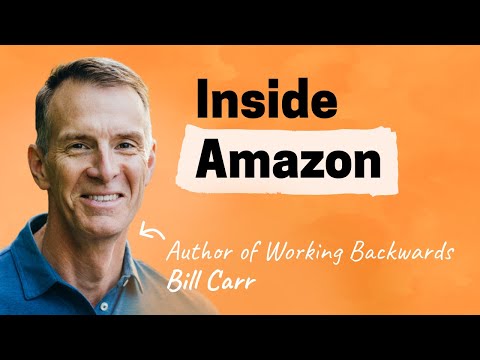
Unpacking Amazon’s unique ways of working | Bill Carr (author of Working Backwards)
Bill Carr (guest), Lenny Rachitsky (host)
In this episode of Lenny's Podcast, featuring Bill Carr and Lenny Rachitsky, Unpacking Amazon’s unique ways of working | Bill Carr (author of Working Backwards) explores inside Amazon’s Playbook: Working Backwards To Build Winning Products Bill Carr, former VP at Amazon and co-author of *Working Backwards*, breaks down the specific operating practices that powered Amazon’s growth, from customer-obsessed product development to rigorous hiring.
Inside Amazon’s Playbook: Working Backwards To Build Winning Products
Bill Carr, former VP at Amazon and co-author of *Working Backwards*, breaks down the specific operating practices that powered Amazon’s growth, from customer-obsessed product development to rigorous hiring.
He explains core mechanisms like the Working Backwards PR/FAQ process, single-threaded leaders, input vs. output metrics, and the Bar Raiser hiring program, including how they emerged and how to implement them.
Carr emphasizes that Amazon’s success came as much from process innovation as product innovation, driven by Bezos’s scientific, experimental approach to management.
He also shares practical guidance for other companies: how to pilot these practices, what preconditions are required, and why commitment and cultural alignment are critical for them to work.
Key Takeaways
Start with the customer problem and work backwards, not from revenue targets.
Amazon treats it as an article of faith that if you relentlessly solve important, enduring customer problems, revenue, growth, and share price will follow—so product work starts from customer needs, not financial goals.
Get the full analysis with uListen AI
Use PR/FAQs to force clarity before building anything.
The Working Backwards PR/FAQ is a written “fake press release” plus FAQ that crisply defines the customer, the problem, and the solution; iterating this document through concentric circles of feedback filters out weak ideas and aligns stakeholders before engineering starts.
Get the full analysis with uListen AI
Organize around single-threaded leaders who own a focused program end-to-end.
Instead of centralized project-style resourcing, Amazon creates teams with one accountable leader and dedicated cross-functional resources who continually improve a domain (e. ...
Get the full analysis with uListen AI
Anchor operating reviews on input metrics that drive the flywheel, not just outputs.
Amazon mapped its flywheel (selection, price, convenience, cost structure) and created input metrics for each; leadership focused plans and weekly reviews on improving those controllable inputs, trusting that outputs like revenue and free cash flow would follow.
Get the full analysis with uListen AI
Practice “have backbone, disagree, and then truly commit.”
Team members are obligated to raise dissenting views with clear reasoning until they’re confident leadership understands them; once a decision is made, they’re expected to internalize the rationale and actively help make it succeed, not passively comply or undermine it.
Get the full analysis with uListen AI
Use a structured, independent Bar Raiser to protect the hiring bar.
On every interview loop, a trained Bar Raiser (not the hiring manager) runs the debrief, enforces objective criteria based on leadership principles and behavioral interviewing, and counterbalances the hiring manager’s urgency bias so growth doesn’t dilute talent quality.
Get the full analysis with uListen AI
Adopting Amazon practices requires CEO-level commitment and patience.
Mechanisms like PR/FAQs, single-threaded leaders, and Bar Raisers fundamentally reshape how decisions, product development, and hiring work; they’re hard to partially or casually adopt and only stick when leadership is deeply bought-in and willing to endure the initial friction.
Get the full analysis with uListen AI
Notable Quotes
“We took it as an article of faith that if we served customers well… things like sales, revenue, and share price would follow.”
— Bill Carr (quoting Jeff Bezos)
“Most of us start with constraints and work forward. Working backwards says, ‘Start with what’s best for the customer, then figure out the hard work to get there.’”
— Bill Carr
“We moved from a project orientation to a program orientation… there’s a team that works on search, and they always work on search.”
— Bill Carr
“Compound metrics like fitness functions turned out to be totally meaningless. We had to break things out and manage each metric on its own.”
— Bill Carr
“None of these mechanisms give you the answer. They’re tools to help you make better decisions—you’re still going to be wrong sometimes.”
— Bill Carr
Questions Answered in This Episode
How can a smaller or earlier-stage startup practically pilot the PR/FAQ process without slowing itself down too much?
Bill Carr, former VP at Amazon and co-author of *Working Backwards*, breaks down the specific operating practices that powered Amazon’s growth, from customer-obsessed product development to rigorous hiring.
Get the full analysis with uListen AI
What are concrete signs that a team is truly single-threaded versus just rebranded under a new org chart?
He explains core mechanisms like the Working Backwards PR/FAQ process, single-threaded leaders, input vs. ...
Get the full analysis with uListen AI
How do you identify the right input metrics in a business where customer behavior is complex and multi-step, like a marketplace or SaaS product?
Carr emphasizes that Amazon’s success came as much from process innovation as product innovation, driven by Bezos’s scientific, experimental approach to management.
Get the full analysis with uListen AI
What cultural preconditions need to be in place before practices like Bar Raisers and disagree-and-commit actually help rather than frustrate people?
He also shares practical guidance for other companies: how to pilot these practices, what preconditions are required, and why commitment and cultural alignment are critical for them to work.
Get the full analysis with uListen AI
Looking back, which Amazon innovations would likely not have happened without these specific mechanisms, and what does that imply for companies that don’t have them?
Get the full analysis with uListen AI
Transcript Preview
... as Jeff would say, we took it as an article of faith. If we served customers well, if we prioritized customers and delivered for them, things like sales, things like revenue and active customers, and things like the share price and free cash flow would follow. So therefore, when we're making a decision thinking about a problem, we're gonna start with what's best for the customer and then come backward from there. That te- that informs, like, what's the work you have to do to then create this new solution for customers.
(instrumental music) Today my guest is Bill Carr. Bill is the co-author of the book Working Backwards, which is a synthesis of the biggest lessons that Bill and his co-author learned from their many years at Amazon. Bill joined Amazon just five years after it was founded, stayed there for 15 years where he worked on the books business, and then as VP of digital media, launched and managed the company's global digital music and video businesses including Amazon Music, Prime Video, and Amazon Studios. After Amazon, Bill was an executive in residence at Maveron, an early stage VC firm, then chief operating officer at OfferUp. And these days Bill runs a consulting firm called Working Backwards LLC where he and his co-author Colin Bryar help growth stage and public companies implement the many practices developed at Amazon. In our conversation, we go many levels deep on how to actually implement a number of the practices and ways of working that helped Amazon become the success that it is today, including the process of how to actually work backwards, how to organize your team with a single threaded leader, how to divide up your metrics into input and output metrics, how to practice disagreeing and committing, how to implement the Bar Raiser program in your hiring process, and so much more. Huge thank you to Ethan Evans for making this episode possible and introducing me to Bill. With that, I bring you Bill Carr after a short word from our sponsors. Today's episode is brought to you by AssemblyAI. If you're looking to build AI-powered features in your audio and video products, then you need to know about AssemblyAI, which makes it easy to transcribe and understand speech at scale. What I love about AssemblyAI is you can use their simple API to access the latest AI breakthroughs from top-tier research labs. Product teams at startups and enterprises are using AssemblyAI to automatically transcribe and summarize phone calls and virtual meetings, detect topics in podcasts, pinpoint when sensitive content is spoken, and lots more. All of AssemblyAI's models which are accessed through their API are production ready. So many PMs I know are considering or already building with AI, and AssemblyAI is the fastest way to build with AI for audio use cases. Now is the time to check out AssemblyAI, which makes it easy to bring the highest accuracy transcription plus valuable insights to your customers, just like Spotify, CallRail, and Writer do for theirs. Visit assemblyai.com/lenny to try their API for free and start testing their models with their no-code playground. That's assemblyai.com/lenny. This episode is brought to you by Coda. You've heard me talk about how Coda is the doc that brings it all together, and how it can help your team run smoother and be more efficient. I know this firsthand, because Coda does that for me. I use Coda every day to wrangle my newsletter content calendar, my interview notes for podcasts, and to coordinate my sponsors. More recently, I actually wrote a whole post on how Coda's product team operates, and within that post they shared a dozen templates that they use internally to run their product team, including managing the roadmap, their OKR process, getting internal feedback, and essentially their whole product development process is done within Coda. If your team's work is spread out across different documents and spreadsheets and a stack of workflow tools, that's why you need Coda. Coda puts data in one centralized location regardless of format, eliminating roadblocks that can slow your team down. Coda allows your team to operate on the same information and collaborate in one place. Take advantage of this special limited time offer just for startups. Sign up today at coda.io/lenny and get $1,000 starter credit on your first statement. That's coda.io/lenny to sign up, and get a startup credit of $1,000. Coda.io/lenny. Bill, thank you so much for being here and welcome to the podcast.
Install uListen to search the full transcript and get AI-powered insights
Get Full TranscriptGet more from every podcast
AI summaries, searchable transcripts, and fact-checking. Free forever.
Add to Chrome