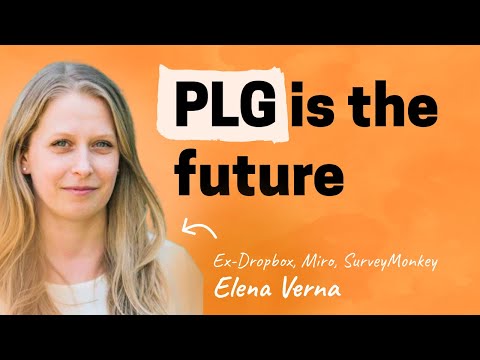
Why product-led growth is the future | Elena Verna (Amplitude, Miro, Surveymonkey)
Elena Verna (guest), Lenny Rachitsky (host), Narrator
In this episode of Lenny's Podcast, featuring Elena Verna and Lenny Rachitsky, Why product-led growth is the future | Elena Verna (Amplitude, Miro, Surveymonkey) explores elena Verna Explains Why Product-Led Growth Will Dominate B2B SaaS Elena Verna, a veteran growth leader at SurveyMonkey, Miro, Netlify, and Amplitude, breaks down how product-led growth (PLG) and sales-led motions should be layered, not treated as either-or choices. She argues every B2B company must first nail product-led retention—activation and engagement—before expecting PLG to drive acquisition or monetization. Verna explains how many PLG companies unintentionally crush their product-led engine when moving upmarket by over-prioritizing enterprise sales and enterprise-specific features. She also predicts product-led sales—using product usage as the primary signal for sales—is on track to box out traditional top-down sales over the next decade.
Elena Verna Explains Why Product-Led Growth Will Dominate B2B SaaS
Elena Verna, a veteran growth leader at SurveyMonkey, Miro, Netlify, and Amplitude, breaks down how product-led growth (PLG) and sales-led motions should be layered, not treated as either-or choices. She argues every B2B company must first nail product-led retention—activation and engagement—before expecting PLG to drive acquisition or monetization. Verna explains how many PLG companies unintentionally crush their product-led engine when moving upmarket by over-prioritizing enterprise sales and enterprise-specific features. She also predicts product-led sales—using product usage as the primary signal for sales—is on track to box out traditional top-down sales over the next decade.
Key Takeaways
Treat product-led and sales-led as layers in a sequence, not a binary choice.
Successful companies don’t “switch” from PLG to sales-led or vice versa; they stack motions over time. ...
Get the full analysis with uListen AI
Always start with product-led retention before product-led acquisition.
If users aren’t activating and habitually engaging, PLG acquisition loops (invites, referrals, content creation) will fail. ...
Get the full analysis with uListen AI
Moving upmarket often kills PLG when companies over-prioritize enterprise sales.
As ACVs rise, teams shift hiring and roadmap toward enterprise reps and enterprise-only features, starving product usage growth. ...
Get the full analysis with uListen AI
Product-led sales uses real product usage—not MQLs—as the core sales signal.
You acquire users self-serve, score accounts based on depth and breadth of usage, then involve sales when usage indicates strong expansion potential. ...
Get the full analysis with uListen AI
Freemium is usually more powerful than time-based trials, especially in B2B.
Time-bound trials misalign with how long different customers need to see value and often alienate enterprises. ...
Get the full analysis with uListen AI
“Free” needs a clear strategic purpose, not just a conversion tactic.
Freemium should be designed to serve explicit goals: indirect monetization (virality, network effects), POC, landing new segments, commoditized features, habit loops, or data to build other products—not just a top-of-funnel gateway to paid.
Get the full analysis with uListen AI
Your first growth model and first growth hire should be rooted internally.
Founders must own the initial growth model instead of delegating it, and internal talent (PMs, analysts, engineers) often make better first growth hires. ...
Get the full analysis with uListen AI
Notable Quotes
“The game is a layering game. It's a sequential game. Which one will you introduce first, and how can you layer the next one on top of it?”
— Elena Verna
“Every single company has to first focus on being product-led in retention. Period.”
— Elena Verna
“Product-led sales in the future... will box out sales-led organizations.”
— Elena Verna
“If you're not doing [self-serve or freemium], somebody else is gonna do it, because this is a Trojan horse into the organization that is based on user focus.”
— Elena Verna
“Copy‑paste never works... Even I have to constantly pull back and say, 'Don't just copy‑paste,' because it's so intuitive to try to replicate your previous successes.”
— Elena Verna
Questions Answered in This Episode
How can a company objectively assess whether its product-led retention (activation and engagement) is strong enough to support product-led acquisition?
Elena Verna, a veteran growth leader at SurveyMonkey, Miro, Netlify, and Amplitude, breaks down how product-led growth (PLG) and sales-led motions should be layered, not treated as either-or choices. ...
Get the full analysis with uListen AI
For a sales-led B2B company today, what is the most practical first step to layering in a product-led motion without disrupting existing revenue?
Get the full analysis with uListen AI
How should product teams design a freemium tier that drives virality and usage growth without undermining paid monetization?
Get the full analysis with uListen AI
What metrics and signals best define a 'product-qualified lead' for product-led sales in different types of B2B products (collaborative vs. single-player, infrastructure vs. application)?
Get the full analysis with uListen AI
When moving upmarket, how can leaders structure org design and roadmaps so that enterprise features do not crowd out continuous investment in user-centric PLG?
Get the full analysis with uListen AI
Transcript Preview
The game is a layering game. It's a sequential game. Which one will you introduce first, and how can you layer the next one on top of it? So if you're sales-led now, if you continue being sales-led, you have a high chance of leaving product-led to be disrupted by it from the bottoms up. But also going from sales-led to product-led does not mean you have to abandon sales-led. That means you have to hunker down on your sales-led and overlay product-led on top of it to amplify already existing growth, never to switch. So in the most successful companies, whether they go from product-led to sales-led to sales-led to product-led, they're able to execute both correctly and together, as opposed to saying, "I have to switch or pick one versus the other." And I think it's the biggest mistake when people view it as a decision-making of which one I should be, versus a sequential play.
(instrumental music) Elena Verna is possibly the single most experienced and smartest person on growth strategy in the entire world. I am not being hyperbolic. Elena led growth at Miro, SurveyMonkey, and now at Amplitude, and she has worked with companies like MongoDB, Netlify, and HP to help them figure out their growth strategies. In our chat, we cover B2B growth strategies, what's changing in B2B growth, why freemium is usually a better path than going trial, why every company should be thinking about their product-led growth strategy, how product-led growth often gets crushed as you move up market and how to avoid that, the emergence of product-led sales and how that might be the future of growth, and also how to hire your first growth lead. My brain is always buzzing after I talk to Elena, and I suspect yours will too. Enjoy the episode. This episode is brought to you by Persona. Persona helps founders, product managers, and engineers easily solve any identity-related problem, including handling KYC, AML, and basically all manner of identity fraud. You can integrate Persona in an afternoon and personalize your flows using their SDK to meet your users on any device. Persona's identity building blocks allow you to manage your entire end-to-end onboarding flow, verifying that each new user and their data are legitimate. Persona is trusted by both startups and the world's largest companies, including Square, BlockFi, Gusto, and Udemy. And for a limited time, Persona's offering listeners of this podcast a free end-to-end KYC and AML solution where you can collect a user's government ID and/or their selfie and automatically verify that those two pieces of data are legitimate. You can also enrich that information to automatically see if the person exists on various watch lists. Just go to withpersona.com/lenny to get started. Do you want to reduce friction in your onboarding flow? Then let me tell you about Stytch, and that's Stytch with a Y. Stytch is on a mission to eliminate friction from the internet. They're starting by making user authentication and onboarding more seamless and more secure. They offer super flexible, out of the box authentication solutions for companies of all sizes. From email magic links, to SMS passcodes, one-tap social logins, to even biometrics, Stytch is your all-in-one platform for authentication. Stytch customers have been able to increase conversion by over 60% after spending just one day integrating. And with their API and SDKs, you can improve user conversion and retention and security, all while saving valuable engineering time. Your engineers will come and thank you for using Stytch, because Stytch keeps you from having to build authentication in-house, and the integration process is super fast and super smooth. To get $1,000 in free credits, just go to stytch.com, and that's Stytch with a Y, and sign up, and just mention that I sent you. Elena, welcome to the podcast. I've been so looking forward to our conversation, and especially all the things that listeners are going to get to learn from you and that I'm going to get to learn. And so thank you for being here.
Install uListen to search the full transcript and get AI-powered insights
Get Full TranscriptGet more from every podcast
AI summaries, searchable transcripts, and fact-checking. Free forever.
Add to Chrome