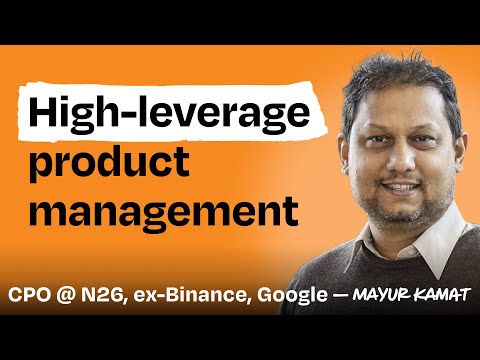
Unconventional product lessons from Binance, N26, Google, more | Mayur Kamat (CPO at N26)
Mayur Kamat (guest), Lenny Rachitsky (host), Paragon representative (guest), Vanta representative (guest)
In this episode of Lenny's Podcast, featuring Mayur Kamat and Lenny Rachitsky, Unconventional product lessons from Binance, N26, Google, more | Mayur Kamat (CPO at N26) explores mayur Kamat’s unconventional playbook for faster, stronger product careers N26 CPO Mayur Kamat shares hard‑won lessons from leading product at Binance, Agoda, Google, Microsoft, and now N26, emphasizing speed of learning, experimentation, and aligning work with personal strengths. He unpacks Binance’s extreme execution culture, N26’s product and hiring philosophy, and why most PMs over-index on strategy instead of fast hypothesis testing. Mayur offers concrete career advice on choosing roles, regions, and paths (CPO vs founder vs specialist vs balanced life), and explains why early compensation and long, slow bets are usually bad optimizations. Throughout, he argues that PMs gain power and respect by making product scientific—through rigorous experimentation, deep attention to detail, and focusing only on the highest‑leverage problems.
Mayur Kamat’s unconventional playbook for faster, stronger product careers
N26 CPO Mayur Kamat shares hard‑won lessons from leading product at Binance, Agoda, Google, Microsoft, and now N26, emphasizing speed of learning, experimentation, and aligning work with personal strengths. He unpacks Binance’s extreme execution culture, N26’s product and hiring philosophy, and why most PMs over-index on strategy instead of fast hypothesis testing. Mayur offers concrete career advice on choosing roles, regions, and paths (CPO vs founder vs specialist vs balanced life), and explains why early compensation and long, slow bets are usually bad optimizations. Throughout, he argues that PMs gain power and respect by making product scientific—through rigorous experimentation, deep attention to detail, and focusing only on the highest‑leverage problems.
Key Takeaways
Optimize for fast compounding of learning, not early compensation.
Choose high-growth environments where you ship constantly, see outcomes quickly, and build a strong network; the vast majority of lifetime earnings and opportunity will come later, so a 10–20% pay bump early on is usually a distraction.
Get the full analysis with uListen AI
Align your role with your true strengths—and be honest about them.
Figure out what you both excel at and enjoy (e. ...
Get the full analysis with uListen AI
Most PMs should obsess over cycle time from hypothesis to data, not grand strategy.
Mayur argues that in product, “strategy” is often just packaged intuition decided by the loudest voice; building a rigorous experimentation culture turns product decisions into science, gives PMs real authority, and makes strategy largely a byproduct of validated learning.
Get the full analysis with uListen AI
Focus your time on 10× leverage problems and be in the details.
Borrowing from Shreyas and founders he’s worked with, Mayur prioritizes work that can massively move KPIs (growth or existential risk), then personally dives into the granular metrics and flows—while keeping his calendar intentionally light to make space for this deep work.
Get the full analysis with uListen AI
Decide early if you truly want a C-level path—or something else.
Being a CPO/exec is not about prestige; it’s about genuinely loving that kind of work so sacrifices don’t feel like sacrifices. ...
Get the full analysis with uListen AI
Shorten big bets and avoid year-long projects you can’t de-risk.
Mayur’s failures on Hangouts and a large Agoda payments initiative taught him that long, monolithic bets are highly exposed to macro shocks and misalignment; instead, break initiatives into smaller experiments to get early signal and maintain agility.
Get the full analysis with uListen AI
Fintech (and certain geographies) are powerful training grounds for PMs.
Fintech forces PMs to serve both customers and regulators with high-stakes trade-offs, and companies like N26 in less crowded ecosystems attract top regional talent and expose PMs to complex, global, category-defining problems—creating outsized career acceleration.
Get the full analysis with uListen AI
Notable Quotes
“For most product managers, your strategy should be: how fast can I go from hypothesis to data?”
— Mayur Kamat
“The challenge with being a product manager is everybody thinks they can do their job.”
— Mayur Kamat
“The moment you build experimentation, you have now made it scientific.”
— Mayur Kamat
“There's no right or wrong decision—there's just slow and fast decisions.”
— Mayur Kamat
“Do not optimize for compensation, especially early in your career. You’ll make 90% of your compensation in the last five years.”
— Mayur Kamat
Questions Answered in This Episode
How can a PM in a low-experimentation company practically introduce and scale an experimentation culture without formal authority?
N26 CPO Mayur Kamat shares hard‑won lessons from leading product at Binance, Agoda, Google, Microsoft, and now N26, emphasizing speed of learning, experimentation, and aligning work with personal strengths. ...
Get the full analysis with uListen AI
What concrete steps can someone take in the next 30 days to identify and move into a role that better matches their strengths?
Get the full analysis with uListen AI
How do you know when a problem is truly a ‘10× leverage’ opportunity versus a distracting fire drill?
Get the full analysis with uListen AI
For PMs outside fintech, what types of companies or problem domains best mimic the high-stakes, dual-stakeholder environment that accelerates growth?
Get the full analysis with uListen AI
If you realize mid-career that you don’t actually want the C-level path, how should you pivot your trajectory without losing momentum or status?
Get the full analysis with uListen AI
Transcript Preview
(instrumental music) My probably most spectacular failure was, I was the first PM on Hangouts. We had thousands of people working for me. We had entire power of Google. We had Larry literally sitting with us, saying we can do anything we want Chrome to do, and we still didn't manage to build a great messaging product. The main kind of learnings from that is, don't take on projects that are gonna be six months, a year, because you just generally don't have control over the macro. The challenge with being a product manager is everybody thinks they can do their job. Anybody who uses the product thinks they have ideas, so at some point in time you're like, "What is my discipline? Like, what is my science?" The moment you build experimentation, you've now made it scientific.
A lot of new people in their career are like, "Oh, I just wanna think about strategy. I'm gonna think about the big picture."
Strategy's a little bit overrated for product. For most product managers, your strategy should be, how fast can I go from hypothesis to data?
Today my guest is Mayur Kamat. Mayur is Chief Product Officer at N26, one of the most successful fintech startups in the world, and which in my research came in amongst the top five companies in the world who are hiring and producing the best product managers. Prior to N26, Mayur was Global Head of Product at Binance; VP of Product at Agoda, which is over $100 billion company based in Thailand; and a PM at Google and Microsoft. In our wide-ranging conversation, Mayur shares what he's learned about hiring and developing great product managers, what he learned from his time working at Binance, which as you'll soon hear was one of the wildest and most unique ways of working, what he learned from the failure of Google's early attempts at Hangouts, where he was the first PM; also the pros and cons of working in Asia versus Europe versus the U.S., and why you should be starting your career on the West Coast of the U.S.; also why comp early in your career does not matter; and so much more. This episode is so full of golden nuggets and advice for product people throughout every stage of their career. If you enjoy this podcast, don't forget to subscribe and follow it in your favorite podcasting app or YouTube. Also, if you become an annual subscriber of my newsletter, you get a year free of a bunch of amazing products, including Superhuman, Notion, Linear, Perplexity, Granola, and more. Check it out at lennysnewsletter.com and click Bundle. With that, I bring you Mayur Kamat. This episode is brought to you by WorkOS. If you're building a SaaS app, at some point your customers will start asking for enterprise features like SAML authentication and SCIM provisioning. That's where WorkOS comes in, making it fast and painless to add enterprise features to your app. Their APIs are easy to understand so that you can ship quickly and get back to building other features. Today, hundreds of companies are already powered by WorkOS, including ones you probably know, like Vercel, Webflow, and Loom. WorkOS also recently acquired Warrant, the fine-grain authorization service. Warrant's product is based on a groundbreaking authorization system called Zanzibar, which was originally designed for Google to power Google Docs and YouTube. This enables fast authorization checks at enormous scale while maintaining a flexible model that can be adapted to even the most complex use cases. If you're currently looking to build role-based access control or other enterprise features like single sign-on, SCIM, or user management, you should consider WorkOS. It's a drop-in replacement for Auth0 and supports up to one million monthly active users for free. Check it out at workos.com to learn more. That's workos.com. Many of you are building AI products, which is why I'm very excited to chat with Brandon Fu, founder and CEO of Paragon. Hey, Brandon.
Install uListen to search the full transcript and get AI-powered insights
Get Full TranscriptGet more from every podcast
AI summaries, searchable transcripts, and fact-checking. Free forever.
Add to Chrome