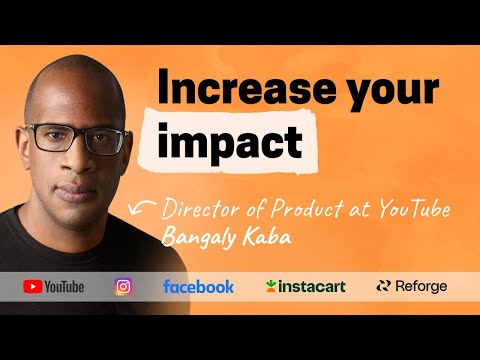
Unorthodox frameworks for growing your product, career, and impact | Bangaly Kaba (YT, IG, FB)
Lenny Rachitsky (host), Bangaly Kaba (guest)
In this episode of Lenny's Podcast, featuring Lenny Rachitsky and Bangaly Kaba, Unorthodox frameworks for growing your product, career, and impact | Bangaly Kaba (YT, IG, FB) explores bangaly Kaba’s unconventional playbook for product, growth, and careers Bangaly Kaba walks through the core frameworks he’s used to consistently drive impact at Facebook, Instagram, Instacart, and YouTube, tying together product growth and personal career growth.
Bangaly Kaba’s unconventional playbook for product, growth, and careers
Bangaly Kaba walks through the core frameworks he’s used to consistently drive impact at Facebook, Instagram, Instacart, and YouTube, tying together product growth and personal career growth.
He defines impact as a function of both environment and skills, and shares a practical scoring system to decide whether to fix your situation or move on.
On the product side, he emphasizes “understand work” (deep, structured problem understanding) as the foundation for high win-rate experiments, durable flywheels, and culture change.
He illustrates these ideas with concrete stories: fixing Instagram’s account churn, pivoting Instagram’s graph from celebrities to friends, international growth at Facebook, and changing team cultures using simple but powerful change-management tools.
Key Takeaways
Optimize your career for impact, not compensation.
Compensation and scope are downstream of the impact you create. ...
Get the full analysis with uListen AI
Score your environment annually across six variables to decide whether to stay or leave.
He evaluates manager, resources, scope, team, compensation, and culture on a 0–2 scale (in 0. ...
Get the full analysis with uListen AI
Replace “identify–justify–execute” with “understand–identify–execute.”
The common anti-pattern is: pick an idea, backfill data to justify it, then over-invest in shipping something that doesn’t move the needle. ...
Get the full analysis with uListen AI
Continuously invest in communication and practical learning to grow your skills.
Communication is the most leveraged PM skill; strong communicators often rise even with middling execution. ...
Get the full analysis with uListen AI
Use adjacent user theory to find your next wave of growth.
Your future growth usually comes from the users just outside your current core—who want your product but bounce because it doesn’t yet fit their context. ...
Get the full analysis with uListen AI
Intentionally design team change using five levers: vision, skills, incentives, resources, action plan.
Bangaly uses a “Managing Complex Change” framework: if any one element is missing, you get predictable failure modes (e. ...
Get the full analysis with uListen AI
Treat PM leadership as coaching a team and building a coaching tree.
He sees PM as a team sport, not a solo CEO role: you need role players, not just stars, and your legacy is the “coaching tree” of PMs and leaders you’ve grown. ...
Get the full analysis with uListen AI
Notable Quotes
“Impact is the thing to optimize for. Compensation is just a reflection of that impact.”
— Bangaly Kaba
“The anti-pattern is identify, justify, execute: someone says, ‘This would be great to build,’ then you go pull data to justify it.”
— Bangaly Kaba
“First you have to really understand from first principles what is actually going on—so understand, identify, execute.”
— Bangaly Kaba
“If you want hypergrowth, you have to be the adjacent user. You have to actually use the product like them and see what’s broken.”
— Bangaly Kaba
“People and teams don’t rise to the level of their goals; they fall to the level of their systems.”
— Bangaly Kaba (paraphrasing a motto he uses)
Questions Answered in This Episode
How would your current role score on Bangaly’s six environment variables, and what does that imply about whether to stay or move?
Bangaly Kaba walks through the core frameworks he’s used to consistently drive impact at Facebook, Instagram, Instacart, and YouTube, tying together product growth and personal career growth.
Get the full analysis with uListen AI
Where in your product lifecycle are you relying on ‘identify–justify–execute’ instead of deliberately investing in understand work?
He defines impact as a function of both environment and skills, and shares a practical scoring system to decide whether to fix your situation or move on.
Get the full analysis with uListen AI
Who are your product’s adjacent users today, and what would change if you dogfooded the product as them for a week?
On the product side, he emphasizes “understand work” (deep, structured problem understanding) as the foundation for high win-rate experiments, durable flywheels, and culture change.
Get the full analysis with uListen AI
If your team feels confused, anxious, or resistant, which element of the Managing Complex Change framework is most likely missing?
He illustrates these ideas with concrete stories: fixing Instagram’s account churn, pivoting Instagram’s graph from celebrities to friends, international growth at Facebook, and changing team cultures using simple but powerful change-management tools.
Get the full analysis with uListen AI
Looking at your own “coaching tree,” what are you doing to intentionally grow the skills and careers of the PMs around you?
Get the full analysis with uListen AI
Transcript Preview
You were early growth PM at Facebook. You were head of growth at Instagram. You were VP of product at Instacart. You're now director of product management at YouTube, and I've heard that you've had a lot of impact on a lot of different cultures.
I've found this framework travels with me. It's got, like, these five components to it: vision, skills, incentives, resources, action plan. And you need all of those to have change. And then within those buckets you've got to figure out what are the right levers that you need to pull, what are the things that are missing.
You're really big on something you call understand work.
What I call the anti-pattern of what we want to do. Someone says, "Hey, you know what? This would be great to build." Then you go pull data to go justify why that would be great to build. Call that identify, justify, execute. First you have to really understand from first principles what is actually going on, so understand, identify, execute.
You wrote this legendary blog post called How to Choose Where to Work and What to Work On.
There's impact that you're really trying to drive, and the impact is only achievable by looking at set of variables related to the environment and set of variables related to your skill set.
Today's guest is Bengali Kaba. Bengali was an early growth PM at Facebook where he was responsible for how people make friends on Facebook. He was head of growth at Instagram, where he helped scale a platform to over one billion users. He was also VP of product at Instacart. He's also worked with tons of amazing startups as a growth advisor, including Twitter. He's now director of product management at YouTube, where from what I hear, he's already made a huge dent. This conversation went long, because there was so much gold to be extracted from Bengali's head, and I could not stop myself from learning everything I could in our time together. This episode is for anyone looking to level up their product and growth chops or also just do better in your career. We dig into his framework for how to choose where to work and what to work on, the importance of spending time on something he calls understand work, his adjacent user theory and how it can help you drive growth, a bunch of advice for coaching product managers and managers of managers, tons of lessons and stories from his time at Instagram, Facebook and YouTube, and so much more. If you enjoy this podcast, don't forget to subscribe and follow it in your favorite podcasting app or YouTube. It's the best way to avoid missing future episodes, and it helps the podcast tremendously. With that, I bring you Bengali Kaba. Bengali, thank you so much for being here, and welcome to the podcast.
Thanks for having me. Excited to be here.
So many previous guests have recommended that I get you on this podcast, which I already knew. Funny story. When I first launched this podcast, uh, I asked you to be on it. You were like, "Sure." And I included you on my launch poster of all the guests that were gonna be on the podcast, and then you decided to take on very, uh, hard work and jobs that kept you from having time. And so, I'm really excited that we're finally doing this.
Install uListen to search the full transcript and get AI-powered insights
Get Full TranscriptGet more from every podcast
AI summaries, searchable transcripts, and fact-checking. Free forever.
Add to Chrome