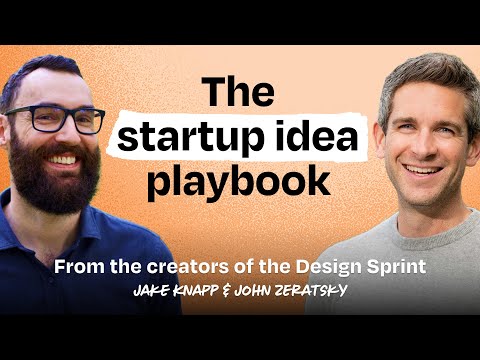
Rapidly test and validate any startup idea with the 2-day Foundation Sprint
Jake Knapp (guest), John Zeratsky (guest), Lenny Rachitsky (host), Narrator, Narrator, Narrator
In this episode of Lenny's Podcast, featuring Jake Knapp and John Zeratsky, Rapidly test and validate any startup idea with the 2-day Foundation Sprint explores two-Day Foundation Sprint: Turn Vague Ideas Into Testable Startup Hypotheses The episode introduces the Foundation Sprint, a 10-hour, two-day process designed to help founders and product teams clarify and rigorously test the core hypothesis behind a new startup or product.
Two-Day Foundation Sprint: Turn Vague Ideas Into Testable Startup Hypotheses
The episode introduces the Foundation Sprint, a 10-hour, two-day process designed to help founders and product teams clarify and rigorously test the core hypothesis behind a new startup or product.
Jake Knapp and John Zeratsky explain how it extends their original Design Sprint work, focusing earlier on basics (customer, problem, competition), differentiation, and selecting the best initial product approach.
They walk through real examples (like Latchit, Melo, and Axion Orbital), showing how teams rapidly move from fuzzy ideas to sharp differentiation, structured experiments, and evidence of whether a product “clicks” with customers.
A key theme is that briefly slowing down to think deeply and align the team dramatically increases the speed and quality of learning, especially in an AI era where building is cheap but generic outcomes are common.
Key Takeaways
Clarify the basics before building anything.
Spend deliberate time aligning on who your primary customer is, what problem you’re solving, who the competition and alternatives are, and what unique advantages your team brings. ...
Get the full analysis with uListen AI
Differentiate with a clear, customer-facing promise.
Use classic differentiators (fast/slow, simple/complex, easy/hard, etc. ...
Get the full analysis with uListen AI
Turn strategy into a single, explicit founding hypothesis.
Combine customer, problem, chosen approach, competition, and differentiators into a Mad Libs-style sentence (e. ...
Get the full analysis with uListen AI
Use structured, silent collaboration instead of open brainstorms.
Methods like “note and vote” (everyone works alone in silence, then votes, with a clear decider making final calls) surface diverse ideas, reduce groupthink, and dramatically speed up alignment compared to loud, unstructured brainstorming.
Get the full analysis with uListen AI
Choose an approach using ‘magic lenses’ before writing code.
Map your possible product approaches (e. ...
Get the full analysis with uListen AI
Validate through rapid Design Sprints and scorecards, not just launches.
Run weekly Design Sprints to prototype, test with real customers, and score against your founding hypothesis (customer fit, problem reality, approach, differentiation, and “click”). ...
Get the full analysis with uListen AI
Leverage AI for prototyping, but don’t outsource the thinking.
AI can dramatically accelerate building realistic prototypes (“vibe coding”), but left unchecked it often produces generic products and copy. ...
Get the full analysis with uListen AI
Notable Quotes
“Going fast can actually slow you down in the long run.”
— John Zeratsky
“Every project has at its core a hypothesis. The problem is it’s usually not explicit.”
— Jake Knapp
“We want you to be really clear on your promise—not to investors, but to customers.”
— Jake Knapp
“While you’re outsourcing prototyping to AI, don’t outsource the thinking.”
— John Zeratsky
“The two days that you invest in a sprint might be the highest-ROI days in the history of your product.”
— Lenny Rachitsky
Questions Answered in This Episode
How do I know if my founding hypothesis is detailed and specific enough to be worth testing, versus still too vague?
The episode introduces the Foundation Sprint, a 10-hour, two-day process designed to help founders and product teams clarify and rigorously test the core hypothesis behind a new startup or product.
Get the full analysis with uListen AI
At what point should a team stop running Foundation and Design Sprints and decide it has strong enough evidence to fully commit and scale?
Jake Knapp and John Zeratsky explain how it extends their original Design Sprint work, focusing earlier on basics (customer, problem, competition), differentiation, and selecting the best initial product approach.
Get the full analysis with uListen AI
How would the Foundation Sprint need to adapt for non-software or non-AI businesses, like hardware or services?
They walk through real examples (like Latchit, Melo, and Axion Orbital), showing how teams rapidly move from fuzzy ideas to sharp differentiation, structured experiments, and evidence of whether a product “clicks” with customers.
Get the full analysis with uListen AI
What are the most common patterns in hypotheses that fail during these sprints, and what do successful teams typically pivot toward?
A key theme is that briefly slowing down to think deeply and align the team dramatically increases the speed and quality of learning, especially in an AI era where building is cheap but generic outcomes are common.
Get the full analysis with uListen AI
How can larger, established companies use this process without being blocked by existing org structures, politics, and calendars?
Get the full analysis with uListen AI
Transcript Preview
We would have a conversation with founders. We're saying like, "Gosh, I'm almost too embarrassed to ask this question, but who exactly is your target customer?" And three co-founders have three different answers.
After these hundreds of teams that we've worked with, we've seen that there's one failure mode, which is they don't know what that set of basics are. Then there's this other failure mode where they never test it.
Let's talk about the foundation sprint. Walk us through the process. How does it start? What are the steps?
The very beginning of your project, we recommend this kind of crazy idea that you clear your calendar, so the core team come together for 10 hours roughly and go through a sequence of activities, so that we can make all of the key decisions together.
I think a lot of people wonder as they're hearing this is, "Why don't I just build something and launch it and learn?"
One phenomenon we've seen when teams are building things really quickly with AI is that the more AI-generated or -assisted they are, the more generic they tend to turn out. Put yourself in a situation where you can slow down and do some hard thinking, some deep thinking about what's actually going to make your product unique. Going fast can actually slow you down in the long run.
Today my guests are Jake Knapp and Jon Zeratsky. The framework that Jake and Jon share in this conversation is basically the missing manual for founders and product teams trying to refine and test their startup or product idea. It's called a foundation sprint and it emerged out of the famous design sprint, which Jake and JZ co-created, and also from working with over 300 teams, building both new products at startups and also with teams at larger companies like Google, Microsoft, YouTube, Slack, Uber and many more. They published a book with this framework at the beginning of this year called Click and the excerpt from that book that dives into this framework is one of my most popular posts of all time and was one of the rare non-AI posts amongst the top post rankings. In this conversation make sure to get your pencils out, because we go through exactly how to execute this two-day sprint where, at the end of it, you have a very clear hypothesis that your entire team is aligned around, that clarifies what you're building, who you're building for, how it differentiates from competitors and how to quickly test it with real potential customers. The two days that you invest in a sprint might be the highest ROI days in the history of your product and I highly encourage you to do this if you're in the process of baking an idea. If you enjoy this podcast don't forget to subscribe and follow it in your favorite podcasting app or YouTube. Also, to become an annual subscriber of my newsletter you get a year free of a bunch of amazing products, including Bolt, Linear, Superhuman, Notion, Perplexity, Granola and more. Check it out at lennysnewsletter.com and click bundle. With that I bring you Jake Knapp and Jon Zeratsky. This episode is brought to you by Brex, the financial stack used by one in every three US venture-backed startups. Brex knows that nearly 40% of startups fail because they run out of cash, so they built a banking experience that focuses on helping founders get more from every dollar. It's a stark difference from traditional banking options that leave a startup's cash sitting idle while chipping away at it with fees. To help founders protect cash and extend runway, Brex combined the best things about checking, treasury and FDIC insurance in one powerhouse account. You can send and receive money worldwide at lightning speed, you can get 20X the standard FDIC protection through program banks and you can earn industry leading yield from your first dollar while still being able to access your funds any time. To learn more check out Brex at brex.com/banking-solutions. That's B-R-E-X dot com slash banking solutions. Many of you are building AI products, which is why I'm very excited to chat with Brandon Fu, founder and CEO of Paragon. Hey, Brandon.
Install uListen to search the full transcript and get AI-powered insights
Get Full TranscriptGet more from every podcast
AI summaries, searchable transcripts, and fact-checking. Free forever.
Add to Chrome