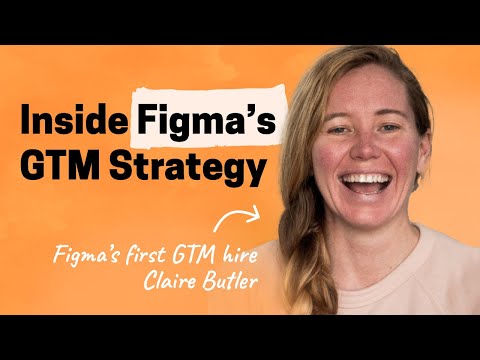
An inside look at Figma’s unique GTM motion | Claire Butler (first GTM hire)
Claire Butler (guest), Lenny Rachitsky (host), Narrator
In this episode of Lenny's Podcast, featuring Claire Butler and Lenny Rachitsky, An inside look at Figma’s unique GTM motion | Claire Butler (first GTM hire) explores inside Figma’s bottom‑up GTM: winning ICs, then whole companies Claire Butler, Figma’s first go-to-market hire, breaks down how Figma grew from stealth to a multi-billion-dollar company using a distinctly bottom-up motion. Instead of selling top-down to executives, Figma obsessed over individual contributors—especially designers—making them love the product so much that they became internal champions. Claire details how they built credibility, co-developed the product with users, leveraged Twitter and community, and later layered in sales and design systems to scale inside enterprises. She also shares concrete stories—from hand-fixing a user’s MacBook to running massive events like Config—that illustrate how scrappy tactics evolved into a repeatable GTM playbook.
Inside Figma’s bottom‑up GTM: winning ICs, then whole companies
Claire Butler, Figma’s first go-to-market hire, breaks down how Figma grew from stealth to a multi-billion-dollar company using a distinctly bottom-up motion. Instead of selling top-down to executives, Figma obsessed over individual contributors—especially designers—making them love the product so much that they became internal champions. Claire details how they built credibility, co-developed the product with users, leveraged Twitter and community, and later layered in sales and design systems to scale inside enterprises. She also shares concrete stories—from hand-fixing a user’s MacBook to running massive events like Config—that illustrate how scrappy tactics evolved into a repeatable GTM playbook.
Key Takeaways
Win individual contributors first; executives follow later.
Figma’s GTM centered on making designers—the daily practitioners—love the editor so much that they willingly spent their social capital to spread it internally. ...
Get the full analysis with uListen AI
Build deep credibility by leading with technical, non-marketing content.
Designers “don’t want to be marketed to,” so Figma published highly technical posts (engineers on WebGL, designers on vector networks and grids) and hired designer advocates instead of traditional marketers. ...
Get the full analysis with uListen AI
Co-build the product with early users, even when it doesn’t scale.
In the early days, everyone—including engineers and the CEO—answered Intercom chats, debugged live with users, and even drove to fix a customer’s MacBook to keep a single team on Figma. ...
Get the full analysis with uListen AI
Use existing communities and channels instead of trying to create your own.
Rather than force designers into Figma-owned spaces, the team went where they already congregated—especially Twitter. ...
Get the full analysis with uListen AI
Design advocates are a force multiplier in both marketing and sales.
Figma’s designer advocates were expert users who joined sales calls as non-quota technical partners, helping prospects solve real workflow problems and translating feedback back to product. ...
Get the full analysis with uListen AI
Align pricing and free tiers with your organic growth engine, not against it.
Initially, Figma limited collaborators on the free tier, which throttled viral spread. ...
Get the full analysis with uListen AI
Turn your biggest adoption blockers into your strongest upgrade levers.
Lack of robust design systems initially prevented large companies from adopting Figma. ...
Get the full analysis with uListen AI
Notable Quotes
“You can’t optimize your way to product–market fit.”
— Claire Butler
“Designers don’t want to hear from marketers. They don’t want to be marketed to.”
— Claire Butler
“We finally got someone… and Dillon was like, ‘Everybody drop everything. We have to fix this.’”
— Claire Butler
“Our whole motion is about getting ICs to love you, and then enabling them to spread the product within the organization.”
— Claire Butler (paraphrased from discussion)
“You don’t stay for collaboration—you just expect it to work. You stay for the tool.”
— Claire Butler
Questions Answered in This Episode
How can a startup with a non-technical audience adapt Figma’s bottom-up, IC-led GTM playbook?
Claire Butler, Figma’s first go-to-market hire, breaks down how Figma grew from stealth to a multi-billion-dollar company using a distinctly bottom-up motion. ...
Get the full analysis with uListen AI
What are practical ways to identify and nurture your own ‘designer advocate’ equivalent inside and outside your company?
Get the full analysis with uListen AI
How do you decide which features belong in free, self-serve, and enterprise tiers without choking organic spread?
Get the full analysis with uListen AI
At what point should a bottoms-up company introduce a formal sales team, and what early signals should you look for?
Get the full analysis with uListen AI
How can you maintain Figma-style transparency and authenticity with users once you’re operating at massive scale and under more scrutiny?
Get the full analysis with uListen AI
Transcript Preview
We had Coda. They were our first user, and they were based in Palo Alto. Uh, Dillon and I drove down and demoed the product to them, and they were the first ones, their designer Jeremy was like, "Yes, we'll take this on full-time." And I remember we were both like, "What? Really? You will?" (laughs) Like that was like the first person who said yes to us. And so we were like so excited. This is like a huge milestone. We were just so stoked. And then we got back to the office, and I think Dillon gets a text from Jeremy being like, "Oh, yeah, I tried to share this with Philippe, my engineer, and he can't get the file to open, so I guess we can't use it." And we were like, " (gasps) What is it? What happened?" (laughs) "This is... We finally got someone." And I remember Dillon was like, "Everybody drop everything. We have to fix this." And after some, you know, looking at the servers and things, they were like, "Nothing's wrong." And then they realized it was a problem with Philippe's MacBook. And Evan... Eh, Evan didn't have a car, so Dillon had to drive Evan down to Palo Alto to fix the MacBook of Philippe just to get them to use the product.
(Intro music plays) Welcome to Lenny's Podcast, where I interview world-class product leaders and growth experts to learn from their hard won experiences building and growing today's most successful products. Today, my guest is Claire Butler. Claire started at Figma while they were still in stealth as their 10th employee, and their first ever marketing hire. She led their original launch and go-to-market, and also their branding and positioning and messaging work. And eight years in, she continues to lead their go-to-market and bottom up growth motion, along with community, events, social, advocacy, and Figma for education teams. In our conversation, we get the first ever in-depth glimpse into how Figma grew and continues to grow. Claire shares her two-part go-to-market strategy, which involves getting ICs at a company to love you, and then enabling them to spread the product within the organization. She shares tons of amazing stories and examples and lessons from how the Figma team executed the strategy and how you can apply it to your own product. This is an incredible episode with so many golden nuggets of wisdom. You'll probably want to listen to it more than once. With that, I bring you Claire Butler after a short word from our sponsors. This episode is brought to you by Vanta, helping you streamline your security compliance to accelerate your growth. Thousands of fast-growing companies like Gusto, Calm, Quora, and Modern Treasury trust Vanta to help build, scale, manage, and demonstrate their security and compliance programs and get ready for audits in weeks, not months. By offering the most in-demand security and privacy frameworks such as SOC 2, ISO 27001, GDPR, HIPAA, and many more, Vanta helps companies obtain the reports they need to accelerate growth, build efficient compliance processes, mitigate risks to their businesses, and build trust with external stakeholders. Over 5,000 fast-growing companies use Vanta to automate up to 90% of the work involved with SOC 2 and these other frameworks. For a limited time, Lenny's Podcast listeners get $1,000 off Vanta. Go to vanta.com/lenny. That's V-A-N-T-A dot com slash Lenny to learn more and to claim your discounts. Get started today. This episode is brought to you by Mixpanel. Get deep insights into what your users are doing at every stage of the funnel at a fair price that scales as you grow. Mixpanel gives you quick answers about your users from awareness to acquisition through retention. And by capturing website activity, ad data, and multi-touch attribution right in Mixpanel, you can improve every aspect of the full user funnel. Powered by first-party behavioral data instead of third-party cookies, Mixpanel is built to be more powerful and easier to use than Google Analytics. Explore plans for teams of every size and see what Mixpanel can do for you at mixpanel.com/friends/lenny. And while you're at it, they're also hiring, so check it out at mixpanel.com/friends/lenny. (Intro music plays) Claire, thank you so much for being here. Welcome to the podcast.
Install uListen to search the full transcript and get AI-powered insights
Get Full TranscriptGet more from every podcast
AI summaries, searchable transcripts, and fact-checking. Free forever.
Add to Chrome