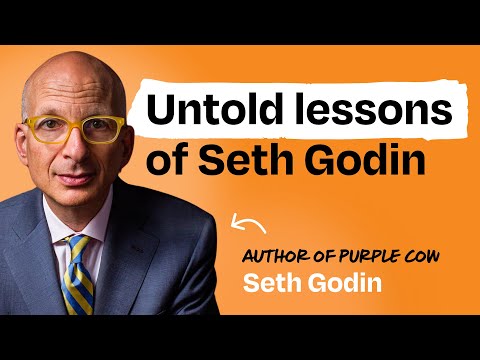
Seth Godin's best tactics for building remarkable products, strategies, brands and more
Lenny Rachitsky (host), Seth Godin (guest)
In this episode of Lenny's Podcast, featuring Lenny Rachitsky and Seth Godin, Seth Godin's best tactics for building remarkable products, strategies, brands and more explores seth Godin on taste, tension, and building truly remarkable products Seth Godin joins Lenny Rachitsky to connect product management, marketing, and strategy through the lenses of taste, tension, and systems thinking.
Seth Godin on taste, tension, and building truly remarkable products
Seth Godin joins Lenny Rachitsky to connect product management, marketing, and strategy through the lenses of taste, tension, and systems thinking.
He explains how to develop good taste and high standards, why brands are promises rather than logos, and how AI companies (and others) must differentiate beyond the mere use of AI.
Godin outlines four foundational strategic choices—customers, competition, validation, and distribution—that quietly determine both your product and your career.
The conversation also covers word-of-mouth-driven growth (Purple Cow), examples like Google, Tesla, Jaguar, and how he used Claude as a humble, rigorous writing assistant for his new book, *This Is Strategy*.
Key Takeaways
Good taste is anticipating what others will want before they do.
Taste isn’t about your personal quirks; it’s the ability to create things the world didn’t expect but is glad to see. ...
Get the full analysis with uListen AI
High standards mean raising the spec, not chasing perfection.
Quality is “meeting spec,” and your job is to relentlessly improve that spec in service of your users—not to block shipping because you’re hiding behind perfectionism or trying to impress your boss.
Get the full analysis with uListen AI
A brand is a promise, not a logo—especially in AI.
Brands are built by making a difficult, meaningful promise and keeping it consistently. ...
Get the full analysis with uListen AI
Four hidden strategic choices quietly define your future.
Choosing your customers, competition set, source of validation, and distribution channel determines what you build, how you work, and what your career feels like. ...
Get the full analysis with uListen AI
Tension, not stress, sits at the heart of effective strategy.
Tension is the productive “it might not work” feeling that arises when you promise a better future and users imagine themselves in it. ...
Get the full analysis with uListen AI
Remarkable products are designed for word-of-mouth by default.
“Remarkable” means worth making a remark about; products should make users’ lives better if they tell others, and you should know in advance what you want people to say. ...
Get the full analysis with uListen AI
Seeing the system is the core of strategic thinking.
Systems—like hiring norms, distribution channels, or college expectations—are often invisible yet govern behavior. ...
Get the full analysis with uListen AI
Notable Quotes
“I define good taste as knowing what other people want just before they do.”
— Seth Godin
“Quality means meeting spec. If you meet spec, you’re done. If you don’t think the spec is good enough, make a better spec.”
— Seth Godin
“A brand is promise. It’s ‘What do I expect from you?’ and ‘Would I miss you if you were gone?’”
— Seth Godin
“Tension is at the heart of every art form and every innovation. Tension is ‘It might not work.’”
— Seth Godin
“The secret to leadership is simple: Do what you believe, paint a picture of the future, go there. People will follow.”
— Seth Godin
Questions Answered in This Episode
How can a product team practically assess and improve its collective “taste” over time?
Seth Godin joins Lenny Rachitsky to connect product management, marketing, and strategy through the lenses of taste, tension, and systems thinking.
Get the full analysis with uListen AI
What specific promises should an early-stage AI startup consider making—and refusing to make—to build a durable brand?
He explains how to develop good taste and high standards, why brands are promises rather than logos, and how AI companies (and others) must differentiate beyond the mere use of AI.
Get the full analysis with uListen AI
How do you know when you’ve chosen the wrong customers, and what does a realistic pivot look like in practice?
Godin outlines four foundational strategic choices—customers, competition, validation, and distribution—that quietly determine both your product and your career.
Get the full analysis with uListen AI
Where in your own organization are invisible systems (like hiring patterns or approval processes) quietly undermining your strategy?
The conversation also covers word-of-mouth-driven growth (Purple Cow), examples like Google, Tesla, Jaguar, and how he used Claude as a humble, rigorous writing assistant for his new book, *This Is Strategy*.
Get the full analysis with uListen AI
If your product truly relied on word-of-mouth to grow, what would you change tomorrow to make it genuinely remarkable?
Get the full analysis with uListen AI
Transcript Preview
Before he came on, I asked on Twitter (keyboard clicking) , "What should I ask Seth Godin?" The most recurring theme actually had to do with AI. How do you think all these new AI companies build brands to distinguish and differentiate themselves?
AI very soon is going to stop being a feature, the same way electricity is not a feature. What AI companies and all companies need to do is say, "What's in this for the user? What promise do I want to make? A difficult promise, a remarkable promise. And then how do I keep it?"
You wrote in your book, you basically talk about how a great strategy has tension at the center of it.
Tension is at the heart of every art form and every innovation. What we do when we launch a new product, we say, "We have this thing that can do X." And now the person is imagining what their life might be like if that were true. If they fall in love with that possibility, now there's tension. Did you tell the truth? Is it going to work for them?
There's th- the section that stuck out to me, these kind of four insights that basically determine what your life is going to be like outside of actually building a product.
For a product person, these are the critical choices, and you probably have glossed over them. (instrumental music)
Today my guest is Seth Godin. Seth is an absolute legend. He's published 21 books, including 18 international bestsellers. He's been blogging every single day for almost 10,000 days in a row now. His writing and his advice have inspired me and so many people all over the world for the past few decades. He shares wisdom and advice around stuff that everyone can benefit from, including how ideas spread, when to quit, how to lead, how to stand out, and most of all, how to change everything. In addition to his writing and speaking, Seth has founded several companies, including Yoyodyne and Squidoo. He also started the AltNBA program. And, as you'll hear in our conversation, he actually started his career as a product manager. In our conversation, Seth shares advice on how to know if you have good taste and how to build your taste, how to build a brand in an increasingly crowded world of AI startups and AI content, his thoughts on the Jaguar rebrand, and also the Tesla Cybertruck. We also delve into his new book, This is Strategy, including why every great strategy has tension at its center, why you need to understand the systems within which you operate in order to build a great strategy, and how choosing your customers, your distribution strategy, and how you validate your idea will inform the product you build and the life that you live. We also talk about how he used Claude as a writing assistant in developing this new book. This episode is short and packed with insights, which I know is what you all love. If you enjoy this podcast, don't forget to subscribe and follow it in your favorite podcasting app or YouTube. It's the best way to avoid missing future episodes and helps the podcast tremendously. With that, I bring you Seth Godin. Seth, thank you so much for being here, and welcome to the podcast.
Install uListen to search the full transcript and get AI-powered insights
Get Full TranscriptGet more from every podcast
AI summaries, searchable transcripts, and fact-checking. Free forever.
Add to Chrome