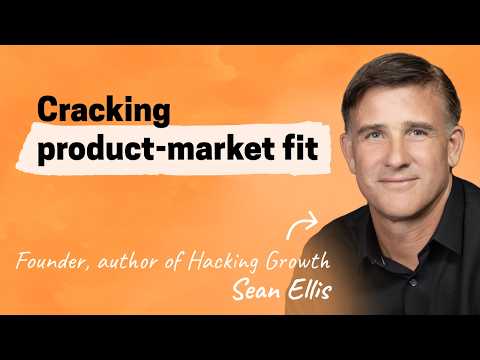
The original growth hacker reveals his secrets | Sean Ellis (author of “Hacking Growth”)
Lenny Rachitsky (host), Sean Ellis (guest), Narrator, Narrator
In this episode of Lenny's Podcast, featuring Lenny Rachitsky and Sean Ellis, The original growth hacker reveals his secrets | Sean Ellis (author of “Hacking Growth”) explores sean Ellis breaks down product‑market fit, activation, and real growth Sean Ellis joins Lenny to unpack how to know if you’ve reached product‑market fit and what to do next to drive sustainable growth.
Sean Ellis breaks down product‑market fit, activation, and real growth
Sean Ellis joins Lenny to unpack how to know if you’ve reached product‑market fit and what to do next to drive sustainable growth.
They dive deep into the origins, use, and limitations of the “Sean Ellis test” (the ‘very disappointed’ survey) and how it acts as a leading indicator for product‑market fit before retention data matures.
Sean shares concrete case studies (LogMeIn, Lookout, Dropbox, Eventbrite, Webs.com, Nubank, Superhuman) showing how to use qualitative and quantitative insights to improve activation, onboarding, engagement, and referral loops.
The conversation closes with how growth has evolved, why cross‑functional experimentation is now essential, how to choose North Star metrics, and where AI will plug into experimentation and analysis.
Key Takeaways
Use the ‘very disappointed’ question as a leading indicator of product‑market fit, not the final word.
Asking “How would you feel if you could no longer use this product? ...
Get the full analysis with uListen AI
Focus on must‑have users and their core benefit before changing your roadmap.
Filter survey responses to people who’d be very disappointed, then learn who they are, what primary benefit they get, why that benefit matters, and what they used before; use this to drive positioning, onboarding, roadmap, and targeting.
Get the full analysis with uListen AI
Onboarding and activation usually move retention more than ‘tactical’ retention tricks.
Sean repeatedly finds poor retention is more about getting users to the right first experience quickly than about emails, nudges, or coupons—improving speed to value and expectation‑setting massively changes long‑term usage and unit economics.
Get the full analysis with uListen AI
You can often dramatically increase your PMF score without changing core functionality.
At Lookout, simply repositioning around antivirus (the must‑have benefit) and re‑sequencing onboarding to deliver that value first moved the ‘very disappointed’ score from 7% to 40% in two weeks, then to 60% in six months.
Get the full analysis with uListen AI
Avoid over‑optimizing for ‘somewhat disappointed’ users unless they share the must‑have benefit.
Chasing nice‑to‑have users can dilute value for must‑have users; Superhuman’s approach—only acting on somewhat‑disappointed users who care about the same primary benefit—is a good pattern to expand the must‑have segment without blurring focus.
Get the full analysis with uListen AI
Design your growth engine around a clear North Star metric that reflects delivered value.
Pick a metric that tracks units of customer value (e. ...
Get the full analysis with uListen AI
Qualitative insights make your experiments dramatically better than data alone.
Sean shifted from being purely data‑driven to combining analytics with constant customer conversations and surveys; this mix surfaced non‑obvious blockers (e. ...
Get the full analysis with uListen AI
Notable Quotes
“A problem well stated is a problem half solved.”
— Sean Ellis (quoting Charles Kettering, then applying it to activation and onboarding)
“If you start paying attention to what your somewhat disappointed users are telling you and then you start tweaking onboarding and product based on their feedback, maybe you're going to dilute it for your must‑have users.”
— Sean Ellis
“Customer acquisition is so hard that if you're not really efficient at converting and retaining and monetizing people, you're going to really struggle on the customer acquisition side.”
— Sean Ellis
“Freemium only works if your free product is so good that people naturally talk about it—and your premium product is different enough that people want to pay for it.”
— Sean Ellis
“Focus on reputation and learning over earnings.”
— Sean Ellis
Questions Answered in This Episode
If my ‘very disappointed’ score is low, how do I distinguish between a fundamentally weak product and a product that’s simply mis‑positioned or poorly onboarded?
Sean Ellis joins Lenny to unpack how to know if you’ve reached product‑market fit and what to do next to drive sustainable growth.
Get the full analysis with uListen AI
How should B2B teams adapt the Sean Ellis test—who exactly should be surveyed (end users vs. buyers) and what threshold makes sense in high‑switching‑cost environments?
They dive deep into the origins, use, and limitations of the “Sean Ellis test” (the ‘very disappointed’ survey) and how it acts as a leading indicator for product‑market fit before retention data matures.
Get the full analysis with uListen AI
When multiple segments show different must‑have benefits and different PMF scores, how do you decide whether to double down on a smaller, passionate niche or a larger but less passionate audience?
Sean shares concrete case studies (LogMeIn, Lookout, Dropbox, Eventbrite, Webs. ...
Get the full analysis with uListen AI
What practical steps can a mid‑ or late‑stage company take to build a true cross‑functional growth team when product, marketing, and sales are already siloed and entrenched?
The conversation closes with how growth has evolved, why cross‑functional experimentation is now essential, how to choose North Star metrics, and where AI will plug into experimentation and analysis.
Get the full analysis with uListen AI
How would Sean design a modern experimentation and prioritization system that uses AI (beyond ICE/RICE) to recommend high‑leverage tests and interpret results across the full funnel?
Get the full analysis with uListen AI
Transcript Preview
... the Sean Ellis test, such a seemingly simple idea that has had such a profound impact on the startup world.
The question is, how would you feel if you could no longer use this product? Once you got a high enough percentage of users saying they'd be very disappointed, most of those products did pretty well. If you fell too low, those products tended to suffer.
Say someone is listening and they're like, "Okay, man, I'm getting like 10%. I don't know what to do." What do you find often works?
Just ignore the people who say they'd be somewhat disappointed. They're telling you it's a nice-to-have. If you start paying attention to what your somewhat disappointed users are telling you and then you start tweaking onboarding and product based on their feedback, maybe you're going to dilute it for your must-have users.
Moving retention often is really hard, but I guess it sounds like there's often something you can do.
It's usually much more a function of onboarding to the right user experience than it is about the kind of tactical things that people try to do to improve retention.
What are, like three or four things that you think people should definitely try to help improve activation?
In my experience...
Today, my guest is Sean Ellis. Sean is one of the earliest and most influential thinkers and operators in the world of growth. He coined the term growth hacking, invented the ICE prioritization framework, was one of the earliest people to use freemium as a growth strategy, and maybe most famously developed the Sean Ellis test to help you understand if you have product-market fit, which a large percentage of founders use today and profoundly impacted the way startups are built. Over the course of his career, Sean was head of growth at Dropbox and Eventbrite, helped companies like Microsoft and Nubank refine their growth strategy, was on the founding team of LogMeIn, which eventually sold for over four billion dollars, and he's the author of one of the most popular growth books of all time called Hacking Growth. In our conversation, we dive deep into two topics. One, how to know if you've got product-market fit and what to do if you don't. And two, how to figure out how to grow once you found product-market fit. If you're in the early stages of a new product wrangling with product-market fit or trying to figure out how to jumpstart or further accelerate growth for your product, this episode is for you. If you enjoy this podcast, don't forget to subscribe and follow it in your favorite podcasting app or YouTube. It's the best way to avoid missing future episodes and it helps the podcast tremendously. With that, I bring you Sean Ellis. Sean, thank you so much for being here and welcome to the podcast.
Thanks, Lenny. I'm, I'm super excited to be on with you.
Install uListen to search the full transcript and get AI-powered insights
Get Full TranscriptGet more from every podcast
AI summaries, searchable transcripts, and fact-checking. Free forever.
Add to Chrome