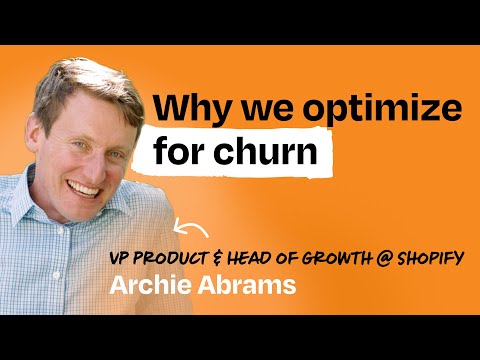
Breaking the rules of growth: Why Shopify bans KPIs, optimizes for churn, and prioritizes intuition
Archie Abrams (guest), Lenny Rachitsky (host)
In this episode of Lenny's Podcast, featuring Archie Abrams and Lenny Rachitsky, Breaking the rules of growth: Why Shopify bans KPIs, optimizes for churn, and prioritizes intuition explores shopify’s Growth Playbook: Ban KPIs, Embrace Churn, Trust Intuition Shopify’s VP of Product & Head of Growth, Archie Abrams, explains an unconventional growth philosophy built around a 100‑year vision, power‑law economics, and radical experimentation discipline. Rather than obsess over churn and retention, Shopify optimizes for lowering barriers to entrepreneurship, accepting high failure rates because a small set of power users generate the vast majority of GMV and profit. Core product teams are not driven by KPIs or OKRs and instead prioritize taste, technical architecture, and long‑term merchant value, while the growth org uses metrics but validates impact through long‑term experiment holdouts. The conversation covers team structure, experiment design, incentives, monetary friction, sales and marketing integration, and how to make a “no KPIs” model work without drifting into chaos.
Shopify’s Growth Playbook: Ban KPIs, Embrace Churn, Trust Intuition
Shopify’s VP of Product & Head of Growth, Archie Abrams, explains an unconventional growth philosophy built around a 100‑year vision, power‑law economics, and radical experimentation discipline. Rather than obsess over churn and retention, Shopify optimizes for lowering barriers to entrepreneurship, accepting high failure rates because a small set of power users generate the vast majority of GMV and profit. Core product teams are not driven by KPIs or OKRs and instead prioritize taste, technical architecture, and long‑term merchant value, while the growth org uses metrics but validates impact through long‑term experiment holdouts. The conversation covers team structure, experiment design, incentives, monetary friction, sales and marketing integration, and how to make a “no KPIs” model work without drifting into chaos.
Key Takeaways
Design for power‑law outcomes, not perfect retention.
Shopify expects many merchants to fail; its model assumes a few successful merchants generate outsized GMV and payments revenue that more than compensate for high churn. ...
Get the full analysis with uListen AI
Lower monetary friction to unlock hidden high‑value customers.
Experiments reducing early monetary friction (e. ...
Get the full analysis with uListen AI
Use absolute counts, not conversion rates, to align incentives.
Teams goaled on funnel conversion rates naturally game the system by adding friction upstream, improving percentages while harming total outcomes. ...
Get the full analysis with uListen AI
Run long‑term holdouts; short‑term wins often don’t endure.
Shopify keeps experimental cohorts “tagged” and automatically re‑analyzes results at 3, 6, 9, and 12+ months, focusing on GMV and profit. ...
Get the full analysis with uListen AI
Ship neutral experiments if they align with strong product intuition.
If an experiment shows no significant short‑term effect but the team has conviction it improves the product experience or merchant outcomes, Shopify often ships it anyway. ...
Get the full analysis with uListen AI
Either anchor on metrics or on a founder’s strong, correct taste—never neither.
A “no-KPI” core org only works because Shopify has a highly opinionated founder (Tobi) and a small group of leaders who enforce a clear, consistent bar for taste and long‑term strategy. ...
Get the full analysis with uListen AI
Architect for the long term; the ‘how’ can define strategy.
Tobi pushes deeply on implementation details (e. ...
Get the full analysis with uListen AI
Notable Quotes
““We want to lower the barriers to getting started and help folks grow, and those winners make the whole system work.””
— Archie Abrams
““In a given cohort, a lot of people will start and not succeed, but the folks who do go on to be successful will make that entire cohort extremely successful for Shopify.””
— Archie Abrams
““It’s almost always easier to just make it harder to do the thing right before your step in the funnel to increase your conversion rate.””
— Archie Abrams
““About 30 to 40 percent of the time, there actually isn’t a long-term lift from a lot of things that you might think in the short term are.””
— Archie Abrams
““You either have to use metrics as accountability, or have an extremely strong founder who has extremely strong opinions on what good is and what taste is.””
— Archie Abrams
Questions Answered in This Episode
How could a smaller or earlier-stage company safely adopt long-term holdout experiments without Shopify’s scale and time horizons?
Shopify’s VP of Product & Head of Growth, Archie Abrams, explains an unconventional growth philosophy built around a 100‑year vision, power‑law economics, and radical experimentation discipline. ...
Get the full analysis with uListen AI
If your founder doesn’t have ‘Tobi-level’ product taste, what is the right balance between intuition and KPI-driven decision-making?
Get the full analysis with uListen AI
How might your funnels change if every team were measured on absolute outcomes (people completing a journey) instead of conversion rates?
Get the full analysis with uListen AI
Where in your product could reducing monetary friction unlock high-potential but currently underserved or excluded users?
Get the full analysis with uListen AI
What existing ‘growth wins’ in your org would look different if you re-evaluated them a year later on true long-term value metrics like revenue or power users created?
Get the full analysis with uListen AI
Transcript Preview
(instrumental music) When you have... Teams naturally break up the world into different funnel stages or different points in the journey. It gets very seductive to just look at my part of the funnel and what's my conversion rate through that part of the funnel, right? And then the team starts to optimize for that conversion rate as their North star. But in practice, it's actually almost always easier to just make it harder to do the thing right before your step in the funnel to increase your conversion rate. Instead of, "I'm trying to convert a bunch of people, I just want more people to get activated." And then once you start thinking that way, you realize, actually, the best way to get more people to get to a step is just get more people in the door in the first place. That will always hurt your conversion rate, but it may actually give you more people on the outside.
(instrumental music) Today my guest is Archie Abrams. Archie is VP of Product and Head of Growth at Shopify, where he leads an org of over 600 people across product, design, engineering, data, ops, and growth marketing. Shopify is both an incredibly unique and also an incredibly successful business. And they do things very differently. And as a result, there's a lot that we can learn from how they approach building product and driving growth. Some examples include their priorities and product roadmap are driven by 100-year vision that comes from Tobi, the CEO, and the core product teams don't have metrics or KPIs. They're essentially banned. And instead, decisions are made based on taste and intuition and building towards this long term vision. Also the growth team optimizes for churn, which is unlike any other company I've ever come across. And once you hear why, this will make a lot of sense. Also, they keep long term holdouts for every experiment they run, and they automatically look at the impact these experiments have had on the business a year later, two years later, and three years later, and then revisit these decisions down the road. And in our conversation, we dig into all this, plus how Shopify organizes their growth team, how they run experiments, how the growth team collaborates with the product team, how they measure impact, plus Archie shares a bunch of very specific and interesting examples of changes that have driven growth for the business, and so much more. This is such a fascinating conversation, and I know this will give you a lot to think about in terms of how you run and organize your own product and growth teams. If you enjoy this podcast, don't forget to subscribe and follow it in your favorite podcasting app or YouTube. It's the best way to avoid missing future episodes, and it helps the podcast tremendously. With that, I bring you Archie Abrams. (instrumental music) Archie, thank you so much for being here, and welcome to the podcast.
Install uListen to search the full transcript and get AI-powered insights
Get Full TranscriptGet more from every podcast
AI summaries, searchable transcripts, and fact-checking. Free forever.
Add to Chrome