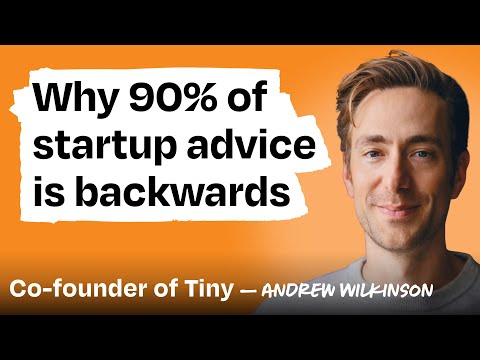
I’ve run 75+ businesses. Here’s why you’re probably chasing the wrong idea. | Andrew Wilkinson
Andrew Wilkinson (guest), Lenny Rachitsky (host)
In this episode of Lenny's Podcast, featuring Andrew Wilkinson and Lenny Rachitsky, I’ve run 75+ businesses. Here’s why you’re probably chasing the wrong idea. | Andrew Wilkinson explores serial founder warns: most entrepreneurs chase sexy, terrible business ideas Andrew Wilkinson, co-founder and CEO of Tiny, shares lessons from starting or running 75+ businesses and now buying dozens more through his internet-focused holding company. He argues most first-time founders pick flashy, over-competitive ideas instead of boring, profitable niches that match their personal unfair advantages. The conversation covers how to evaluate and choose business models, the reality of lifestyle vs. VC-backed companies, and how AI agents are already replacing assistants and reshaping knowledge work. Wilkinson also opens up about money and happiness, his ADHD and SSRI journey, and how understanding your own brain chemistry can matter more than making more money.
Serial founder warns: most entrepreneurs chase sexy, terrible business ideas
Andrew Wilkinson, co-founder and CEO of Tiny, shares lessons from starting or running 75+ businesses and now buying dozens more through his internet-focused holding company. He argues most first-time founders pick flashy, over-competitive ideas instead of boring, profitable niches that match their personal unfair advantages. The conversation covers how to evaluate and choose business models, the reality of lifestyle vs. VC-backed companies, and how AI agents are already replacing assistants and reshaping knowledge work. Wilkinson also opens up about money and happiness, his ADHD and SSRI journey, and how understanding your own brain chemistry can matter more than making more money.
Key Takeaways
Start with simple, winnable businesses to build confidence and skills.
Wilkinson compares ambitious first-time ideas (like building the next great AI company) to deadlifting 300 pounds on your first day at the gym. ...
Get the full analysis with uListen AI
Fish where the fish are—but avoid crowded ponds and dead bodies.
He urges founders to find niches with real demand and weak competition, often in ‘boring’ areas like pest control, funeral homes, or government-form software, instead of overfished spaces like cafes, productivity apps, or hyper-competitive SaaS categories where margins are crushed.
Get the full analysis with uListen AI
Align your business with your unfair advantages and passions, then pivot to the most lucrative segment.
You don’t have to choose between passion and profit: study the ecosystem around what you love (e. ...
Get the full analysis with uListen AI
Avoid business models littered with smart failures and bad economics.
Wilkinson’s biggest mistakes came from believing he could “do it better” in structurally bad categories like restaurants, bars, local news, or productivity tools against heavily funded incumbents. ...
Get the full analysis with uListen AI
A great business has a moat: brand, network effects, or high switching costs.
When buying companies, Tiny looks for businesses that are hard to mess up and hard to compete with—strong brands (like AeroPress), communities with network effects (like Letterboxd or Serato), or sticky systems (like Salesforce). ...
Get the full analysis with uListen AI
AI agents can already replace large chunks of knowledge work and admin.
Wilkinson uses tools like Lindy, Replit, Limitless, and LLMs to triage and respond to email, manage his calendar, create automatic CRM entries, prep for meetings, and even summarize relationship conflicts. ...
Get the full analysis with uListen AI
More money doesn’t fix anxiety; treating your brain might.
Despite becoming a billionaire, his baseline anxiety and unhappiness barely changed; he just worried about bigger numbers. ...
Get the full analysis with uListen AI
Notable Quotes
“You don't want to walk into the gym on day one and try and deadlift 300 pounds.”
— Andrew Wilkinson
“Fish where the fish are… you actually want to walk off into the forest and find a small fishing hole with lots of fish and very little competition.”
— Andrew Wilkinson (quoting Charlie Munger and extending the metaphor)
“The biggest mistakes I've made have been going into business models where other people have repeatedly failed and thinking, 'I can do this better.'”
— Andrew Wilkinson
“It's like having the world's most reliable employee who costs $200 a month and works 24/7.”
— Andrew Wilkinson, on AI agents
“No amount of money or success or attention had done what this little tiny yellow pill could do for my mental state.”
— Andrew Wilkinson, on starting SSRIs
Questions Answered in This Episode
How can a first-time founder practically identify ‘boring’ niches with real moats and demand instead of just guessing?
Andrew Wilkinson, co-founder and CEO of Tiny, shares lessons from starting or running 75+ businesses and now buying dozens more through his internet-focused holding company. ...
Get the full analysis with uListen AI
What specific questions should you ask AI tools when evaluating whether a business model is structurally good or bad?
Get the full analysis with uListen AI
Where is the ethical line when using AI agents to replace assistants or other human roles, and how should founders handle that transition?
Get the full analysis with uListen AI
Given Dario Amodei’s prediction about AI exceeding PhDs by 2027, which knowledge-work careers are most resilient, and which are most at risk?
Get the full analysis with uListen AI
How should ambitious people balance the drive to build big companies with the personal costs Wilkinson describes, and when is ‘enough’ actually enough?
Get the full analysis with uListen AI
Transcript Preview
You don't want to walk into the gym on day one and try and deadlift 300 pounds. So when someone comes to me and they're a first time entrepreneur and they say, "I'm going to make the next great AI company," I think that is the equivalent.
I feel like you've actually started and run more companies than maybe anyone else in the world. What is your best advice for coming up with a great startup idea?
Charlie Munger, Warren Buffett's longtime business partner, has this amazing quote.
"Fish where the fish are."
The biggest mistakes I've made have been going into business models where other people have repeatedly failed and thinking, "I can do this better."
It's so funny to watch you on Twitter. Clearly, you've become AI obsessed.
It's like having the world's most reliable employee who costs $200 a month and works 24/7. So many knowledge work jobs are going to change massively. I think the fundamental question is, do all jobs just become a single prompt?
Today my guest is Andrew Wilkinson. Andrew is the co-founder and CEO of Tiny, a holding company that's often called the Berkshire Hathaway of the internet. They own over 40 businesses ranging from Dribble to WeCommerce to the AeroPress coffee maker. And they focus on buying profitable businesses from founders and holding them for the long term. Andrew and his co-founder bootstrapped the business from zero to hundreds of millions of dollars in value. And Andrew personally was worth over one billion dollars at one point. In our wide ranging conversation, we cover a bunch of strategies for coming up with a good business idea, what common business ideas you should avoid, his experience automating much of his work and life using AI, and what that means for employment in the near future. Also, what he's learned about happiness and money, and how they are not directly related. And also, how getting diagnosed with ADHD and then taking SSRIs was the thing that most impacted his happiness in life. This is both a powerful and also a very tactically useful conversation, and I'm really excited for you to hear it. If you enjoy this podcast, don't forget to subscribe and follow it in your favorite podcasting app or YouTube. Also, if you become an annual subscriber of my newsletter, you get a year free of a bunch of amazing products, including Bolt, Linear, Superhuman, Notion, Perplexity, Granola, and more. Check it out at LennysNewsletter.com and click Bundle. With that, I bring you Andrew Wilkinson. This episode is brought to you by Sauce. The way teams turn feedback into product impact is stuck in the past. Vague reports, static taxonomies, unactionable insights that don't move business metrics. The result? Churn, lost deals, missed growth. Sauce is the AI product co-pilot that helps CPOs and product teams uncover business impact and act faster. It listens to your sales calls, support tickets, churn reasons, and lost deals, surfacing the biggest product issues and opportunities in real time. It then routes them to the right teams to turn signals into PRDs, prototypes, and even code that drives revenue, retention, and adoption. That's why whatnot, Linktree, IncidentIO, and Zip use Sauce. One enterprise uncovered a product gap that unlocked 16 million dollars ARR. Another caught a spiking issue and prevented millions in churn. You can too at sauce.app/lenny. Sauce, built for AI product teams. Don't get left behind. This episode is brought to you by Interpret. Interpret is a customer intelligence platform used by leading CX and product orgs like Canva, Notion, Perplexity, Strava, Hinge, and Linear. To leverage the voice of the customer and build best in class products, Interpret unifies all customer conversations in real time, from Gong recordings to Zendesk tickets, to Twitter threads, and makes it available for your team for analysis and for action. What makes Interpret unique is its ability to build and update a customer specific knowledge graph that provides the most granular and accurate categorization of all customer feedback, and connects that customer feedback to critical metrics like revenue and CSAT. If modernizing your voice of customer program to a generational upgrade is a 2025 priority, like customer centric industry leaders like Canva, Notion, Perplexity, and Linear, reach out to the team at interpret.com/lenny. That's E-N-T-E-R-P-R-E-T.com/lenny. Andrew, thank you so much for being here, and welcome to the podcast.
Install uListen to search the full transcript and get AI-powered insights
Get Full TranscriptGet more from every podcast
AI summaries, searchable transcripts, and fact-checking. Free forever.
Add to Chrome