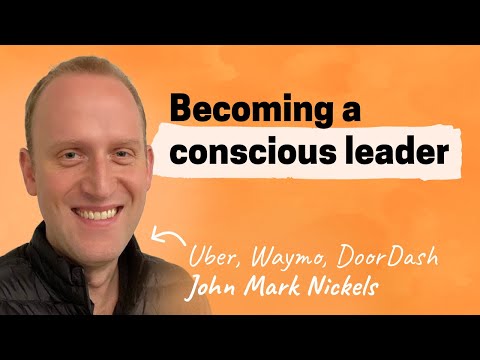
Conscious leadership: Unlocking vision, strategy and purpose | JM Nickels (Uber, Waymo, DoorDash)
JM Nickels (guest), Lenny Rachitsky (host), Narrator, Narrator
In this episode of Lenny's Podcast, featuring JM Nickels and Lenny Rachitsky, Conscious leadership: Unlocking vision, strategy and purpose | JM Nickels (Uber, Waymo, DoorDash) explores conscious leadership, emotional mastery, and visionary strategy in product JM Nichols, a longtime product leader at Uber, DoorDash, and Waymo, shares how ‘conscious leadership’—deep self-awareness and responsibility for one’s influence—can transform both work and life.
Conscious leadership, emotional mastery, and visionary strategy in product
JM Nichols, a longtime product leader at Uber, DoorDash, and Waymo, shares how ‘conscious leadership’—deep self-awareness and responsibility for one’s influence—can transform both work and life.
He argues that emotional literacy, presence, and a clear personal objective function matter more than optics and fear-driven performance, and explains how this shift actually improved his promotions and impact.
On the hard-skills side, he breaks down how to craft compelling product vision and strategy by deeply understanding a domain, visualizing the future, and balancing big-picture thinking with disciplined execution.
Woven throughout are reflections on mortality, parenting, and victim mentality, urging leaders to reclaim agency, prioritize what truly matters, and bring their whole selves—including emotions—into work.
Key Takeaways
Get clear on your personal objective function before optimizing your career.
Nichols urges people to define what success truly means—often from the vantage point of their future self—so daily trade-offs (e. ...
Get the full analysis with uListen AI
Conscious leadership starts with self-awareness and responsibility for your influence.
Leadership isn’t a title; it’s the impact you have on others. ...
Get the full analysis with uListen AI
Emotions at work are signals, not weaknesses, and can improve decisions.
Rather than suppressing fear, sadness, anger, or joy, Nichols suggests noticing and ‘allowing’ them—because fear can signal risk, sadness invites letting go, anger flags misalignment, and joy/creative energy point toward what wants to be built.
Get the full analysis with uListen AI
Paradoxically, caring less about optics and more about the work can accelerate your career.
When Nichols shifted focus from impressing executives to building truly great products aligned with a meaningful mission, his promotions and influence increased—while presentations and ‘optics’ became tools, not ends in themselves.
Get the full analysis with uListen AI
Strong vision and strategy come from deep domain immersion and future visualization.
He recommends spending years in a problem space, then regularly stepping away from day-to-day noise to literally close your eyes, imagine the world 5–10 years out, and reason from first principles about what will be true and where opportunities lie.
Get the full analysis with uListen AI
Balance theory and action: avoid both over-visioning and blind execution.
Nichols has seen teams at Uber get ‘wrapped around the axle’ in theory, and teams at DoorDash run ‘ready, fire, aim’; he advocates deliberately dialing up vision work at some times and ruthless execution at others, instead of living at either extreme.
Get the full analysis with uListen AI
Drop victim mentality and reclaim agency over how you relate to events.
While acknowledging real external constraints, he emphasizes choosing how you interpret and respond to circumstances—seeing challenges as chances to grow—rather than living as if life is only happening to you.
Get the full analysis with uListen AI
Notable Quotes
“To me, leadership is having influence in the world—and by that definition, everyone is a leader.”
— JM Nichols
“What you resist will persist, and what you fear will appear.”
— JM Nichols (quoting an early coach)
“As long as I was going out there looking for approval, money, and titles to complete something inside of me, I was like a hungry ghost.”
— JM Nichols
“Five years from now, I’m not gonna give a shit if I made the presentation slightly better, but I’m gonna care a lot about what kind of relationship I have with my daughters.”
— JM Nichols
“Most of us try to pretend like we’re gonna live forever—and the horror of it is that we succeed.”
— JM Nichols
Questions Answered in This Episode
How can I practically start building emotional awareness and ‘allowing’ emotions in a high-pressure, data-driven workplace without seeming unprofessional?
JM Nichols, a longtime product leader at Uber, DoorDash, and Waymo, shares how ‘conscious leadership’—deep self-awareness and responsibility for one’s influence—can transform both work and life.
Get the full analysis with uListen AI
What concrete steps can I take this month to clarify my own objective function and ensure my daily calendar reflects what I’ll care about in 5–10 years?
He argues that emotional literacy, presence, and a clear personal objective function matter more than optics and fear-driven performance, and explains how this shift actually improved his promotions and impact.
Get the full analysis with uListen AI
If my company’s mission doesn’t deeply resonate with me, is it still possible to be a great strategic/visionary leader there, or is it time to move on?
On the hard-skills side, he breaks down how to craft compelling product vision and strategy by deeply understanding a domain, visualizing the future, and balancing big-picture thinking with disciplined execution.
Get the full analysis with uListen AI
How do I know when my team is over-indexing on theory and vision versus when we’re just mindlessly executing without enough strategic thought?
Woven throughout are reflections on mortality, parenting, and victim mentality, urging leaders to reclaim agency, prioritize what truly matters, and bring their whole selves—including emotions—into work.
Get the full analysis with uListen AI
What are some early warning signs that I’m slipping into victim mentality at work, and how can I reliably shift back into a stance of agency and responsibility?
Get the full analysis with uListen AI
Transcript Preview
Get clear on your objective function. And one way that I've gotten clear on it is, like, trying to think about it from future me. 'Cause like five years from now, I'm not gonna give a shit if I made the presentation slightly better, but I'm gonna care a lot about what kind of relationship I have with my daughters. And like, that means that th- the next action, the next thing I do today and tomorrow, those will translate into the relationship with her, right? Not to be, like, morbid, but just again, most of us just aren't really tuned into an awareness that our lives will come to an end. We try to pretend like we're gonna live forever and just not think about it, and the horror of it is that we succeed, right? We mostly manage to just go live our life and eat ice cream and go to work and go on vacation and do what we do. To me, an awareness and mindfulness that our lives will come to an end punctuates reality in a way that requires me to rethink my priorities.
(instrumental music) Today, my guest is JM Nichols. JM has been a product leader at Waymo, DoorDash, and Uber. He's also an engineering manager at Groupon, and before that, an equity trader at GetGo. At Uber, he built and launched the very first version of Uber Pool, and then went on to lead the team responsible for the infrastructure and algorithms powering the economic and logistics brain behind Uber's matching and pricing systems. At DoorDash, he was head of product for DoorDash platform. At Waymo, he led product for the commercialization of autonomous ride-hailing and last-mile delivery. And he recently returned to Uber to lead product for their mobility team. This conversation is a unique and beautiful mixture of hard skills, soft skills, tactics, and emotions. I won't give away too much about the conversation, but this is a powerful one. Tears are shed, stories are shared, and I am confident you'll become a better leader and human having listened to JM's insights and lessons. If you enjoy this podcast, don't forget to subscribe and follow it in your favorite podcasting app or YouTube. It's the best way to avoid missing future episodes, and it helps the podcast tremendously. With that, I bring you JM Nichols. JM, thank you so much for being here and welcome to the podcast.
Thank you, Lenny. Thanks for having me. I'm thrilled to be here. Um, really appreciate your dedication to helping product managers kind of, like, improve their craft and uplevel. There's not a lot of great resources out there for that. And coaching and development, as I'm sure we'll get into, is a, a passion of mine as well. So, we have a lot of shared interests there.
Aw, I really appreciate that. I wanna start with a phrase that came up again and again when I asked people what to talk to you about from your colleagues. And this phrase is conscious leadership. What is conscious leadership? What does this phrase mean?
Install uListen to search the full transcript and get AI-powered insights
Get Full TranscriptGet more from every podcast
AI summaries, searchable transcripts, and fact-checking. Free forever.
Add to Chrome