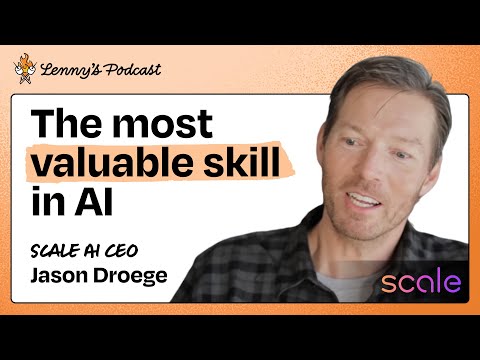
Scale AI CEO on Meta’s $14B deal, scaling Uber Eats to $80B, & what frontier labs are building next
Lenny Rachitsky (host), Jason Droege (guest), Narrator, Narrator
In this episode of Lenny's Podcast, featuring Lenny Rachitsky and Jason Droege, Scale AI CEO on Meta’s $14B deal, scaling Uber Eats to $80B, & what frontier labs are building next explores scale AI’s New CEO Explains Future Of AI, Data, And Entrepreneurship Jason Droege, new CEO of Scale AI and creator of Uber Eats, discusses how AI progress is increasingly driven by expert human data, rigorous evaluations, and real-world enterprise deployments rather than just model architecture and compute.
Scale AI’s New CEO Explains Future Of AI, Data, And Entrepreneurship
Jason Droege, new CEO of Scale AI and creator of Uber Eats, discusses how AI progress is increasingly driven by expert human data, rigorous evaluations, and real-world enterprise deployments rather than just model architecture and compute.
He breaks down the Meta–Scale $14B deal, clarifies that Scale remains an independent company, and details how expert networks (doctors, engineers, PhDs) now label and evaluate complex tasks to move models from ‘knowing’ to ‘doing’.
Droege shares on-the-ground realities of deploying AI in enterprises—why production systems take 6–12 months, why most quick POCs fail, and why humans will remain in the loop for a long time.
Drawing on his experience scaling Uber Eats from zero to a $20B run-rate business, he also offers concrete lessons on customer obsession, business model selection, gross margins, risk-taking, and building durable teams.
Key Takeaways
AI progress now depends heavily on expert human input, not just big datasets.
Early gen-AI systems used cheap, generalist labelers; today’s frontier models require highly skilled experts (engineers, doctors, PhDs) who spend hours on tasks like building full websites or explaining nuanced medical topics, and defining what ‘good’ looks like in each domain.
Get the full analysis with uListen AI
Evaluations (evals) are becoming the backbone of serious AI deployments.
Enterprises and governments increasingly need robust eval suites that encode ‘what good looks like’ for their specific processes (e. ...
Get the full analysis with uListen AI
Real enterprise AI impact typically takes 6–12 months, not weeks.
POCs often stall at 60–70% performance; getting to production-grade reliability requires months of iteration, domain data collection, policy and legal approvals, change management, and careful human–AI handoffs, which news headlines and demo videos tend to obscure.
Get the full analysis with uListen AI
Humans will remain central to AI training and oversight for the foreseeable future.
Droege argues that as long as new human skills, judgments, and organizational contexts matter, models will need fresh human-generated data and judgment; ‘no-human-in-the-loop’ would imply a world where no new human knowledge is worth encoding, which he sees as very far off.
Get the full analysis with uListen AI
Choosing the right market and business model dramatically improves odds of success.
When launching Uber Eats, Droege systematically compared ideas (convenience vans, grocery, point-to-point delivery) and prioritized a marketplace with strong unit economics, clear incrementality for restaurants, and the potential for network effects and large scale.
Get the full analysis with uListen AI
Gross margin is a fast filter for whether you’re truly adding value.
He uses target gross margins (e. ...
Get the full analysis with uListen AI
Survival and risk management are underrated compared to ‘going for it’.
Droege stresses that ‘not losing is a precursor to winning’—great founders manage risk asymmetrically, avoid bets that can kill the company, and stay alive long enough for timing, insights, and product–market fit to converge.
Get the full analysis with uListen AI
Notable Quotes
“The general trend right now is going from models knowing things to models doing things.”
— Jason Droege
“With any of these major tech revolutions, headlines tell one story, and then on the ground… someone’s got to dig up the road or run the undersea cable.”
— Jason Droege
“If you have a human process that is 10 or 20% accurate, AI is awesome. If it’s 98% accurate and you expect AI to get you the remaining 2%, we’re not totally there yet.”
— Jason Droege
“At the point at which you don’t need external human data in models, we’ve gotten to a level of advancement that is almost unfathomable.”
— Jason Droege
“Not losing is a precursor to winning. Survival is just part of the game.”
— Jason Droege
Questions Answered in This Episode
How should enterprises design evals and environments so that AI agents can safely ‘do’ things, not just answer questions?
Jason Droege, new CEO of Scale AI and creator of Uber Eats, discusses how AI progress is increasingly driven by expert human data, rigorous evaluations, and real-world enterprise deployments rather than just model architecture and compute.
Get the full analysis with uListen AI
What specific characteristics distinguish data that is truly valuable for training models from the massive volumes of enterprise data that are effectively noise?
He breaks down the Meta–Scale $14B deal, clarifies that Scale remains an independent company, and details how expert networks (doctors, engineers, PhDs) now label and evaluate complex tasks to move models from ‘knowing’ to ‘doing’.
Get the full analysis with uListen AI
How can product leaders better estimate whether a new AI use case belongs in the ‘10–20% accurate’ bucket (great for AI) or the ‘98% accurate’ bucket (dangerous for AI)?
Droege shares on-the-ground realities of deploying AI in enterprises—why production systems take 6–12 months, why most quick POCs fail, and why humans will remain in the loop for a long time.
Get the full analysis with uListen AI
Given the shift to expert and in-house labeling, what new roles and career paths will emerge for domain experts inside enterprises?
Drawing on his experience scaling Uber Eats from zero to a $20B run-rate business, he also offers concrete lessons on customer obsession, business model selection, gross margins, risk-taking, and building durable teams.
Get the full analysis with uListen AI
When evaluating a new AI business or product line, how can founders systematically apply Droege’s gross-margin and risk frameworks to avoid building into structurally bad markets?
Get the full analysis with uListen AI
Transcript Preview
There's been a lot of talk these days about AI not delivering on the promise that we hear, especially at enterprises.
These things take 6 to 12 months to get them truly robust enough where an important process can be automated. Like with any of these major tech revolutions, headlines tell one story, and then on the ground... Laying broadband means you need to dig up every single road in America to lay it. Someone's got to dig up the road or someone's got to run the undersea cable.
Is there anything you think people don't truly grasp or understand about where AI models are going to be in the next two, three years?
The general trend right now is going from models knowing things to models doing things. The next question becomes, what can it do for me? How does the agent make decisions for you?
Let's talk about scale and this whole world of AI that you're in. You essentially pioneered data labeling, training data, creating evals for labs.
18 months ago, you would get a short story and I would say, "Is this short story better than this short story?" And now you're at a point where one task is building an entire website by one of the world's best web developers, or it is explaining some very nuanced topic on cancer to a model. These tasks now take hours of time, and they require PhDs and professionals.
I've talked to a bunch of people that have worked with you over the years, and I heard a lot about just how high of a bar you set for new businesses.
From an entrepreneurship standpoint, it truly is about, what insight do I have? Why am I so lucky to have this insight? Why, in a world of a million entrepreneurs who are thinking, who are smart, who are trying everything, why am I in the position where I likely have an insight that others do not?
Today my guest is Jason Droege. Jason is the new CEO of Scale AI. This is the first interview that he's done since taking over for Alex Wang after the Meta deal. Alex now leads the superintelligence team at Meta. Prior to Scale, Jason co-founded a company with Travis Kalanick before he started Uber, worked at a couple startups. Most famously, Jason launched and led Uber Eats, which went from an idea that he and his team had to what is now a multi-billion dollar run rate business, and one that basically saved Uber during the pandemic when nobody was taking rides. This interview is following a theme that I've been following through a bunch of interviews, which is the evolution of how AI models actually get smarter. Along with scaling compute and improving the actual model code, much of the improvements we're seeing in ChatGPT and Claude and every frontier AI model is these labs hiring experts to fill in gaps in their knowledge and correcting their understanding of how things work, and basically showing them what good looks like in every domain that consumers are using models. Scale was the pioneer in this space. They created the category. And in our conversation, we talk about what is happening at Scale and just how this deal with Meta worked, what experts like doctors and software engineers are specifically doing to help models get smarter, how the whole market of data labeling and evals and data training has changed from when Scale entered the market to today, and also just how long will we need humans to keep helping AI get smarter? We also get into where Jason sees models going in the next few years, because they have such a unique glimpse into the future. We also talk about a ton of really unique and really important product lessons from the course of Jason's career, including a bunch of advice on how to start a new business, both startups and within existing companies, and also a bunch of advice on hiring and leadership and so much more. A huge thank you to Allen Pen and Stephen Chow for suggesting topics for this conversation. If you enjoy this podcast, don't forget to subscribe and follow it in your favorite podcasting app or YouTube. It helps tremendously. And if you become an annual subscriber of my newsletter, you get a year free of 15 incredible products, including Lovable, Replit, Bolt, n8n, Linear, Superhuman, Descript, WhisperFlow, Gamma, Perplexity, Warp, Granola, Magic Patterns, Raycast, ChatPRD and Mobbin. Head on over to lennysnewsletter.com and click Product Pass. With that, I bring you Jason Droege. This episode is brought to you by Merge. Product leaders hate building integrations. They're messy, they're slow to build, they're a huge drain on your roadmap. And they're definitely not why you got into product in the first place. Lucky for you, Merge is obsessed with integrations. With a single API, B2B SaaS companies embed Merge into their product and ship 220 plus customer-facing integrations in weeks, not quarters. Think of Merge like Plaid, but for everything B2B SaaS. Companies like Mistral AI, Ramp and Drata use Merge to connect their customers' accounting, HR, ticketing, CRM and file storage systems to power everything from automatic onboarding to AI-ready data pipelines. Even better, Merge now supports the secure deployment of connectors to AI agents with a new product so that you can safely power AI workflows with real customer data. If your product needs customer data from dozens of systems, Merge is the fastest, safest way to get it. Book and attend a meeting at merge.dev/lenny and they'll send you a $50 Amazon gift card. That's merge.dev/lenny. This episode is brought to you by Figma, makers of Figma Make. When I was a PM at Airbnb, I still remember when Figma came out and how much it improved how we operated as a team. Suddenly, I could involve my whole team in the design process, give feedback on design concepts really quickly, and it just made the whole product development process so much more fun. But Figma never felt like it was for me. It was great for giving feedback and designs, but as a builder, I wanted to make stuff. That's why Figma built Figma Make. With just a few prompts, you can make any idea or design into a fully functional prototype or app that anyone can iterate on and validate with customers. Figma Make is a different kind of vibe coding tool. Because it's all in Figma, you can use your team's existing design building blocks, making it easy to create outputs that look good and feel real and are connected to how your team builds. Stop spending so much time telling people about your product vision, and instead show it to them. Make code-backed prototypes and apps fast with Figma Make. Check it out at figma.com/lenny.Jason, thank you so much for being here and welcome to the podcast.
Install uListen to search the full transcript and get AI-powered insights
Get Full TranscriptGet more from every podcast
AI summaries, searchable transcripts, and fact-checking. Free forever.
Add to Chrome