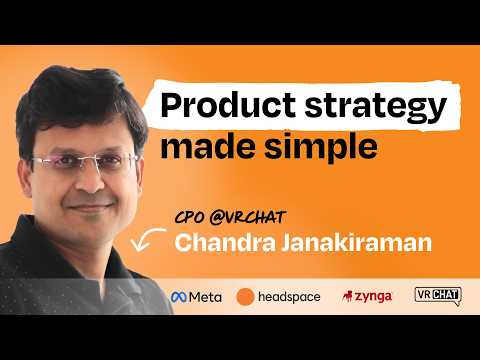
An operator’s guide to product strategy | Chandra Janakiraman (CPO at VRChat, ex-Meta, Headspace)
Chandra Janakiraman (guest), Lenny Rachitsky (host), Chandra Janakiraman (guest), Guest ad sponsor representative (guest)
In this episode of Lenny's Podcast, featuring Chandra Janakiraman and Lenny Rachitsky, An operator’s guide to product strategy | Chandra Janakiraman (CPO at VRChat, ex-Meta, Headspace) explores operator’s five-step playbook demystifies product strategy and execution Chandra Janakiraman lays out an “operator’s guide” to product strategy, turning classic strategy theory into a concrete, repeatable five-step process any product team can run in 8–12 weeks.
Operator’s five-step playbook demystifies product strategy and execution
Chandra Janakiraman lays out an “operator’s guide” to product strategy, turning classic strategy theory into a concrete, repeatable five-step process any product team can run in 8–12 weeks.
He distinguishes between “small‑S” present‑forward strategy (2‑year horizon, problem-focused) and “Big‑S” future‑back strategy (5–10 year horizon, aspirational), and shows how both should feed a single roadmap.
The small‑S process centers on a cross‑functional strategy working group that gathers inputs, clusters problems into opportunities, selects three strategic pillars, visualizes them through a design sprint, and encodes everything into a concise strategy document and rollout.
Chandra illustrates the approach with examples from Zynga, Meta, Headspace, and VRChat, emphasizes that strategy is only valuable when tested via execution, and explores how AI can support research, mock strategies, and eventually multi‑agent strategic systems.
Key Takeaways
Treat strategy as the bridge between vision and roadmap, not as a roadmap itself.
Product strategy should sit between mission/vision and the plan, forcing explicit choices about where to focus scarce resources, rather than becoming a feature list or release schedule.
Get the full analysis with uListen AI
Use a structured, five-phase process to build strategy in 8–12 weeks.
Chandra’s small‑S process—Preparation, Strategy Sprint, Design Sprint, Document Writing, Rollout—gives teams a realistic quarter-long cadence to gather inputs, make hard choices, and codify strategy that can guide 1–2 years of work.
Get the full analysis with uListen AI
Anchor strategy in a cross‑functional working group to build true alignment.
By involving engineering, product, design, and data (plus PMM/UXR where possible) in research, problem clustering, and pillar selection, the strategy feels owned by the team and leadership rather than handed down by one PM.
Get the full analysis with uListen AI
Select a few strategic pillars by systematically scoring problem clusters.
After clustering problems into 10–15 themes and reframing them as opportunities, the team ranks them on expected impact, certainty of impact, clarity of levers, and uniqueness, then down‑selects to roughly three pillars—and explicitly notes what they will *not* do.
Get the full analysis with uListen AI
Complement problem-focused “small‑S” with aspirational “Big‑S” futures.
Big‑S work starts from mission, long‑term trends, and leadership interviews to create distinct 5–10 year futures, prototype them like concept cars, test them with users, and feed the winning components back into the live product and roadmap.
Get the full analysis with uListen AI
Strategy only matters if it produces results; keep testing and adjusting.
From Meta’s Oculus vs. ...
Get the full analysis with uListen AI
Leverage AI for inputs and mock strategies, but keep humans making the hard choices.
Today’s AI can synthesize competitive trends, user reviews, and even propose comprehensive ‘mock strategies,’ but humans still need to impose focus, prioritize, and apply company-specific judgment—at least until richer multi‑agent systems emerge.
Get the full analysis with uListen AI
Notable Quotes
“It was almost as if there was a strategy gene that you needed to be born with to be good at it—and that bothered me a lot.”
— Chandra Janakiraman
“Strategy sits between the mission and vision and the plan. It forces choice to deploy scarce resources to generate maximum impact.”
— Chandra Janakiraman
“The core of strategy is really picking those areas you will focus on and the areas you are not going to invest in.”
— Chandra Janakiraman
“Intrinsically, strategy has no business value. It starts accumulating value as you generate business impact and results.”
— Chandra Janakiraman
“We may be wrong, but we’re not confused.”
— Tomer Cohen (quoted by Lenny Rachitsky)
Questions Answered in This Episode
How would this five-phase small‑S strategy process need to change for an early-stage startup versus a large, mature organization?
Chandra Janakiraman lays out an “operator’s guide” to product strategy, turning classic strategy theory into a concrete, repeatable five-step process any product team can run in 8–12 weeks.
Get the full analysis with uListen AI
When your leadership’s “pet ideas” conflict with the prioritized strategic pillars, how should a PM reconcile those tensions?
He distinguishes between “small‑S” present‑forward strategy (2‑year horizon, problem-focused) and “Big‑S” future‑back strategy (5–10 year horizon, aspirational), and shows how both should feed a single roadmap.
Get the full analysis with uListen AI
What are the early signals during execution that should prompt you to revisit your chosen strategic pillars rather than just tweaking tactics?
The small‑S process centers on a cross‑functional strategy working group that gathers inputs, clusters problems into opportunities, selects three strategic pillars, visualizes them through a design sprint, and encodes everything into a concise strategy document and rollout.
Get the full analysis with uListen AI
How can product teams balance the time and energy required for Big‑S, future‑back work with near-term growth and roadmap pressure?
Chandra illustrates the approach with examples from Zynga, Meta, Headspace, and VRChat, emphasizes that strategy is only valuable when tested via execution, and explores how AI can support research, mock strategies, and eventually multi‑agent strategic systems.
Get the full analysis with uListen AI
As AI-generated ‘mock strategies’ get better, what uniquely human skills will matter most for product leaders shaping strategy?
Get the full analysis with uListen AI
Transcript Preview
(instrumental music plays) I started noticing that there was a certain mystique and aura about product strategy. There was this perception that some people were intrinsically really good at strategy and others were not. It was almost as if there was a strategy gene you needed to be born with to be good at it.
Say someone's sitting down, "Okay, I'm going to start developing a strategy for our product." Where do you begin? What does this process look like?
In terms of what product strategy is, there is the smallest flavor of it, which focuses on solving problems, I call present forward, and it typically operates at a two-year horizon. We use a five-stage process to get there, and it takes about 8 to 12 weeks. The reason I think this process works is there is a ton of alignment built in. It goes back to human psychology of just something that comes from you feels a lot more familiar and easy to accept.
Let's talk about big S Strategy. When should you approach strategy this way?
There's this interesting quote by Elon Musk, which is...
Life's got to be about more than just solving problems.
I think this is true of every sort of company. There needs to be an aspirational and cool component to strategy. What does the product look like in sort of five to 10 years? Why is the world better in 10 years, and what is the most exciting version of that view?
(intro music plays) Today my guest is Chandra Janakiraman. Chandra is chief product officer and executive vice president at VRChat. He was a product leader at Meta, chief product officer at Headspace, a GM at Zynga, and a senior PM at Amazon. And the way this podcast episode happened was an avid podcast listener, Karthik Suresh, told me about Chandra at a community meetup. And when I connected with Chandra, it was clear that I needed to get him on the podcast. Chandra is a student of strategy and has spent his career developing what he calls an operator's guide to strategy, which essentially pulls together the best ideas from Good Strategy / Bad Strategy, Playing to Win, Michael Porter, and others, to create a very clear, reliable, and easy-to-follow five-step process to develop a great strategy and a set of next steps for your product and company. After hearing Chandra walk through this in our conversation, I'm basically going to now point everyone who wants to get better at strategy to this episode and Chandra's method. Strategy is at the heart of every great product and team and business, and it's also the source of so much pain if you do it badly. This episode is meant to help you avoid that. A big thank you to Karthik for making this connection. If you enjoy this podcast, don't forget to subscribe and follow it in your favorite podcasting app or YouTube. It's the best way to avoid missing future episodes and it helps the podcast tremendously. With that, I bring you Chandra Janakiraman.
Install uListen to search the full transcript and get AI-powered insights
Get Full TranscriptGet more from every podcast
AI summaries, searchable transcripts, and fact-checking. Free forever.
Add to Chrome