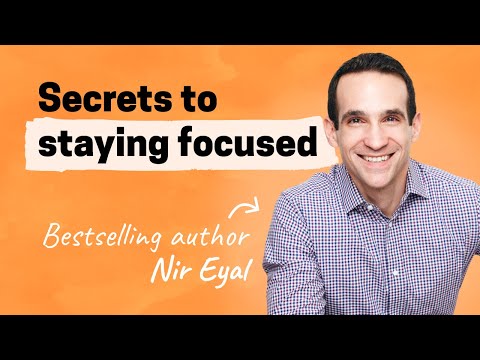
Strategies for becoming less distractible and improving focus | Nir Eyal
Nir Eyal (guest), Lenny Rachitsky (host)
In this episode of Lenny's Podcast, featuring Nir Eyal and Lenny Rachitsky, Strategies for becoming less distractible and improving focus | Nir Eyal explores nir Eyal’s four-step system to master distraction and reclaim focus Nir Eyal explains that distraction is rarely about technology itself and mostly about our inability to handle internal discomfort—boredom, anxiety, and the “cold start” of hard work.
Nir Eyal’s four-step system to master distraction and reclaim focus
Nir Eyal explains that distraction is rarely about technology itself and mostly about our inability to handle internal discomfort—boredom, anxiety, and the “cold start” of hard work.
He reframes distraction versus traction, then lays out a four-part framework: master internal triggers, make time for traction via timeboxing, hack back external triggers, and create pacts as a last line of defense.
The conversation gets very tactical: from the 10‑minute rule, indistractable calendars, Do Not Disturb norms, and “concentration crowns,” to tools like Forest, Focusmate, and wifi timers.
Nir also challenges the popular narrative that we’re universally “addicted” to tech, arguing instead for personal responsibility, identity (“being indistractable”), and cultural norms at home and work that support deep, focused work.
Key Takeaways
Distraction is mostly emotional, not technological.
Around 90% of distractions come from internal triggers like boredom, anxiety, or resistance to hard work—not from external pings. ...
Get the full analysis with uListen AI
Use the traction–distraction model to judge your actions.
Traction is any action you do with intent that moves you toward your values; distraction is anything that pulls you away from what you planned. ...
Get the full analysis with uListen AI
Replace pure to-do lists with a timeboxed calendar.
You can’t call something a distraction if you don’t know what it’s distracting you from. ...
Get the full analysis with uListen AI
Apply the 10-minute rule to surf urges instead of obeying them.
When you feel the pull to check email or social media, set a 10‑minute timer. ...
Get the full analysis with uListen AI
Systematically hack back external triggers at home and work.
Use Do Not Disturb defaults, visible signals (like a ‘concentration crown’ at home or an “I’m indistractable” sign on your monitor), and norms (no Slack after hours, no phones in meetings) so others don’t gain “unauthorized access” to your attention.
Get the full analysis with uListen AI
Use pacts and tools as a last line of defense.
Effort pacts (e. ...
Get the full analysis with uListen AI
Stop labeling everything as ‘addiction’ and reclaim agency.
True addiction affects a small minority; for most people, tech overuse is distraction, not pathology. ...
Get the full analysis with uListen AI
Notable Quotes
“The problem is not our technology. The problem is our inability to deal with discomfort.”
— Nir Eyal
“You can’t call something a distraction unless you know what it distracted you from.”
— Nir Eyal
“The antidote for impulsiveness is forethought.”
— Nir Eyal
“A mistake repeated more than once is a decision.”
— Nir Eyal (quoting Paulo Coelho)
“It’s not that technology is stealing our focus. We are giving it away.”
— Nir Eyal
Questions Answered in This Episode
Which internal triggers (boredom, anxiety, fear of hard thinking) most often drive my distractions, and how could I start surfacing them in the moment?
Nir Eyal explains that distraction is rarely about technology itself and mostly about our inability to handle internal discomfort—boredom, anxiety, and the “cold start” of hard work.
Get the full analysis with uListen AI
If I truly timeboxed my week according to my values, what would change about how I spend my time versus today?
He reframes distraction versus traction, then lays out a four-part framework: master internal triggers, make time for traction via timeboxing, hack back external triggers, and create pacts as a last line of defense.
Get the full analysis with uListen AI
What external triggers in my environment—Slack, email, kids, coworkers—do I need to explicitly “hack back,” and what norms or signals would make that acceptable?
The conversation gets very tactical: from the 10‑minute rule, indistractable calendars, Do Not Disturb norms, and “concentration crowns,” to tools like Forest, Focusmate, and wifi timers.
Get the full analysis with uListen AI
What kind of identity pact (“I am indistractable,” “I’m a non-multitasker”) would help me behave differently day to day?
Nir also challenges the popular narrative that we’re universally “addicted” to tech, arguing instead for personal responsibility, identity (“being indistractable”), and cultural norms at home and work that support deep, focused work.
Get the full analysis with uListen AI
If my team or company is highly distractible, what small experiments could we run—like schedule syncing or no-phone meetings—to move toward an indistractable culture?
Get the full analysis with uListen AI
Transcript Preview
I went to Alibaba and I bought myself one of these flip phones from China, you know, like we used to have in the 1990s with no apps, no internet connection. And then I got myself a word processor off of Ebay so that I, you know, had, I could just sit down and write and do the important stuff. And even when I stopped using all the technology, even when I got rid of all the apps, I would sit down at my desk and I'd say, "Oh, you know what? Um, there's that book that I've been meaning, want to do some research in." Or, "Let me just clean off my desk real quick." Or, "You know what? I should take out the trash." And I kept getting distracted because the problem is not our technology. The problem is our inability to deal with discomfort. So what I have adopted for myself and what I'd advise anyone who finds themselves in this situation, is to always identify what is that internal trigger? What is that itch that you are looking to escape when you get distracted? Because that is the source of 90% of our distractions. It's not the pings, dings, and rings. It's the feelings. But to me that's incredibly empowering because once you realize, wait a minute, it's just a feeling. It's all it is. It's just an emotion. Then you can have tools ready to go. You can have arrows in your quiver ready to take out as soon as you feel that discomfort.
(instrumental music) Today my guest is Nir Eyal. Nir is the author of two bestselling books, Hooked: How to Build Habit-Forming Products and Indistractable: How to Control Your Attention and Choose Your Life. Nir spends his time teaching and consulting at the intersection of psychology, technology, and business. His books have sold over one million copies in over 30 languages. In our conversation, we get very tactical about how to become less distractible and how to get better at focusing on doing the work that you know you need to do. Nir shares at least a dozen tools and tricks that you can put into place today to help you stay focused and avoid getting distracted. After this conversation, I've already implemented some of these tactics and they're actually working. If you find these helpful or you want to go deeper, definitely check out Nir's book, Indistractable. With that, here's Nir Eyal after a short word from our sponsors. This episode is brought to you by Vanta, helping you streamline your security compliance to accelerate your growth. Thousands of fast-growing companies like Gusto, Calm, Quora, and Modern Treasury trust Vanta to help build, scale, manage, and demonstrate their security and compliance programs and get ready for audits in weeks, not months. By offering the most in-demand security and privacy frameworks such as SOC 2, ISO 27001, GDPR, HIPAA, and many more, Vanta helps companies obtain the reports they need to accelerate growth, build efficient compliance processes, mitigate risks to their businesses, and build trust with external stakeholders. Over 5,000 fast-growing companies use Vanta to automate up to 90% of the work involved with SOC 2 and these other frameworks. For a limited time, Lenny's Podcast listeners get $1,000 off Vanta. Go to vanta.com/lenny. That's V-A-N-T-A dot com slash Lenny to learn more and to claim your discounts. Get started today. You fell in love with building products for a reason, but sometimes the day-to-day reality is a little different than you imagined. Instead of dreaming up big ideas, talking to customers and crafting a strategy, you're drowning in spreadsheets and roadmap updates and you're spending your days basically putting out fires. A better way is possible. Introducing Jira Product Discovery, the new prioritization and road mapping tool built for product teams by Atlassian. With Jira Product Discovery, you can gather all your product ideas and insights in one place and prioritize confidently, finally replacing those endless spreadsheets. Create and share custom product roadmaps with any stakeholder in seconds, and it's all built on Jira where your engineering teams are already working, so true collaboration is finally possible. Great products are built by great teams, not just engineers. Sales, support, leadership, even Greg from finance. Anyone that you want can contribute ideas, feedback, and insights in Jira Product Discovery for free. No catch. And it's only $10 a month for you. Say goodbye to your spreadsheets and the never-ending alignment efforts. The old way of doing product management is over. Rediscover what's possible with Jira Product Discovery. Try for free at atlassian.com/lenny. That's atlassian.com/lenny. Nir, thank you so much for being here and welcome to the podcast.
Install uListen to search the full transcript and get AI-powered insights
Get Full TranscriptGet more from every podcast
AI summaries, searchable transcripts, and fact-checking. Free forever.
Add to Chrome