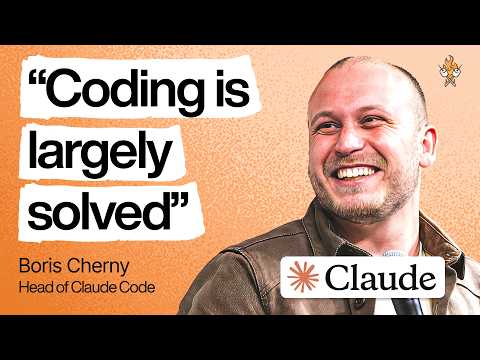
Head of Claude Code: What happens after coding is solved | Boris Cherny
Boris Cherny (guest), Lenny Rachitsky (host), Lenny Rachitsky (host)
In this episode of Lenny's Podcast, featuring Boris Cherny and Lenny Rachitsky, Head of Claude Code: What happens after coding is solved | Boris Cherny explores claude Code’s head explains agentic coding, builders, and safety ahead Boris Cherny says he no longer hand-edits code: Claude Code writes 100% of it, enabling him to ship 10–30 PRs per day while still performing human oversight and using Claude for automated code review.
Claude Code’s head explains agentic coding, builders, and safety ahead
Boris Cherny says he no longer hand-edits code: Claude Code writes 100% of it, enabling him to ship 10–30 PRs per day while still performing human oversight and using Claude for automated code review.
He frames coding as “largely solved” for many real-world stacks and argues the next frontier is agentic work: AI that uses tools, acts in systems, and increasingly suggests what to build by mining feedback, bug reports, and telemetry.
The conversation covers how Claude Code emerged from lightweight prototyping, why the terminal form factor worked early, and how “latent demand” (users misusing a tool in revealing ways) shaped both Claude Code and Cowork.
Cherny also emphasizes safety as Anthropic’s core mission, describing a layered approach (interpretability, evals, and real-world behavior) and advocating for a “race to the top” via open-sourcing safety infrastructure like sandboxes.
Key Takeaways
AI coding is shifting engineers from typing code to directing agents.
Cherny reports Claude Code writes all his code and he hasn’t hand-edited since November, but he still reviews outputs and relies on checkpoints like AI + human review—suggesting the core skill becomes specifying goals, validating results, and managing throughput.
Get the full analysis with uListen AI
The next leap is AI proposing work, not just executing it.
Claude increasingly generates fix/feature ideas by scanning Slack feedback channels, bug reports, and telemetry, then offering PRs—moving from “assistant” toward “coworker” that helps decide priorities.
Get the full analysis with uListen AI
Speed comes from under-resourcing and forcing “clodification.”
He argues that small teams (or even one engineer) move faster because they’re compelled to automate via Claude rather than coordinate; the constraint drives creative delegation to agents instead of adding headcount.
Get the full analysis with uListen AI
Don’t optimize token spend too early—maximize experimentation first.
Cherny advises giving engineers “as many tokens as possible” initially because the cost is small relative to salary at exploratory scale; optimization (cheaper models, tighter loops) should come after an idea proves valuable.
Get the full analysis with uListen AI
Build products around what users and the model are already trying to do (latent demand).
Claude Code and Cowork both emerged from observing “misuse”—developers using a terminal agent for non-coding tasks (tomato growing, corrupted photo recovery, MRI analysis). ...
Get the full analysis with uListen AI
Avoid boxing the model in; give tools + goals, not rigid workflows.
He cautions against heavy orchestration (“step 1, step 2, step 3”) and excessive upfront context. ...
Get the full analysis with uListen AI
“Software engineer” may blur into a broader ‘builder’ role.
Cherny predicts rising role overlap—PMs, designers, finance, and data science all coding with agents—leading to titles converging as everyone both specifies product intent and ships implementation.
Get the full analysis with uListen AI
Notable Quotes
“A hundred percent of my code is written by Claude Code. I have not edited a single line by hand since November.”
— Boris Cherny
“Productivity per engineer has increased two hundred percent.”
— Boris Cherny
“Coding is largely solved.”
— Boris Cherny
“By the end of the year... the title software engineer is gonna start to go away. It’s just gonna be replaced by builder.”
— Boris Cherny
“The product is the model. We wanna expose it... give it the minimal set of tools, so it can decide which tools to run.”
— Boris Cherny
Questions Answered in This Episode
When you say “coding is largely solved,” which categories of work still break down (legacy monoliths, safety-critical systems, performance tuning, regulated environments)?
Boris Cherny says he no longer hand-edits code: Claude Code writes 100% of it, enabling him to ship 10–30 PRs per day while still performing human oversight and using Claude for automated code review.
Get the full analysis with uListen AI
What’s your internal rubric for deciding when Claude’s “plan mode” output is good enough to auto-accept edits without step-by-step supervision?
He frames coding as “largely solved” for many real-world stacks and argues the next frontier is agentic work: AI that uses tools, acts in systems, and increasingly suggests what to build by mining feedback, bug reports, and telemetry.
Get the full analysis with uListen AI
You noted Claude reviews 100% of PRs at Anthropic—what kinds of issues does AI review catch well vs. miss, and how has human review changed?
The conversation covers how Claude Code emerged from lightweight prototyping, why the terminal form factor worked early, and how “latent demand” (users misusing a tool in revealing ways) shaped both Claude Code and Cowork.
Get the full analysis with uListen AI
How do you prevent “fast PR spam” (10–30/day) from degrading system coherence, architecture, or long-term maintainability?
Cherny also emphasizes safety as Anthropic’s core mission, describing a layered approach (interpretability, evals, and real-world behavior) and advocating for a “race to the top” via open-sourcing safety infrastructure like sandboxes.
Get the full analysis with uListen AI
Cowork ships a VM and guardrails—what are the top failure modes you’ve observed in the wild (wrong clicks, irreversible actions, credential mishandling), and how do you mitigate them?
Get the full analysis with uListen AI
Transcript Preview
A hundred percent of my code is written by Claude Code. I have not edited a single line by hand since November. Every day, I ship ten, twenty, thirty pull requests. So, like, at the moment, I have, like, five agents running.
While we're recording this?
Yeah, yeah, yeah.
Do you miss writing code?
I have never enjoyed coding as much as I do today, because I don't have to deal with all the minutiae. Productivity per engineer has increased two hundred percent. There's always this question: Should I learn to code? In a year or two, it's not gonna matter. Coding is largely solved. I imagine a world where everyone is able to program. Anyone can just build software anytime.
What's the next big shift to how software is written?
Claude is starting to come up with ideas. It's looking through feedback, it's looking at bug reports, it's looking at telemetry for bug fixes and things to ship. A little more like a coworker or something like that.
A lot of people listening to this are product managers, and [chuckles] they're probably sweating.
I think by the end of the year, everyone's gonna be a product manager, and everyone codes. The title software engineer is gonna start to go away. It's just gonna be replaced by builder, and it's gonna be painful for a lot of people.
[gentle music] Today, my guest is Boris Cherny, head of Claude Code at Anthropic. It is hard to describe the impact that Claude Code has had on the world. Around the time this episode comes out will be the one-year anniversary of Claude Code, and in that short time, it has completely transformed the job of a software engineer, and it is now starting to transform the jobs of many other functions in tech, which we talk about. Claude Code itself is also a massive driver of Anthropic's overall growth over the past year. They just raised a round at over three hundred and fifty billion dollars, and as Boris mentions, the growth of Claude Code itself is still accelerating. Just in the past month, their daily active users has doubled. Boris is also just a really interesting, thoughtful, deep-thinking human, and during this conversation, we discover we were born in the same city in Ukraine. That is so funny. I had no idea. A huge thank you to Ben Mann, Jenny Wen, and Mike Krieger for suggesting topics for this conversation. Don't forget to check out lennysproductpass.com for an incredible set of deals available exclusively to Lenny's Newsletter subscribers. Let's get into it after a short word from our wonderful sponsors. Today's episode is brought to you by DX, the developer intelligence platform designed by leading researchers. To thrive in the AI era, organizations need to adapt quickly, but many organization leaders struggle to answer pressing questions like: Which tools are working? How are they being used? What's actually driving value? DX provides the data and insights that leaders need to navigate this shift. With DX, companies like Dropbox, Booking.com, Adyen, and Intercom get a deep understanding of how AI is providing value to their developers and what impact AI is having on engineering productivity. To learn more, visit DX's website at getdx.com/lenny. That's getdx.com/lenny. Applications break in all kinds of ways: crashes, slowdowns, regressions, and the stuff that you only see once real users show up. Sentry catches it all. See what happened, where, and why, down to the commit that introduced the error, the developer who shipped it, and the exact line of code all in one connected view. I've definitely tried the five tabs and Slack thread approach to debugging. This is better. Sentry shows you how the request moved, what ran, what slowed down, and what users saw. Seer, Sentry's AI debugging agent, takes it from there. It uses all of that Sentry context to tell you the root cause, suggest a fix, and even opens a PR for you. It also reviews your PRs and flags any breaking changes with fixes ready to go. Try Sentry and Seer for free at sentry.io/lenny, and use code Lenny for one hundred dollars in Sentry credits. That's S-E-N-T-R-Y.io/lenny. [gentle music] Boris, thank you so much for being here, and welcome to the podcast.
Install uListen to search the full transcript and get AI-powered insights
Get Full TranscriptGet more from every podcast
AI summaries, searchable transcripts, and fact-checking. Free forever.
Add to Chrome