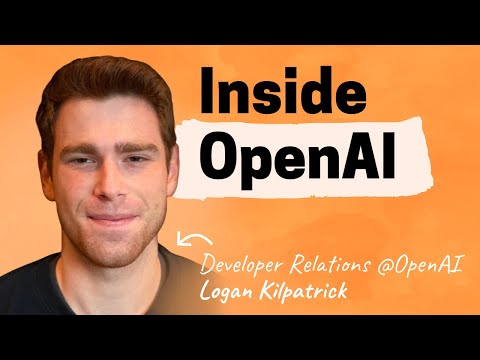
Inside OpenAI | Logan Kilpatrick (head of developer relations)
Logan Kilpatrick (guest), Lenny Rachitsky (host)
In this episode of Lenny's Podcast, featuring Logan Kilpatrick and Lenny Rachitsky, Inside OpenAI | Logan Kilpatrick (head of developer relations) explores inside OpenAI: Culture, GPTs, and the Future of AI Products Logan Kilpatrick, head of developer relations at OpenAI, discusses OpenAI’s internal culture, how they ship products quickly, and what they look for in new hires. He explains how developers and companies are using ChatGPT, GPTs, and the API today, and where he sees the biggest opportunities for new products. The conversation dives into prompt engineering best practices, new multimodal and agent-like interfaces, and where OpenAI will focus versus where startups should build. Logan also reflects on the Sam Altman board crisis, why it ultimately strengthened the company, and how OpenAI thinks about planning, metrics, and the path toward AGI.
Inside OpenAI: Culture, GPTs, and the Future of AI Products
Logan Kilpatrick, head of developer relations at OpenAI, discusses OpenAI’s internal culture, how they ship products quickly, and what they look for in new hires. He explains how developers and companies are using ChatGPT, GPTs, and the API today, and where he sees the biggest opportunities for new products. The conversation dives into prompt engineering best practices, new multimodal and agent-like interfaces, and where OpenAI will focus versus where startups should build. Logan also reflects on the Sam Altman board crisis, why it ultimately strengthened the company, and how OpenAI thinks about planning, metrics, and the path toward AGI.
Key Takeaways
Hire for high agency and urgency to move exceptionally fast.
OpenAI’s speed comes less from process and more from people who see a problem, don’t wait for consensus, and immediately start building solutions based on customer feedback.
Get the full analysis with uListen AI
Build on specific, vertical use cases rather than generic AI assistants.
OpenAI intends to own the broad, general-purpose assistant space (e. ...
Get the full analysis with uListen AI
Context is the single biggest lever in prompt engineering.
Models default to generic answers because they have no prior about you or your goal; providing detailed context, links, and constraints dramatically improves output quality, especially for nuanced tasks.
Get the full analysis with uListen AI
Use GPTs to encode company- or role-specific workflows and knowledge.
Organizations are already building internal GPTs for ad generation, experiment analysis, planning, and OKRs, turning generic ChatGPT into tailored, domain-aware tools that reduce load on marketers, data scientists, and managers.
Get the full analysis with uListen AI
Think beyond chat—new AI interfaces will be a major advantage.
Infinite canvases, dedicated creative tools, hardware devices (like Rabbit R1), and embedded agent experiences will outperform plain chat UIs for many workflows, giving product teams a powerful differentiation axis.
Get the full analysis with uListen AI
Plan for future, stronger models but don’t expect magic.
GPT-5 will be a more capable, faster tool, not a science-fiction AGI doing “backflips and life management”; builders should assume better reasoning and reliability, but understand that real-world problems still require product and domain insight.
Get the full analysis with uListen AI
Embeddings plus your own data are crucial for grounded, reliable AI.
OpenAI’s improved, cheaper, multilingual embeddings make it easier to power “ask me anything about X” experiences (like LennyBot) that reference a trusted corpus instead of relying on free-form model hallucination.
Get the full analysis with uListen AI
Notable Quotes
“Finding people who are high agency and work with urgency is like one of the most important things.”
— Logan Kilpatrick
“Context is all you need. Context is the only thing that matters.”
— Logan Kilpatrick
“If you're going to try to build the next general assistant to compete with ChatGPT, it has to be so radically different.”
— Logan Kilpatrick
“It's not AI that's going to replace humans, it's humans using AI tools who are going to be more competitive.”
— Logan Kilpatrick
“GPT-5 is surely going to be extremely useful… but fundamentally, the same problems that exist in the world are still going to be the same problems.”
— Logan Kilpatrick
Questions Answered in This Episode
How should a startup rigorously decide whether to build a vertical AI product versus relying on OpenAI’s evolving general-purpose tools?
Logan Kilpatrick, head of developer relations at OpenAI, discusses OpenAI’s internal culture, how they ship products quickly, and what they look for in new hires. ...
Get the full analysis with uListen AI
What internal mechanisms does OpenAI use to prevent high-agency culture from turning into chaos or misalignment as the company scales?
Get the full analysis with uListen AI
How will GPTs and agent-like capabilities change knowledge work in concrete ways over the next 2–3 years inside typical companies?
Get the full analysis with uListen AI
What empirical research on prompt engineering has surprised OpenAI the most, and how might that change how we design user interfaces for AI?
Get the full analysis with uListen AI
As models get stronger and cheaper, which current moats for AI-native startups (data, UX, distribution, integrations) will matter most and which will erode first?
Get the full analysis with uListen AI
Transcript Preview
Finding people who are high agency and work with urgency. If I was hiring five people today, like those are, like some of the top two characteristics that I would look for in people. Because you can take on the world if you have people who have high agency. And like, not needing to get 50 people's different consensus, they hear something from our customers about a challenge that they're having and like, they're already pushing on what the solution for them is and not waiting for all the other things to happen. That like, people just go and do it and solve the problem and I love that. It's so fun to be able to, to be a part of those situations.
(instrumental music) Today my guest is Logan Kilpatrick. Logan is head of developer relations at OpenAI where he supports developers building on OpenAI's APIs and ChatGPT. Before OpenAI, Logan was a machine learning engineer at Apple and advised NASA on their open source policy. If you can believe it, ChatGPT launched just over a year ago and transformed the way that we think about AI and what it means for our products and our lives. Logan has been at the front lines of this change and every day, is helping developers and companies figure out how to leverage these new AI superpowers. In our conversation, we dig into examples of how people are using ChatGPT and the new GPTs and other OpenAI APIs in their work and their life, Logan shares some really interesting advice on how to get better at prompt engineering. We also get into how OpenAI operates internally, how they ship so quickly, and the two key attributes they look for in the people that they hire, plus where Logan sees the biggest opportunities for new products and new startups building on their APIs. We also get a little bit into the very dramatic weekend that OpenAI had with the board and Sam Altman and all of that, and so much more. A huge thank you to Dan Schipper and Dennis Yang for some great question suggestions. With that, I bring you Logan Kilpatrick after a short word from our sponsors. This episode is brought to you by Hex. If you're a data person, you probably have to jump between different tools to run queries, build visualizations, write Python, and send around a lot of screenshots and CSV files. Hex brings everything together. Its powerful notebook UI lets you analyze data in SQL, Python, or no code, in any combination, and work together with live multiplayer and version control. And now, Hex's AI tools can generate queries and code, create visualizations, and even kickstart a whole analysis for you, all from natural language prompts. It's like having an analytics copilot built right into where you're already doing your work. Then when you're ready to share, you can use Hex's drag and drop app builder to configure beautiful reports or dashboards that anyone can use. Join the hundreds of data teams like Notion, AllTrails, Loom, Mixpanel, and Algolia using Hex every day to make their work more impactful. Sign up today at hex.tech/lenny to get a 60-day free trial of the Hex team plan. That's hex.tech/lenny. This episode is brought to you by Whimsical, the iterative product workspace. Whimsical helps product managers build clarity and shared understanding faster with tools designed for solving product challenges. With Whimsical, you can easily explore new concepts using drag and drop wireframe and diagram components, create rich product briefs that show and sell your thinking, and keep your team aligned with one source of truth for all of your build requirements. Whimsical also has a library of easy-to-use templates from product leaders like myself, including a project proposal one-pager and a go-to-market worksheet. Give them a try and see how fast and easy it is to build clarity with Whimsical. Sign up at whimsical.com/lenny for 20% off a Whimsical pro plan. That's whimsical.com/lenny. Logan, thank you so much for being here and welcome to the podcast.
Install uListen to search the full transcript and get AI-powered insights
Get Full TranscriptGet more from every podcast
AI summaries, searchable transcripts, and fact-checking. Free forever.
Add to Chrome