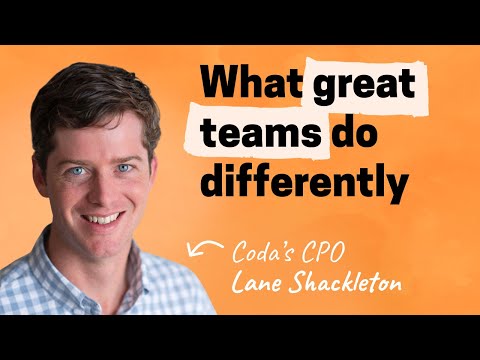
What sets great teams apart | Lane Shackleton (CPO of Coda)
Lane Shackleton (guest), Lenny Rachitsky (host)
In this episode of Lenny's Podcast, featuring Lane Shackleton and Lenny Rachitsky, What sets great teams apart | Lane Shackleton (CPO of Coda) explores lane Shackleton Reveals Principles and Rituals Behind Exceptional Product Teams Lane Shackleton, CPO of Coda and former YouTube PM, shares the principles and operating rituals he believes set great product managers and product teams apart. He frames the core PM job as turning ambiguity into clarity, then walks through concrete principles like focusing on systems over goals, building cathedrals not bricks, learning by making, and actively seeking “oh-shit” stretch moments.
Lane Shackleton Reveals Principles and Rituals Behind Exceptional Product Teams
Lane Shackleton, CPO of Coda and former YouTube PM, shares the principles and operating rituals he believes set great product managers and product teams apart. He frames the core PM job as turning ambiguity into clarity, then walks through concrete principles like focusing on systems over goals, building cathedrals not bricks, learning by making, and actively seeking “oh-shit” stretch moments.
Lane also details how Coda structures career ladders, compensation, and review rituals (like Catalyst, tag-ups, and two-way write-ups) to keep teams aligned, fast, and customer-centric while minimizing politics. He draws heavily on lessons from outside tech—mountain guiding, sports, storytelling, and Stoicism—and from his early career in support and ad review at Google.
Throughout, he emphasizes practical, repeatable behaviors: default-on customer contact, lightweight but robust planning, clear decision-making frameworks, and deliberate calibration of feedback and involvement. The conversation becomes a playbook for anyone wanting to design better product cultures, accelerate their growth, and run more effective teams.
Key Takeaways
The core PM job is turning ambiguity into clarity, not just shipping features.
Lane defines product work as constantly spotting ambiguous questions (role, problem, customer, solution) and systematically making them clear, then uses principles and rituals to make this a repeatable team habit.
Get the full analysis with uListen AI
Focus on systems, not just goals, to build durable product instincts.
Rather than sporadic OKRs like “talk to 10 customers this quarter,” great teams create default-on systems (e. ...
Get the full analysis with uListen AI
Teams need a vivid cathedral, not just a task list of bricks.
Performance and motivation improve when people see the bigger arc of their work—Lane advocates over-communicating vision through narratives, metrics, mocks, and artifacts so everyone can see their own facet of the cathedral.
Get the full analysis with uListen AI
You grow fastest by seeking “oh-shit” stretch moments and running toward obstacles.
Lane suggests tracking how many times in the last 6–24 months you felt underqualified or uncomfortable; if it’s been a while, you may be stagnating and should pursue harder challenges or different roles.
Get the full analysis with uListen AI
Learn by making, not talking—prototype and test extremes instead of debating endlessly.
The YouTube skippable ads story shows that directional experiments (e. ...
Get the full analysis with uListen AI
Rituals like Catalyst, tag-ups, and two-way write-ups dramatically increase decision velocity.
Coda replaces standing, single-threaded reviews with modular sessions (Catalyst), small-group weekly “group 1:1s” (tag-ups), and docs that integrate questions, sentiment, and discussion, enabling more inclusive and faster decisions.
Get the full analysis with uListen AI
Calibrating feedback and involvement prevents organizational drag.
Frameworks like Dharmesh Shah’s flash tags (FYI → plea), $100 voting, and explicit sentiment polls let teams distinguish strong conviction from casual opinions, reduce overreaction to every comment, and keep plans moving.
Get the full analysis with uListen AI
Notable Quotes
“The core job of a product person is to turn ambiguity into clarity.”
— Lane Shackleton
“Instead of being obsessed with the goal, be obsessed with the system that gets you there.”
— Lane Shackleton
“You want your teams to feel like they’re building a cathedral, not laying bricks.”
— Lane Shackleton
“Moments that stretch you or make you think ‘oh shit, I shouldn’t be here’—those are the moments you should be seeking out.”
— Lane Shackleton
“Stop talking about it and go make something—run an experiment, build a prototype, write a doc.”
— Lane Shackleton
Questions Answered in This Episode
How could I redesign my team’s weekly rituals (reviews, standups, planning) to embody the principles of systems over goals and cathedrals over bricks?
Lane Shackleton, CPO of Coda and former YouTube PM, shares the principles and operating rituals he believes set great product managers and product teams apart. ...
Get the full analysis with uListen AI
What are the most impactful “oh-shit” moments in my own career, and what does it say if I haven’t had one in a long time?
Lane also details how Coda structures career ladders, compensation, and review rituals (like Catalyst, tag-ups, and two-way write-ups) to keep teams aligned, fast, and customer-centric while minimizing politics. ...
Get the full analysis with uListen AI
Which version of two-way write-ups—or equivalent tooling—could I adopt to replace slide-based meetings and scattered comment threads?
Throughout, he emphasizes practical, repeatable behaviors: default-on customer contact, lightweight but robust planning, clear decision-making frameworks, and deliberate calibration of feedback and involvement. ...
Get the full analysis with uListen AI
How might I implement Dharmesh Shah’s flash tags or $100 voting in my own org to better calibrate feedback and avoid overreacting to every opinion?
Get the full analysis with uListen AI
If my current role vanished tomorrow, what customer-facing skills and deep customer understanding would still make me valuable as a product leader?
Get the full analysis with uListen AI
Transcript Preview
... moments that stretch you or moments that you feel uncomfortable in, or you find yourself saying like, "Oh, shit," you know, "I shouldn't be here. I'm underqualified to be here," those are the moments you should be seeking out, right? Like those are the moments that stretch you and give you sort of like a new, uh, foundation. So oftentimes, you know, you'll hear like a career question like, "All right. Do you feel like you're growing in your role?" And that's like a very ambiguous, in my opinion, way to ask this question. A much sharper way is like, "Hey, how many like oh-shit moments have you had in the last like six months, year, two years, and what are they?" I think if you ask yourself that question and the answer is, "It's been a really long time since I've been like stretched in some meaningful way," or, "I've felt like I- I'm underqualified to be there," then it may be worth kind of like digging into.
(instrumental music) Welcome to Lenny's Podcast, where I interview world-class product leaders and growth experts to learn from their hard-won experiences building and growing today's most successful products. Today my guest is Lane Shackleton. Lane is chief product officer at Coda, where he is held the role for over eight years. Before that, he was group product manager at YouTube, a product specialist at Google, and as you'll hear, he started his career as an Alaskan mountain guide and then as a manual reviewer of Google AdWords ads. Lane is an incredibly deep thinker, very first-principles oriented, and has built an incredible product team and culture at Coda. In part, he's done that by studying the principles and rituals of great product leaders and great product teams. In our conversation, Lane shares what he's learned and what he's found great PMs and great teams do differently. He shares a bunch of his favorite rituals and principles, how you can implement them on your own team, plus a really clever and unique way of understanding if you're making progress in your career, plus so much more. I could talk to Lane for hours, but we try to keep this to under an hour and a half. With that, I bring you Lane Shackleton after a short word from our sponsors. This episode is brought to you by Eppo. Eppo is a next-generation A/B testing platform built by Airbnb alums from modern growth teams. Companies like DraftKings, Zapier, ClickUp, Twitch, and Cameo rely on Eppo to power their experiments. Wherever you work, running experiments is increasingly essential, but there are no commercial tools that integrate with a modern growth team stack. This leads to wasted time building internal tools or trying to run your own experiments through a clunky marketing tool. When I was at Airbnb, one of the things that I loved most about working there was our experimentation platform, where I was able to slice and dice data by device types, country, user stage. Eppo does all that and more, delivering results quickly, avoiding annoying prolonged analytic cycles and helping you easily get to the root cause of any issue you discover. Eppo lets you go beyond basic click-through metrics and instead use your North Star metrics like activation, retention, subscription, and payments. Eppo supports tests on the front end, on the back end, email marketing, even machine learning claims. Check out Eppo at geteppo.com. That's geteppo.com and 10X your experiment velocity. This episode is brought to you by Vanta, helping you streamline your security compliance to accelerate your growth. Thousands of fast-growing companies like Gusto, Calm, Quora, and Modern Treasury trust Vanta to help build, scale, manage, and demonstrate their security and compliance programs and get ready for audits in weeks, not months. By offering the most in-demand security and privacy frameworks such as SOC 2, ISO 27001, GDPR, HIPAA, and many more, Vanta helps companies obtain the reports they need to accelerate growth, build efficient compliance processes, mitigate risks to their businesses, and build trust with external stakeholders. Over 5,000 fast-growing companies use Vanta to automate up to 90% of the work involved with SOC 2 and these other frameworks. For a limited time, Lenny's Podcast listeners get $1,000 off Vanta. Go to vanta.com/lenny. That's V-A-N-T-a.com/lenny to learn more and to claim your discounts. Get started today. (instrumental music) Lane, thank you so much for being here. Welcome to the podcast.
Install uListen to search the full transcript and get AI-powered insights
Get Full TranscriptGet more from every podcast
AI summaries, searchable transcripts, and fact-checking. Free forever.
Add to Chrome