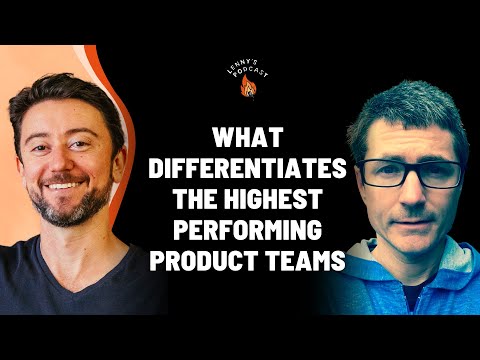
What differentiates the highest-performing product teams | John Cutler (The Beautiful Mess)
John Cutler (guest), Lenny Rachitsky (host)
In this episode of Lenny's Podcast, featuring John Cutler and Lenny Rachitsky, What differentiates the highest-performing product teams | John Cutler (The Beautiful Mess) explores inside High-Performing Product Teams: Complexity, Culture, and Coherence Lenny interviews product thinker John Cutler about lessons from his unique four-year role at Amplitude, where he coached hundreds of product teams worldwide. Cutler shares what truly differentiates high-performing teams: coherence between strategy and structure, strong beliefs in product, and context-aware practices rather than copy‑pasted frameworks. He stresses that underperforming teams tend to fail in similar, predictable ways while high performers succeed through many different, often contradictory, approaches. The conversation also explores how to adapt Silicon Valley-style advice in larger or more traditional organizations, the limits of “product mindset” as a concept, and how PMs can make progress even in imperfect environments.
Inside High-Performing Product Teams: Complexity, Culture, and Coherence
Lenny interviews product thinker John Cutler about lessons from his unique four-year role at Amplitude, where he coached hundreds of product teams worldwide. Cutler shares what truly differentiates high-performing teams: coherence between strategy and structure, strong beliefs in product, and context-aware practices rather than copy‑pasted frameworks. He stresses that underperforming teams tend to fail in similar, predictable ways while high performers succeed through many different, often contradictory, approaches. The conversation also explores how to adapt Silicon Valley-style advice in larger or more traditional organizations, the limits of “product mindset” as a concept, and how PMs can make progress even in imperfect environments.
Key Takeaways
High-performing teams are coherent, not uniform.
Cutler finds that while failing teams tend to share the same anti-patterns, successful teams look very different from one another. ...
Get the full analysis with uListen AI
Strong beliefs, loosely held, underpin great product organizations.
Top teams have stubborn core beliefs—such as the long-term power of product quality or customer closeness—balanced with a genuine willingness to change tactics when new information emerges.
Get the full analysis with uListen AI
Frameworks are job aids, not end goals.
Many companies, especially large transforming ones, mistakenly treat adopting frameworks (e. ...
Get the full analysis with uListen AI
Context-free Silicon Valley advice can be harmful if copied blindly.
Most PM content assumes a fast-moving, digital, growth-stage startup context, which doesn’t match reality for many teams. ...
Get the full analysis with uListen AI
You can still get ‘learning loops’ in dysfunctional environments.
Even in top-down or waterfall organizations, individuals can document assumptions, clarify success metrics with executives, and run small learning cycles. ...
Get the full analysis with uListen AI
‘Product sense’ should be unpacked into teachable skills.
Rather than mystifying product sense or mindset, Cutler advocates breaking it into components like systems thinking, decision-making under uncertainty, facilitation, and modeling problems—skills that can be learned, practiced, and coached.
Get the full analysis with uListen AI
Diverse worldviews and cultures fundamentally change how product work looks.
Working globally, Cutler sees stark differences between individualistic, meritocracy-focused cultures and collectivist, consensus-oriented ones. ...
Get the full analysis with uListen AI
Notable Quotes
“The dysfunctional companies are all the same, and the happy companies can be very, very different.”
— John Cutler (citing Josh Arnold’s ‘Reverse Anna Karenina’ principle)
“You work in complex adaptive systems. You don’t work in closed systems.”
— John Cutler
“Strategy and structure have to be coherent. You can hire brilliant teams and still fail if your strategy–structure mismatch is huge.”
— John Cutler
“Frameworks should be job aids for thinking and learning, not things you install and declare victory.”
— John Cutler
“Don’t throw up your hands and say, ‘My company is messed up.’ Work with what you’ve got and get your reps in.”
— John Cutler
Questions Answered in This Episode
How do I assess whether my team’s strategy, structure, and incentives are actually coherent—or fundamentally at odds?
Lenny interviews product thinker John Cutler about lessons from his unique four-year role at Amplitude, where he coached hundreds of product teams worldwide. ...
Get the full analysis with uListen AI
Which parts of the ‘modern product’ playbook (empowered teams, OKRs, discovery practices, etc.) are realistic to adapt in a legacy or heavily regulated organization?
Get the full analysis with uListen AI
If ‘product sense’ is a bundle of skills, which ones am I weakest in, and how can I deliberately practice them in my current role?
Get the full analysis with uListen AI
What small, low-risk learning loops could my team run within our current constraints to start shifting away from a pure ‘feature factory’ mode?
Get the full analysis with uListen AI
How do my own cultural assumptions about meritocracy, ownership, and leadership shape the way I interpret product advice and lead my team?
Get the full analysis with uListen AI
Transcript Preview
Let's say you're a founder and you're trying to decide, "Should I invest more on processes or should I invest more on people?" The first thing is introspection. What do you believe in, really? What do you believe in and what do the people around you believe in? And how can you be a coherent leader? And you know what? You can't... You can nudge yourself a little bit away from your happy place, but you're not gonna go super far. You're not gonna go from, like, a process-driven, meritocratic XYZ person all the way to like a, "I'm going to start a collectivist company where everything is sort of a consensus decision to do" that. You're not gonna do that. But, like, I think it starts with self-awareness and then that's like, that's how people form their authentic leadership vibe, and then they flex a little bit and then they embrace other perspectives.
(Instrumental music) Welcome to Lenny's Podcast. I'm Lenny, and my goal here is to help you get better at the craft of building and growing products. I interview world-class product leaders and growth experts to learn from their hard-won experiences building and scaling today's most successful companies. Today my guest is Jon Cutler. Jon is one of the most prolific, beloved and longtime writers and sharers of product wisdom online. And as you'll hear at the start of this episode, thanks to his really unique role at Amplitude, he's worked with a large percentage of product teams and product managers around the world. I've learned a lot from Jon's writings over the years and share his stuff often, and so it was a real honor to chat in-depth with Jon. I anticipated this would happen, and it happened. This ended up being the longest episode I've done yet and honestly we could have kept going for a lot longer. We chat about what differentiates the highest performing product teams from less well-performing product teams, what it takes to create real change within a company, why you should be skeptical of frameworks and tools that you read about online, why all underperforming teams fail in similar ways but high performing teams succeed in many different ways, and so much more. I am confident you will love this episode and I cannot wait for you to hear it. With that I bring you Jon Cutler after a short word from our wonderful sponsors. This episode is brought to you by Merge. Every product manager knows the pain of slowing product velocity when developers struggle to build and maintain integrations with other platforms. Merge's unified API can remove this blocker from your roadmap. With one API, your team can add over 150 HR, ATS, accounting, ticketing and CRM integrations right into your product. You can get your first integration into production in a matter of days and save countless weeks building custom integrations, letting you get back to building your core product. Merge's integrations speed up the product development process for companies like Ramp, Drata, and many other fast-growing and established companies, allowing them to test their features at scale without having to worry about a never-ending integrations roadmap. Save your engineers countless hours and expedite your sales cycle by making integration offerings your competitive advantage with Merge. Visit merge.dev/lenny to get started and integrate up to five customers for free. This episode is brought to you by Eppo. Eppo is a next generation A/B testing platform built by Airbnb alums for modern growth teams. Companies like Netlify, Contentful and Cameo rely on Eppo to power their experiments. Wherever you work, running experiments is increasingly essential, but there are no commercial tools that integrate with a modern growth team stack. This leads to wasted time building internal tools or trying to run your experiments through a clunky marketing tool. When I was at Airbnb, one of the things that I loved about our experimentation platform was being able to easily slice results by device, by country and by user stage. Eppo does all that and more, delivering results quickly, avoiding annoying prolonged analytic cycles, and helping you easily get to the root cause of any issue you discover. Eppo lets you go beyond basic click-through metrics and instead use your North Star metrics like activation, retention, subscriptions and payments. And Eppo supports tests on the front end, the back end, email marketing and even machine learning clients. Check out Eppo at GetEppo.com, GetE-P-P-O.com, and 10X your experiment velocity. Jon Cutler, welcome to the podcast.
Install uListen to search the full transcript and get AI-powered insights
Get Full TranscriptGet more from every podcast
AI summaries, searchable transcripts, and fact-checking. Free forever.
Add to Chrome