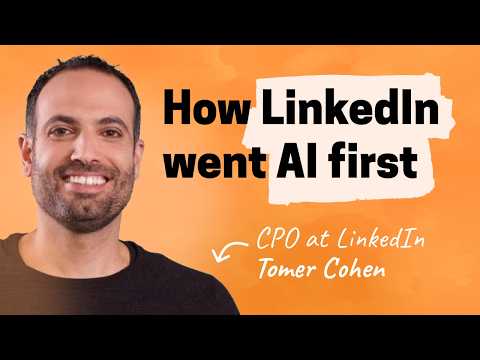
How LinkedIn became interesting: The inside story | Tomer Cohen (CPO at LinkedIn)
Lenny Rachitsky (host), Tomer Cohen (guest)
In this episode of Lenny's Podcast, featuring Lenny Rachitsky and Tomer Cohen, How LinkedIn became interesting: The inside story | Tomer Cohen (CPO at LinkedIn) explores inside LinkedIn’s Transformation: AI-First Strategy, Feed Revival, Career Lessons LinkedIn’s CPO Tomer Cohen explains how the company transformed its previously cringey, promotional feed into a high-signal, knowledge-sharing destination that many professionals now check multiple times a day.
Inside LinkedIn’s Transformation: AI-First Strategy, Feed Revival, Career Lessons
LinkedIn’s CPO Tomer Cohen explains how the company transformed its previously cringey, promotional feed into a high-signal, knowledge-sharing destination that many professionals now check multiple times a day.
He details the strategic shift to an AI-first mindset—treating AI as the core “matchmaker” in LinkedIn’s marketplaces and putting product leaders, not just engineers, in charge of algorithm objectives, data, and infrastructure.
Cohen shares the product and org tactics behind LinkedIn’s feed turnaround, including carving out a 2M-user sandbox, redefining success metrics, and aggressively focusing on professional relevance over raw engagement.
He also reflects on the mindset that fueled his rapid rise at LinkedIn: valuing clarity over being right, setting audacious product “mountain peaks,” and choosing roles based on conviction and impact rather than prestige.
Key Takeaways
Prioritize clarity over correctness to unlock decisive execution.
Cohen’s mantra, “We might be wrong, but we’re not confused,” pushes teams to align on a clear problem, a sharp opinionated solution, and explicit tradeoffs—then execute fully in one direction instead of hedging and stalling.
Get the full analysis with uListen AI
Treat AI as the product’s steering wheel, not a black-box add-on.
At LinkedIn, product leaders are expected to own algorithm objectives, features, data collection, fine-tuning, and even infrastructure choices, recognizing AI as the core matchmaker that drives value in every marketplace.
Get the full analysis with uListen AI
For turnarounds, carve out a protected sandbox to prove a new reality.
To reinvent the feed without destabilizing company-wide metrics, LinkedIn isolated 2 million members, ran bold AI-driven changes there, and used the dramatic behavior shifts in that cohort to justify rolling the new model out broadly.
Get the full analysis with uListen AI
Start from the product’s full potential, not today’s metrics.
Cohen sets ambitious “mountain peak” visions (e. ...
Get the full analysis with uListen AI
Design AI initiatives around existing goals, not novelty.
When the new wave of LLMs hit, LinkedIn asked every team to drop their roadmaps, restate their core objectives, and then reimagine better solutions with AI—avoiding random “AI features” that don’t solve real problems.
Get the full analysis with uListen AI
Impactful product careers are built on conviction and craft, not prestige.
Cohen attributes his growth from senior PM to CPO to choosing problems he deeply believed in (mobile, feed, ads, AI), obsessing over outcomes, and measuring his work by product impact rather than titles or brand logos.
Get the full analysis with uListen AI
Optimize for the right audience seeing the right content, not volume.
LinkedIn deliberately trades off “bad engagement,” tuning its feed to prioritize meaningful professional interactions—like the right executives seeing a post or a professor landing advisory roles—over pure clicks or time spent.
Get the full analysis with uListen AI
Notable Quotes
“We might be wrong, but we’re not confused.”
— Tomer Cohen
“I don’t start building from the numbers today. I start from what this could be.”
— Tomer Cohen
“AI is the ultimate matchmaker. It’s underutilized, it’s misunderstood.”
— Tomer Cohen
“Let go of what you’ve built. Go back to the objectives you were trying to solve. And now with this technology, how can you do that objective better?”
— Tomer Cohen
“Becoming is better than being.”
— Tomer Cohen (referencing a growth mindset motto)
Questions Answered in This Episode
How can smaller startups replicate LinkedIn’s ‘2 million user carve-out’ strategy at their own scale to safely test bold product changes?
LinkedIn’s CPO Tomer Cohen explains how the company transformed its previously cringey, promotional feed into a high-signal, knowledge-sharing destination that many professionals now check multiple times a day.
Get the full analysis with uListen AI
What concrete steps should a PM take in the next 30 days to become truly ‘AI-first’ in their current role?
He details the strategic shift to an AI-first mindset—treating AI as the core “matchmaker” in LinkedIn’s marketplaces and putting product leaders, not just engineers, in charge of algorithm objectives, data, and infrastructure.
Get the full analysis with uListen AI
How do you decide when engagement is ‘bad engagement’ that should be deprioritized, especially when it boosts top-line metrics?
Cohen shares the product and org tactics behind LinkedIn’s feed turnaround, including carving out a 2M-user sandbox, redefining success metrics, and aggressively focusing on professional relevance over raw engagement.
Get the full analysis with uListen AI
What are the biggest organizational or cultural blockers you’ve seen when trying to shift teams from being right-focused to clarity-focused?
He also reflects on the mindset that fueled his rapid rise at LinkedIn: valuing clarity over being right, setting audacious product “mountain peaks,” and choosing roles based on conviction and impact rather than prestige.
Get the full analysis with uListen AI
As AI becomes an increasingly intimate ‘coach’ or ‘companion’ for professionals, how should product leaders think about ethics, dependency, and user trust?
Get the full analysis with uListen AI
Transcript Preview
I think it's so underappreciated, the turnaround that has happened within LinkedIn. Like, I check it at least 10 times a day. What was the strategy behind it?
I started backwards and was like, "What is the potential here?" If you start from the premise that LinkedIn ultimately is a platform for economic opportunity that sits on top of a very strong social graph, almost every aspect of economic transaction is possible.
Is there anything tactically that would just like, wow, that really made a big dent in people wanting to come here and post your interesting content?
To really set the new purpose for it, which was this is not a springboard for other products. This is not a traffic jumpstart. It's not an upsell feed. It's really about people that matter, talking about things that I care about professionally. The first thing we did was really making it AI-first.
How do you actually, like, on the ground help people shift their perspective and think AI-first?
So it wasn't like, "Oh, we have this cool technology. What can we do with it?" It was like, "Let go of what you've built. Go back to the objectives you were trying to solve. And now with this technology, how can you do that objective better?"
There's so much I want to dig into here. Is there anything else that you think would be interesting or useful for folks?
AI is the ultimate matchmaker. It's underutilized. It's misunderstood. It's really about... (instrumental music)
Today, my guest is Tomer Cohen. Tomer is chief product officer at LinkedIn, overseeing all teams responsible for building and creating LinkedIn products and experiences, including product development, design, business development, content creation, and customer operations. During his tenure at LinkedIn, Tomer was head of the mobile team, led the effort to revamp the LinkedIn feed, and to many people's surprise, made it extremely interesting and a place I check regularly. And he was also at the center of shifting LinkedIn to an AI-first mindset, which started way before AI became cool. In our conversation, Tomer goes inside the strategy behind the transformation of LinkedIn's feed and how they approached making it a place that people wanted to check and make it much more social. We also get into the one mindset that Tomer credits for helping him rise so quickly within LinkedIn. Also, why Tomer's most repeated mantra is, "We might be wrong, but we are not confused," and so much more. This episode is for anyone wanting to see what great product leadership looks like and wants to be inspired to think bigger. A big thank you to Shira Gasarch, Dan Roth, Josh Redfern, and Sparsh Agarwal for question suggestions that made this episode so interesting. With that, I bring you Tomer Cohen. (instrumental music) Tomer, thank you so much for being here and welcome to the podcast.
Thank you for having me.
Absolutely my pleasure. Uh, so as I was preparing for this podcast, I reached out to a bunch of people that have worked with you and asked them what I should ask you on this podcast. And interestingly, every single one of them said this one thing that I need to ask you, which is about this phrase that apparently you use all the time. So first of all, can you guess what this phrase might be?
Install uListen to search the full transcript and get AI-powered insights
Get Full TranscriptGet more from every podcast
AI summaries, searchable transcripts, and fact-checking. Free forever.
Add to Chrome