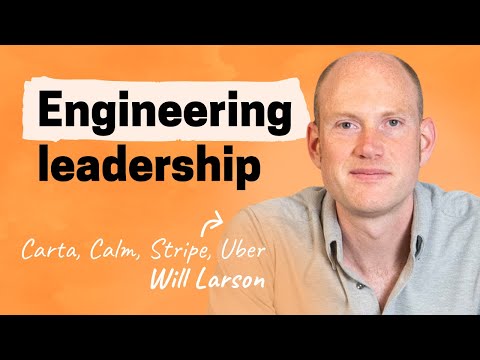
The engineering mindset | Will Larson (Carta, Stripe, Uber, Calm, Digg)
Will Larson (guest), Lenny Rachitsky (host)
In this episode of Lenny's Podcast, featuring Will Larson and Lenny Rachitsky, The engineering mindset | Will Larson (Carta, Stripe, Uber, Calm, Digg) explores will Larson on engineering strategy, accountability, and sustainable writing careers CTO Will Larson discusses how the engineering landscape has shifted from hypergrowth and coddling engineers to a more accountable, constraints-driven environment. He explains systems thinking, practical engineering strategy, and how to build healthier EM–PM partnerships with aligned incentives. Larson also shares his approach to writing prolifically while working intense leadership roles, the importance of honest, applicable company values, and lessons from high‑stakes failures like Digg’s disastrous rewrite. Throughout, he emphasizes treating engineers as peers, embracing constraints, and focusing on long-term learning over short-term optics.
Will Larson on engineering strategy, accountability, and sustainable writing careers
CTO Will Larson discusses how the engineering landscape has shifted from hypergrowth and coddling engineers to a more accountable, constraints-driven environment. He explains systems thinking, practical engineering strategy, and how to build healthier EM–PM partnerships with aligned incentives. Larson also shares his approach to writing prolifically while working intense leadership roles, the importance of honest, applicable company values, and lessons from high‑stakes failures like Digg’s disastrous rewrite. Throughout, he emphasizes treating engineers as peers, embracing constraints, and focusing on long-term learning over short-term optics.
Key Takeaways
Stop coddling engineers; give them real accountability and leadership opportunities.
Larson argues that over-optimizing for retention led companies to shield engineers from hard problems, which stunted growth and limited senior IC roles; today’s environment allows holding engineers accountable and putting them into true senior leadership positions.
Get the full analysis with uListen AI
Use systems thinking to diagnose, not to deny reality.
By modeling stocks and flows (e. ...
Get the full analysis with uListen AI
Good engineering strategy is often boring, constraint-heavy, and written down.
Effective strategies look like “we only use our standard tech stack” or “no cloud, only our own data centers”; these constraints focus scarce engineering capacity on what the business actually values and enable faster, more coherent execution.
Get the full analysis with uListen AI
Align EM–PM incentives, ideally via shared performance ratings.
Many EM–PM conflicts stem from misaligned incentives and unspoken needs; tying their performance reviews together forces them to own outcomes jointly and pushes both to solve for company goals, not just functional metrics.
Get the full analysis with uListen AI
Measure engineering productivity imperfectly, then use metrics to educate.
Larson recommends starting with DORA-style metrics and basic benchmarks even though they’re flawed, using them for diagnosis and board communication, and layering in qualitative input from engineers who usually know where the real bottlenecks are.
Get the full analysis with uListen AI
Write what energizes you and publish consistently, not perfectly.
He separates career artifacts (a few polished pieces) from long-term writing practice, advising would-be writers to follow their curiosity, avoid chasing trends, repurpose work-adjacent thinking, and ship almost everything rather than hoarding drafts.
Get the full analysis with uListen AI
Company values must be honest, applicable, and meaningfully reversible.
Values like “integrity” or “we care about customers” are useless if every company could claim them; effective values reflect what the company actually does, guide real trade-offs, and imply that some reasonable alternative was consciously rejected.
Get the full analysis with uListen AI
Notable Quotes
“We often treat engineers a little bit like children instead of giving them the responsibilities and ability to actually thrive as adults.”
— Will Larson
“Reality is never wrong. Reality is always right. Your model is always wrong if it's in conflict with reality.”
— Will Larson
“The goal of good strategy is not to appease everyone. The goal of good strategy is to dictate how we invest the limited capacities we have into the problems we care about.”
— Will Larson
“The biggest risk to content creation of any sort is quitting soon because you get burned out. The biggest risk is not that you grow too slow initially.”
— Will Larson
“Values have to be honest and applicable. If everyone can say them and no one would ever choose the opposite, they’re not helping you make decisions.”
— Will Larson
Questions Answered in This Episode
How can an engineering org practically transition from a culture of coddling engineers to one of accountability without triggering mass attrition?
CTO Will Larson discusses how the engineering landscape has shifted from hypergrowth and coddling engineers to a more accountable, constraints-driven environment. ...
Get the full analysis with uListen AI
What does a strong, written engineering strategy look like for a mid-stage startup, and how should it evolve as the company scales?
Get the full analysis with uListen AI
In your experience, what are the most common misdiagnoses leaders make when using DORA or similar productivity metrics?
Get the full analysis with uListen AI
How should PMs and EMs surface and reconcile their hidden incentives before they become recurring conflicts?
Get the full analysis with uListen AI
Looking back, what would you change about the decision-making around Digg V4’s rewrite, and how should leaders evaluate when a full rewrite is ever justified?
Get the full analysis with uListen AI
Transcript Preview
I think that we often treat engineers a little bit like children instead of giving them, like, the responsibilities and ability to actually thrive as adults. And so we're like, "Oh, the engineers won't want to do that work." You're like, well, that's actually not good for the engineers to kind of be sheltered from what is important. And so I, I actually, like, one of the, I think highlights is that I think we're coming back to this moment where we can actually treat engineers like our peers and put them into really senior leadership roles and not have this kind of baseline assumption that they'll go, we have to coddle them or hide them from the real problems and this is how they're gonna get the opportunity to grow as well.
(instrumental music) Today my guest is Will Larson, one of the most requested guests I've had on this podcast. Will is currently CTO at Carta. He's been a software engineering leader at Stripe, Uber, and Calm. He's the author of two essential books for all engineers, An Elegant Puzzle and Staff Engineer. And he's releasing his newest book, The Engineering Executives Primer in February of next year. He also publishes regularly on his blog at lethane.com which is a must read for every engineer and eng leader. In our conversation, Will shares advice on developing your engineering strategy and strategy in general, how to improve the relationship between an eng manager and a PM, how he finds time to write while also working an intense full-time job, how he recommends approaching measuring engineering productivity, how to develop your company values, an amazing story about his time at Digg, and so much more. Will is such a gem of a human and leader and I'm excited to bring you this episode. With that, I bring you Will Larson after a short word from our sponsor. Today's episode is brought to you by DX, a platform for measuring and improving developer productivity. DX is designed by the researchers behind frameworks such as DORA, SPACE, and DevEx. If you've tried measuring developer productivity, you know that there are a lot of basic metrics out there and a lot of ways to do this wrong, and getting that full view of productivity is still really hard. DX tackles this problem by combining qualitative and quantitative insights, giving you full clarity into how your developers are doing. DX is used by both startups and Fortune 500 companies, including companies like Twilio, Amplitude, eBay, Brex, Toast, Pfizer, and Procter & Gamble. To learn more about DX and get a demo of their product, visit their website at getdx.com/lenny. That's getdx.com/lenny. Today's episode is brought to you by OneSchema, the embeddable CSV importer for SaaS. Customers always seem to want to give you their data in the messiest possible CSV file and building a spreadsheet importer becomes a never-ending sink for your engineering and support resources. You keep adding features to your spreadsheet importer, but customers keep running into issues. Six months later, you're fixing yet another date conversion edge case bug. Most tools aren't built for handling messy data, but OneSchema is. Companies like Scale AI and Pave are using OneSchema to make it fast and easy to launch delightful spreadsheet import experiences, from embeddable CSV import to importing CSVs from an SFTP folder on a recurring basis. Spreadsheet import is such an awful experience in so many products. Customers get frustrated by useless messages like error on line 53 and never end up getting started with your product. OneSchema intelligently corrects messy data so that your customers don't have to spend hours in Excel just to get started with your product. For listeners of this podcast, OneSchema's offering a $1,000 discount. Learn more at oneschema.co/lenny. Will, thank you so much for being here and welcome to the podcast.
Install uListen to search the full transcript and get AI-powered insights
Get Full TranscriptGet more from every podcast
AI summaries, searchable transcripts, and fact-checking. Free forever.
Add to Chrome