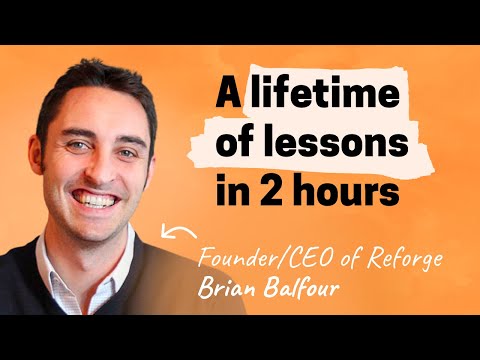
Brian Balfour: 10 lessons on career, growth, and life
Brian Balfour (guest), Lenny Rachitsky (host), Narrator
In this episode of Lenny's Podcast, featuring Brian Balfour and Lenny Rachitsky, Brian Balfour: 10 lessons on career, growth, and life explores brian Balfour’s 10 hard‑won rules for careers, growth, and startups Brian Balfour, founder/CEO of Reforge and former VP Growth at HubSpot, shares 10 of his most important lessons spanning company building, growth, and life. He explains how he captures and reuses these lessons in a living Notion document to guide strategic decisions. Themes include hiring and performance, planning and growth strategy, product focus, org design, and personal mindset as a founder and parent. Throughout, he grounds each lesson in concrete examples from HubSpot, Reforge, and the broader tech ecosystem.
Brian Balfour’s 10 hard‑won rules for careers, growth, and startups
Brian Balfour, founder/CEO of Reforge and former VP Growth at HubSpot, shares 10 of his most important lessons spanning company building, growth, and life. He explains how he captures and reuses these lessons in a living Notion document to guide strategic decisions. Themes include hiring and performance, planning and growth strategy, product focus, org design, and personal mindset as a founder and parent. Throughout, he grounds each lesson in concrete examples from HubSpot, Reforge, and the broader tech ecosystem.
Key Takeaways
Judge people by their work, not by conversations or charisma.
Balfour argues that interviews, promo packets, and performance narratives are full of bias; the most reliable signal is actual artifacts of work (portfolios, simulations, shipped outputs) and how someone approached creating them. ...
Get the full analysis with uListen AI
Tell me what it takes to win, then tell me the cost.
Leaders should first hear the uncompromised plan that would truly win, before teams self-censor for perceived budget, politics, or effort. ...
Get the full analysis with uListen AI
Problems never end; switch from hoping they’ll stop to loving the grind.
As companies grow, solved problems are simply replaced with bigger, harder ones; expecting things to “get easier” only breeds stress and disappointment. ...
Get the full analysis with uListen AI
The year is made in the first six months.
Because of long decision and adoption cycles (especially in SaaS), initiatives shipped after mid‑year rarely move that year’s numbers in a meaningful way. ...
Get the full analysis with uListen AI
Growth is a tightly coupled system of acquisition, retention, and monetization.
Changes in one part (e. ...
Get the full analysis with uListen AI
Focus on use cases, not personas—and explicitly choose who you’re not for.
Useful segmentation starts from concrete problems and use cases (problem, alternatives, value prop, why you win, and natural frequency), not vague archetypes like “Marketing Mary. ...
Get the full analysis with uListen AI
To create meaningful change, you must inject 2×+ activation energy into new bets.
New products, channels, or strategies must grow faster than the existing business to ever show up in the numbers, which means you can’t “toe dip” forever. ...
Get the full analysis with uListen AI
Notable Quotes
“Inspect the work, not the person.”
— Brian Balfour
“Tell me what it takes to win, then tell me the cost.”
— Brian Balfour
“The more problems you solve, you just end up taking on bigger and bigger problems over time.”
— Brian Balfour
“Solving for everyone is solving for no one.”
— Brian Balfour
“Your job as a parent is to move kids from fully dependent to fully independent—and you’re just an input into their decisions.”
— Brian Balfour
Questions Answered in This Episode
How could I redesign my own hiring and promotion processes to be almost entirely based on inspecting real work rather than interviews and narratives?
Brian Balfour, founder/CEO of Reforge and former VP Growth at HubSpot, shares 10 of his most important lessons spanning company building, growth, and life. ...
Get the full analysis with uListen AI
Where in my current growth system am I treating a downstream symptom (e.g., poor monetization) instead of fixing the upstream cause (e.g., acquisition or engagement)?
Get the full analysis with uListen AI
What are the explicit use cases I’m building for—and which important adjacent use cases or customer types should I deliberately say ‘no’ to right now?
Get the full analysis with uListen AI
Which ‘new bets’ in my company are underpowered because we’re not giving them enough activation energy to ever catch up to the core business?
Get the full analysis with uListen AI
Who could be a true sparring partner in my career (or life), and how can I structure an ongoing relationship that pushes us both to get better?
Get the full analysis with uListen AI
Transcript Preview
I think historically, I've gotten really caught in this trap, where at any moment in Reforge, it's like, "Ah, if I just solve this one thing, this X problem, everything's gonna get easier." That might be landing, like, some big hire, some executive hire or figuring out, you know, some major lever or defining, like, some strategy. But the reality is, is that the opposite is true. The more problems you solve, you just end up taking on bigger and bigger problems over time. And hoping it gets easier is the thing that just sets you up for this frustration, this anxiety, this stress. And I think switching to that mentality of, like, getting rid of that hope and more of like, "Hmm, if I solve this thing, I get to take on an even harder (laughs) thing," I think is the thing that actually reduces the stress.
(instrumental music) Today, my guest is Brian Balfour. Brian is the founder and CEO of Reforge, which is by far the best place in the world to get in-depth training on growth and product and related topics. Previously, Brian was VP of Growth at HubSpot, co-founder of three other startups. And in my mind, Brian is the sensei of growth. With Brian on the podcast, I wanted to do something special. So instead of going into the typical stuff that he writes about and speaks about, we instead talked through 10 of the biggest and most interesting lessons Brian has learned from his career and from his life. These come from a list that he keeps where he gathers lessons that he learns over time, which turns out is over a hundred. We only have time for 10. There is so much gold in this episode, and I believe there is something for everyone. I can't wait for you to listen to it and to hear what you think. With that, I bring you Brian Balfour after a short word from our sponsors. You fell in love with building products for a reason. But sometimes the day-to-day reality is a little different than you imagined. Instead of dreaming up big ideas, talking to customers, and crafting a strategy, you're drowning in spreadsheets and roadmap updates, and you're spending your days basically putting out fires. A better way is possible. Introducing Jira Product Discovery, the new prioritization and road mapping tool built for product teams by Atlassian. With Jira Product Discovery, you can gather all your product ideas and insights in one place and prioritize confidently, finally replacing those endless spreadsheets. Create and share custom product roadmaps with any stakeholder in seconds. And it's all built on Jira, where your engineering teams are already working, so true collaboration is finally possible. Great products are built by great teams, not just engineers. Sales, support, leadership, even Greg from finance. Anyone that you want can contribute ideas, feedback and insights in Jira Product Discovery for free. No catch. And it's only $10 a month for you. Say goodbye to your spreadsheets and the never-ending alignment efforts. The old way of doing product management is over. Rediscover what's possible with Jira Product Discovery. Try it for free at atlassian.com/lenny. That's atlassian.com/lenny. This episode is brought to you by Coda. You've heard me talk about how Coda is the doc that brings it all together, and how it can help your team run smoother and be more efficient. I know this firsthand because Coda does that for me. I use Coda every day to wrangle my newsletter content calendar, my interview notes for podcasts, and to coordinate my sponsors. More recently, I actually wrote a whole post on how Coda's product team operates. And within that post, they shared a dozen templates that they use internally to run their product team, including managing the roadmap, their OKR process, getting internal feedback, and essentially their whole product development process is done within Coda. If your team's work is spread out across different documents and spreadsheets and a stack of workflow tools, that's why you need Coda. Coda puts data in one centralized location regardless of format, eliminating roadblocks that can slow your team down. Coda allows your team to operate on the same information and collaborate in one place. Take advantage of this special limited time offer just for startups. Sign up today at coda.io/lenny and get $1,000 startup credit on your first statement. That's C-O-D-A dot I-O slash Lenny to sign up, and get a startup credit of $1,000. Coda.io/lenny. Brian, thank you so much for being here and welcome to the podcast.
Install uListen to search the full transcript and get AI-powered insights
Get Full TranscriptGet more from every podcast
AI summaries, searchable transcripts, and fact-checking. Free forever.
Add to Chrome