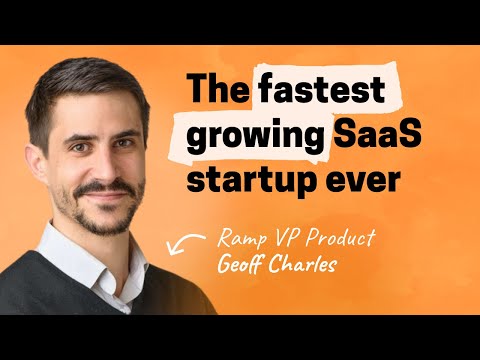
Velocity over everything: How Ramp became the fastest-growing SaaS startup ever | Geoff Charles
Geoff Charles (guest), Lenny Rachitsky (host), Narrator
In this episode of Lenny's Podcast, featuring Geoff Charles and Lenny Rachitsky, Velocity over everything: How Ramp became the fastest-growing SaaS startup ever | Geoff Charles explores inside Ramp’s playbook: tiny empowered teams, extreme velocity, huge impact Ramp’s VP of Product, Geoff Charles, explains how Ramp became the fastest-growing SaaS and fintech company by aggressively prioritizing velocity, small empowered teams, and A+ talent. The company repeatedly built competitive products to incumbents like Amex, Expensify, and Bill.com in months with very lean teams, by focusing on single-threaded ownership, first-principles thinking, and minimal process. Strategy at Ramp centers on clear goals, strong financial targets, and a roadmap ‘contract’, while product teams are given wide autonomy and context instead of top-down control. Geoff also digs into how they avoid burnout, structure planning, organize support under product, hire and evaluate PMs, and why writing and deep work are core to good decision-making.
Inside Ramp’s playbook: tiny empowered teams, extreme velocity, huge impact
Ramp’s VP of Product, Geoff Charles, explains how Ramp became the fastest-growing SaaS and fintech company by aggressively prioritizing velocity, small empowered teams, and A+ talent. The company repeatedly built competitive products to incumbents like Amex, Expensify, and Bill.com in months with very lean teams, by focusing on single-threaded ownership, first-principles thinking, and minimal process. Strategy at Ramp centers on clear goals, strong financial targets, and a roadmap ‘contract’, while product teams are given wide autonomy and context instead of top-down control. Geoff also digs into how they avoid burnout, structure planning, organize support under product, hire and evaluate PMs, and why writing and deep work are core to good decision-making.
Key Takeaways
Optimize for velocity with small, single-threaded teams and big goals.
Ramp repeatedly shipped full competitors to large incumbents (Amex, Expensify, Bill. ...
Get the full analysis with uListen AI
Empower teams with context over control to scale decision-making.
Leaders align with teams on goals, hypotheses, and key data, then largely step back from dictating solutions; teams closer to the problem own the ‘how,’ while leaders act as ‘repeater-in-chief’ for strategy and context.
Get the full analysis with uListen AI
Use simple, lightweight strategy instead of heavy OKR machinery.
Ramp moved away from time-consuming quarterly OKRs toward biannual one-page company priorities, a strong financial plan with clear owners, and team-level strategy docs that define goals, hypotheses, metrics, risks, and why Ramp has a right to win.
Get the full analysis with uListen AI
Maintain quality at high speed through clear control metrics, not process.
They fix every surfaced bug, track NPS/CSAT, operational burden (ticket rate per user), and ‘confused’ tickets; when these go red, teams stop shipping new features and must improve quality before resuming.
Get the full analysis with uListen AI
Treat support as a product failure and put it under product.
Customer support reports into product, is incentivized to reduce contacts (not just resolve them), and feeds structured customer feedback directly into teams—resulting in a tiny support staff serving hundreds of thousands of users.
Get the full analysis with uListen AI
Talent density in engineering and design is the primary growth lever.
Ramp’s early CTO spent his first year almost exclusively on hiring A+ engineers and designers; this allowed PMs to be force multipliers while engineers proactively think about customers, product decisions, and even support issues.
Get the full analysis with uListen AI
Use writing and deep work to solve novel scaling problems from first principles.
Geoff regularly blocks time to answer hard questions (e. ...
Get the full analysis with uListen AI
Notable Quotes
“Velocity is everything at Ramp. It’s how we design our product development process, how we incentivize teams, who we hire, and who we promote.”
— Geoff Charles
“Every support ticket is a failure of our product.”
— Geoff Charles
“Any second you spend planning is a second you don’t spend doing.”
— Geoff Charles
“I actually think velocity is a way to potentially avoid burnout. When I felt burnout, it was when I had the lowest amount of velocity.”
— Geoff Charles
“Don’t take everything I’m saying at face value. Start from first principles for your own company.”
— Geoff Charles
Questions Answered in This Episode
How can a company with less experienced or less ‘A+’ engineering talent safely adopt parts of Ramp’s high-velocity model without breaking quality?
Ramp’s VP of Product, Geoff Charles, explains how Ramp became the fastest-growing SaaS and fintech company by aggressively prioritizing velocity, small empowered teams, and A+ talent. ...
Get the full analysis with uListen AI
What specific behaviors or metrics should leaders watch to know when their push for velocity is actually starting to create harmful chaos or burnout?
Get the full analysis with uListen AI
How would Ramp’s approach to small, single-threaded pods change in a heavily regulated or safety-critical domain where iteration is costly?
Get the full analysis with uListen AI
What does a strong, practical ‘right to win’ section look like in a team’s strategy document, and how should it influence what they say no to?
Get the full analysis with uListen AI
If support truly reports into product, how should PMs and product leaders balance feature roadmap work against ongoing UX fixes and support-driven improvements?
Get the full analysis with uListen AI
Transcript Preview
So when I joined, we were about, you know, 10-ish folks, about eight engineers and in three months we built a competitor to Amex. Six months after that, we built a competitor to, to Expensify, you know, both publicly traded companies. We hit 100 million in annual revenue. I think we were under, at that point, 50 total in the R&D department, less than 40 engineers and three PMs. And then we started expanding into accounts payable. It was three engineers, one designer, one PM, three months, and, and they hit it out of the park and, and, and that product is moving in billions of dollars a year. And I think, you know, the, the recipe for all this is...
(instrumental music) Welcome to Lenny's podcast, where I interview world class product leaders and growth experts to learn from their hard won experiences building and growing today's most successful products. Today my guest is Geoff Charles, who is VP of product at Ramp. This episode is a unique glimpse into a startup and an approach to product that optimizes for moving quickly, thinking from first principles and empowering individual team members. If you're not familiar with Ramp, they are the fastest growing SaaS business in history, getting to over $100 million in annual run rate in two years, which is just wild. And as you'll hear in this episode, they did this with 50 people. In our conversation, Geoff shares how they operationalize a culture of velocity, how they do a lot with few people, how they organize planning, how they define strategy, how they interview product managers and keep a very high bar for talent, plus also avoid burnout in a very fast moving culture, and so much more. My advice is to seriously study how Ramp operates because there's a lot to learn from their success and their approach to product. Enjoy this episode with Geoff Charles after a short word from our sponsors. This episode is brought to you by Ezra, the leading full body cancer screening company. I actually used Ezra earlier this year, unrelated to this podcast, completely on my own dime because my wife did one and loved it, and I was super curious to see if there's anything that I should be paying attention to in my body as I get older. The way it works is you book an appointment, you come in, you put on some very cool silky pajamas that they give you that you get to keep afterwards. You go into an MRI machine for 30 to 45 minutes, and then about a week later you get this detailed report sharing what they found in your body. Luckily, I had what they called an unremarkable screening, which means they didn't find anything cancerous, but they did find some issues in my back, which I'm getting checked out at a physical next month, probably because I spend so much time sitting in front of a computer. Half of all men will have cancer at some point in their lives, as will one third of women. Half of all of them will detect it late. According to the American Cancer Society, early cancer detection has an 80% survival rate compared to less than 20% for late stage cancer. The Ezra team has helped 13% of their customers identify potential cancer early and 50% of them identify other clinically significant issues such as aneurysms, disk herniations, which maybe is what I have, or fatty liver disease. Ezra scans for cancer and 500 other conditions in 13 organs using a full body MRI powered by AI, and just launched the world's only 30 minute full body scan, which is also their most affordable. Their scans are non-invasive and radiation-free and Ezra is offering listeners $150 off their first scan with code Lenny150. Book your scan at ezra.com/lenny. That's ezra.com/lenny. This episode is brought to you by Coda. You've heard me talk about how Coda is the doc that brings it all together, and how it can help your team run smoother and be more efficient. I know this firsthand because Coda does that for me. I use Coda every day to wrangle my newsletter content calendar, my interview notes for podcasts and to coordinate my sponsors. More recently, I actually wrote a whole post on how Coda's product team operates, and within that post they shared a dozen templates that they use internally to run their product team, including managing the roadmap, their OKR process, getting internal feedback, and essentially their whole product development process is done within Coda. If your team's work is spread out across different documents and spreadsheets and a stack of workflow tools, that's why you need Coda. Coda puts data in one centralized location regardless of format, eliminating roadblocks that can slow your team down. Coda allows your team to operate on the same information and collaborate in one place. Take advantage of this special limited time offer just for startups. Sign up today at coda.io/lenny and get $1,000 starter credit on your first statement. That's coda.io/lenny to sign up, and get a startup credit of $1,000. Coda.io/lenny. Geoff, thank you so much for being here. Welcome to the podcast.
Install uListen to search the full transcript and get AI-powered insights
Get Full TranscriptGet more from every podcast
AI summaries, searchable transcripts, and fact-checking. Free forever.
Add to Chrome