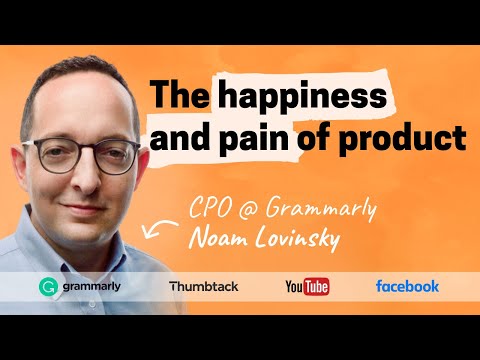
The happiness and pain of product management | Noam Lovinsky (Grammarly, FB, Thumbtack, YT)
Lenny Rachitsky (host), Noam Lovinsky (guest)
In this episode of Lenny's Podcast, featuring Lenny Rachitsky and Noam Lovinsky, The happiness and pain of product management | Noam Lovinsky (Grammarly, FB, Thumbtack, YT) explores noam Lovinsky on navigating product growth, decline, and reinvention Noam Lovinsky, currently CPO at Grammarly and formerly at YouTube, Thumbtack, and Facebook’s New Product Experimentation team, reflects on building products across every stage: zero-to-one, negative-to-one recovery, and scaling to massive reach.
Noam Lovinsky on navigating product growth, decline, and reinvention
Noam Lovinsky, currently CPO at Grammarly and formerly at YouTube, Thumbtack, and Facebook’s New Product Experimentation team, reflects on building products across every stage: zero-to-one, negative-to-one recovery, and scaling to massive reach.
He emphasizes optimizing for authentic work that gives you energy, advocating for what’s best for the business even when it hurts your role, and deliberately choosing roles that stretch you the most.
The conversation dives into how YouTube and Thumbtack handled major inflection points, why single-channel growth is dangerous, how to structure startup-within-a-startup incubators, and what makes Grammarly a durable consumer subscription business.
Throughout, Noam shares practical career advice on when to kill projects, when to ask to be layered, how leadership teams should engage in product strategy, and how to build systems that genuinely support innovation inside large companies.
Key Takeaways
Optimize your career for authenticity and energy, not performative visibility.
Noam is highly successful without tweeting, newsletters, or heavy networking; he focuses on deep work and genuine collaborations, advising others to lean into what feels natural and energizing rather than external pressure to build a public persona.
Get the full analysis with uListen AI
Advocate for what’s best for the business, even at personal risk.
At YouTube he argued to de-staff his own project and later asked to be layered under another leader; in healthy organizations this kind of honesty is rewarded, and it’s a powerful way to test whether you’re in the right culture.
Get the full analysis with uListen AI
Don’t rely on a single growth channel; diversify before it’s too late.
Thumbtack’s dependence on SEO led to a brutal downturn when Google changed its algorithms; the recovery required building multiple channels (SEM, Facebook, referrals) and rethinking how to acquire and target demand across thousands of micro-marketplaces.
Get the full analysis with uListen AI
Growth hides structural problems; slowdowns force necessary clarity.
Triple-digit growth at Thumbtack masked major liquidity and UX issues; only once growth went flat/negative did the organization seriously confront dropped demand, marketplace friction, and a broken monetization loop.
Get the full analysis with uListen AI
Internal incubators live or die by incentives, autonomy, and time horizons.
Facebook’s NPE learned that using standard corporate performance cycles, infra rules, and process kills zero-to-one work; successful incubators must have different incentives, lightweight infra choices, and realistic expectations (many wins will be “wine,” not “unicorns”).
Get the full analysis with uListen AI
The magic of Grammarly is low-friction, ubiquitous, push-based assistance.
Grammarly works everywhere users type, requires almost no setup, and gently pushes help at the right time; this ‘install-and-you’re-better’ UX, combined with deep AI and a long-standing profitable culture, underpins its rare success as a consumer subscription product.
Get the full analysis with uListen AI
Choose roles that stretch you, but keep at least one core strength as an anchor.
Noam advises prioritizing positions that force growth and discomfort, while ensuring there are one or two areas where you already have strong competency; this balance prevents burnout while maximizing learning and long-term career upside.
Get the full analysis with uListen AI
Notable Quotes
“Do what you like. You’re generally going to be a lot better at the things that really fill you up.”
— Noam Lovinsky
“Advocate for what’s best for the team and the organization, even if that means putting yourself in a difficult moment.”
— Noam Lovinsky
“Growth masks all problems. You don’t really have a true understanding of what’s working well and what’s not when you have incredible growth.”
— Noam Lovinsky
“If you’re a large organization and you do some performance management process twice a year in your zero to one incubator, you’ve already killed it.”
— Noam Lovinsky
“We are meant to struggle. Through struggle is how we get better, how good things happen, how bonds form.”
— Noam Lovinsky
Questions Answered in This Episode
How can a PM realistically assess whether their organization will actually reward ‘do what’s best for the business’ behavior, or quietly punish it?
Noam Lovinsky, currently CPO at Grammarly and formerly at YouTube, Thumbtack, and Facebook’s New Product Experimentation team, reflects on building products across every stage: zero-to-one, negative-to-one recovery, and scaling to massive reach.
Get the full analysis with uListen AI
What early warning signals should a company look for to know it’s overly dependent on a single growth channel like SEO?
He emphasizes optimizing for authentic work that gives you energy, advocating for what’s best for the business even when it hurts your role, and deliberately choosing roles that stretch you the most.
Get the full analysis with uListen AI
How would you design incentive structures and equity/ownership inside a big company so that an internal incubator really competes with starting a startup?
The conversation dives into how YouTube and Thumbtack handled major inflection points, why single-channel growth is dangerous, how to structure startup-within-a-startup incubators, and what makes Grammarly a durable consumer subscription business.
Get the full analysis with uListen AI
Where is the next major product opportunity for Grammarly beyond grammar and writing assistance, given the rise of generative AI and integrated copilots?
Throughout, Noam shares practical career advice on when to kill projects, when to ask to be layered, how leadership teams should engage in product strategy, and how to build systems that genuinely support innovation inside large companies.
Get the full analysis with uListen AI
How do you personally distinguish between ‘this is healthy growth pain I should push through’ and ‘this is unsustainable and harming my mental or physical health’?
Get the full analysis with uListen AI
Transcript Preview
(instrumental music) You've worked at so many great companies. At YouTube, when you joined, my understanding is, YouTube was losing a lot of money?
There were many times where Google leadership reconsidered the acquisition, and, "Should we, like, sell YouTube?" If you can believe it or not.
At Thumbtack, it looks like you went from one to negative one, and then back to one.
I remember in a board meeting, the new model really started to show legs, and one of the board members, Brian Schrier at Sequoia said it was the prettiest smile graph that he had ever seen.
When you were at Facebook, you built what is called the New Product Experimentation Team, trying to create a startup within a startup.
You're thinking on a different time horizon. If you're a large organization and you do some performance management process twice a year in your zero to one incubator, you've already killed it. It's the wrong incentive.
As the chief product officer at Grammarly, I'm curious what word you most often misspell.
(laughs) "The."
T- you do T-H?
T-H, yeah, exactly.
Oh, man.
Yeah, yeah. (laughs)
(instrumental music) Today, my guest is Noam Levinsky. Noam is currently chief product officer at Grammarly. Previously, he was an early PM at YouTube, where he spent five years leading the creator product experience and then the broader YouTube consumer product experience. He then went on to take on the chief product officer role at Thumbtack, which involved helping the company reignite growth after a downturn caused by some changes Google made in SEO. He then went on to Facebook, where he created the New Product Experimentation Team, whose charter was to incubate big new ideas protected from the larger Facebook org. Noam has such a unique set of experiences taking products from zero to one, from negative one to one, from one to 100, and even starting his own companies. He's never really been on a podcast before and he rarely ever tweets or post anything online, which we actually talk about. In our conversation, we walk through the lessons that he's learned through his amazing career at YouTube, Facebook, Thumbtack, and at Grammarly. We talk about when it makes sense to kill your project at a company, when it makes sense to ask to be layered at a company, why you should be keeping a nose out for which products matter most at a business and to find those products, why you need to diversify your growth channels at your business, why you should be finding work that is gonna most stretch you to help you advance in your career, a bunch of advice for creating space for innovation within a large company, and so much more. Noam is such a gem and I'm really excited to share his wisdom with you. If you enjoy this podcast, don't forget to subscribe and follow this podcast in your favorite podcasting app or YouTube. It's the best way to avoid missing future episodes, and it helps the podcast tremendously. With that, I bring you Noam Levinsky, after a short word from our sponsors. This episode is brought to you by Whimsical, the iterative product workspace. Whimsical helps product managers build clarity and shared understanding faster with tools designed for solving product challenges. With Whimsical, you can easily explore new concepts using drag and drop wireframe and diagram components, create rich product briefs that show and sell your thinking, and keep your team aligned with one source of truth for all of your build requirements. Whimsical also has a library of easy-to-use templates from product leaders, like myself, including a project proposal one-pager and a go-to-market worksheet. Give them a try and see how fast and easy it is to build clarity with Whimsical. Sign up at whimsical.com/lenny for 20% off a Whimsical pro plan. That's whimsical.com/lenny. This episode is brought to you by Vanta. When it comes to ensuring your company has top-notch security practices, things get complicated fast. Now, you can assess risk, secure the trust of your customers, and automate compliance for SOC 2, ISO 27001, HIPAA, and more with a single platform, Vanta. Vanta's market-leading trust management platform helps you continuously monitor compliance alongside reporting and tracking risks. Plus, you can save hours by completing security questionnaires with Vanta AI. Join thousands of global companies that use Vanta to automate evidence collection, unify risk management, and streamline security reviews. Get $1,000 off Vanta when you go to vanta.com/lenny. That's V-A-N-T-A.com/lenny. Noam, thank you so much for being here and welcome to the podcast.
Install uListen to search the full transcript and get AI-powered insights
Get Full TranscriptGet more from every podcast
AI summaries, searchable transcripts, and fact-checking. Free forever.
Add to Chrome