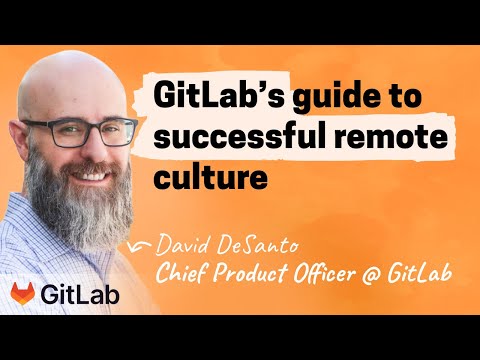
The GitLab way: Kindness, transparency, and short toes | David DeSanto (CPO)
Lenny Rachitsky (host), David DeSanto (guest), Narrator
In this episode of Lenny's Podcast, featuring Lenny Rachitsky and David DeSanto, The GitLab way: Kindness, transparency, and short toes | David DeSanto (CPO) explores inside GitLab: Radical transparency, remote culture, and product at scale GitLab CPO David DeSanto discusses how GitLab operationalizes extreme transparency through public meeting recordings, an open handbook, and a public issue tracker, and how this fuels community contribution and customer trust.
Inside GitLab: Radical transparency, remote culture, and product at scale
GitLab CPO David DeSanto discusses how GitLab operationalizes extreme transparency through public meeting recordings, an open handbook, and a public issue tracker, and how this fuels community contribution and customer trust.
He explains GitLab’s cultural values—kindness, short toes, assuming positive intent, and results-focus—and how they enable a fully remote, async-first company of 2,000+ people to function effectively across 60+ countries.
DeSanto shares practical guidance on making remote work succeed (outcomes over hours, overcommunication, clear written requirements, and periodic in‑person time), plus how GitLab evolved from breadth-over-depth product strategy to deepening key areas of its DevSecOps platform.
He also outlines GitLab’s AI principles—full lifecycle coverage, privacy-first, and using the right model for each use case—and how GitLab Duo aims to materially increase productivity without compromising customers’ intellectual property.
Key Takeaways
Transparency can be an execution advantage, not a competitive risk.
By publicly sharing team meetings, their handbook, roadmap, and issue tracker, GitLab attracts community contributions, builds trust with customers, and reduces internal silos—while relying on fast execution (12 releases a year for 12+ years) as the real moat.
Get the full analysis with uListen AI
Codified values are essential for making remote and transparency work.
Values like kindness, assuming positive intent, short toes (not personalizing feedback), and “negative feedback is one-on-one” reduce conflict and misinterpretation in an async, text-heavy environment and make high transparency psychologically sustainable.
Get the full analysis with uListen AI
Remote success requires clear writing, overcommunication, and async-first habits.
GitLab expects PMs to write crisp requirements, use issues as the single source of truth, document decisions in the handbook, default to async communication, and only escalate to meetings (e. ...
Get the full analysis with uListen AI
Focus on outcomes and adoption, not tasks and hours.
Instead of measuring success by features shipped or bugs closed, GitLab encourages outcome metrics (e. ...
Get the full analysis with uListen AI
Use breadth-over-depth early to find your platform edges, then go deep where it matters.
GitLab initially expanded broadly across the DevSecOps lifecycle to discover where it could truly differentiate, then pivoted to depth in core areas like SCM, CI/CD, security, planning, and AI, letting adjacent areas benefit from the platform halo.
Get the full analysis with uListen AI
AI should support the whole SDLC and respect customer privacy.
GitLab’s AI suite (GitLab Duo) deliberately targets not just coding but planning, security, and operations, uses multiple specialized models rather than one monolith, and explicitly does not train on customer IP—key for winning and keeping large enterprise trust.
Get the full analysis with uListen AI
Hiring for remote product roles requires testing async collaboration skills.
GitLab’s PM interview process includes a written deep-dive exercise and simulated PM–engineering collaboration to assess whether candidates can specify work clearly, operate asynchronously, and thrive without in-person “hallway” interactions.
Get the full analysis with uListen AI
Notable Quotes
“If everyone's really annoyed at you, you're probably actually doing your job well.”
— David DeSanto
“It's about the work, it's not about you.”
— David DeSanto (on the value of having 'short toes')
“Sometimes it's actually a lot easier to be transparent than it is to not be transparent.”
— David DeSanto
“You can't be as transparent as we are without having our values, and you can't have our values unless you’re putting them into a remote work environment.”
— David DeSanto
“It's just software, so anything's possible.”
— David DeSanto
Questions Answered in This Episode
How far could your organization realistically push transparency before it becomes risky, and what would be the first experiment to try?
GitLab CPO David DeSanto discusses how GitLab operationalizes extreme transparency through public meeting recordings, an open handbook, and a public issue tracker, and how this fuels community contribution and customer trust.
Get the full analysis with uListen AI
Which of GitLab’s values (kindness, short toes, assume positive intent, negative feedback is 1:1) would most change your team’s dynamics if you truly enforced it?
He explains GitLab’s cultural values—kindness, short toes, assuming positive intent, and results-focus—and how they enable a fully remote, async-first company of 2,000+ people to function effectively across 60+ countries.
Get the full analysis with uListen AI
If you shifted from measuring outputs (features, tickets) to outcomes (adoption, customer impact), how would your roadmap and rituals change?
DeSanto shares practical guidance on making remote work succeed (outcomes over hours, overcommunication, clear written requirements, and periodic in‑person time), plus how GitLab evolved from breadth-over-depth product strategy to deepening key areas of its DevSecOps platform.
Get the full analysis with uListen AI
Where in your product could a breadth-over-depth approach help you discover new strategic opportunities before you commit to going deep?
He also outlines GitLab’s AI principles—full lifecycle coverage, privacy-first, and using the right model for each use case—and how GitLab Duo aims to materially increase productivity without compromising customers’ intellectual property.
Get the full analysis with uListen AI
How might you safely introduce AI into your workflow while maintaining customer privacy and choosing the “right model for the right use case” rather than defaulting to a single provider?
Get the full analysis with uListen AI
Transcript Preview
(instrumental music) You guys share so many of the things that most people keep secret. You post videos of your team meetings on YouTube.
We get people who then contribute because of what they see. "Oh, I can go build that, I know what that is." "Hey, I ran into that same problem too, (laughs) I'd love to hear how you solved it."
You also have this handbook, how you onboard people, how (laughs) account payables works at Gitlab.
We'll have companies who will fork the handbook. If you can leverage what Gitlab has done, that's amazing.
You mentioned the value of short toes, which I was definitely gonna ask about. (laughs)
That's where if you have long toes, you feel like people are stepping on you. Whereas if you have short toes, it's about the work, it's not about you. You end with a lot less of the negative head-butting, especially in an asynchronous culture like Gitlab.
Is there any tips you could share with PMs that are just struggling in a remote world?
If everyone's really annoyed at you, you're probably actually doing your job well.
Today, my guest is David Di Santo. David is the chief product officer at Gitlab, which is an incredibly unique company. It's the largest remote only company in the world. They share many of their team meetings on YouTube, and they've grown from being just a source code management business competing with GitHub, to a multi-product platform that covers security, compliance, continuous integration, project management, deploy tools and more. Many of which are infused with AI magic. In our conversation, we dig into Gitlab's culture of transparency, including how they operationalize it, what they share publicly versus what they don't, the surprising benefits of working this way, and why it's worth considering going transparent with your organization. Also, we explore some of Gitlab's other unique cultural values, like kindness and having short toes. Plus, David shares a bunch of great advice for scaling remote work based on what's worked well at Gitlab over the years, also when it makes sense to go breadth over depth versus depth over breadth when launching new product lines and how it worked for Gitlab over the years. This was a fascinating conversation, and if you want to learn more about a company that's doing things very differently while also kicking a lot of ass, this episode is for you. If you enjoy this podcast, don't forget to subscribe and follow it in your favorite podcasting app or YouTube. It's the best way to avoid missing future episodes and it helps the podcast tremendously. With that, I bring you David Di Santo after a short word from our sponsors. This episode is brought to you by Orb. As a business, you care about revenue. But as a product team, the last thing you want to do is delay a product launch or a pricing change because your team has to rebuild billing from scratch. Orb is a flexible usage-based billing engine that lets you evolve your pricing with ease. The fastest growing product teams at companies like Vercel and Replit trust Orb to power their pricing changes and launches. Use Orb to ship product faster, stop worrying about billing, and evolve pricing with ease and control. Check it out at withorb.com/lenny and skip the line for a demo or sandbox by using promo code Lenny. That's withorb.com/lenny. This episode is brought to you by Eppo. Eppo is a next generation A/B testing and feature management platform built by alums of Airbnb and Snowflake for modern growth teams. Companies like Twitch, Miro, ClickUp, and DraftKings rely on Eppo to power their experiments. Experimentation is increasingly essential for driving growth and for understanding the performance of new features, and Eppo helps you increase experimentation velocity while unlocking rigorous deep analysis in a way that no other commercial tool does. When I was at Airbnb, one of the things that I loved most was our experimentation platform, where I could set up experiments easily, troubleshoot issues, and analyze performance all on my own. Eppo does all that and more with advanced statistical methods that can help you shave weeks off experiment time, an accessible UI for diving deeper into performance, and out-of-the-box reporting that helps you avoid annoying prolonged analytic cycles. Eppo also makes it easy for you to share experiment insights with your team, sparking new ideas for the A/B testing flywheel. Eppo powers experimentation across every use case, including product, growth, machine learning, monetization, and email marketing. Check out Eppo at geteppo.com/lenny and 10X your experiment velocity. That's geteppo.com/lenny. David, thank you so much for being here, and welcome to the podcast.
Install uListen to search the full transcript and get AI-powered insights
Get Full TranscriptGet more from every podcast
AI summaries, searchable transcripts, and fact-checking. Free forever.
Add to Chrome