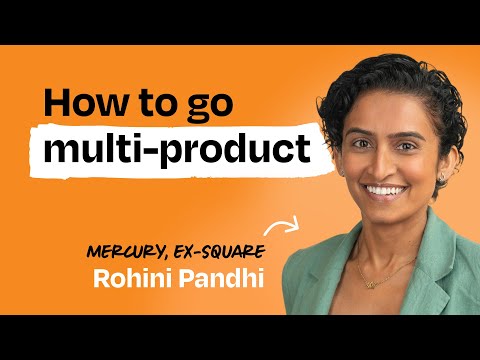
How to build your product team from scratch, attract top product talent, go multi-product, and more
Lenny Rachitsky (host), Rohini Pandhi (guest), Christina (OneSchema ad spokesperson) (guest), Narrator
In this episode of Lenny's Podcast, featuring Lenny Rachitsky and Rohini Pandhi, How to build your product team from scratch, attract top product talent, go multi-product, and more explores from PM Skepticism To Multi-Product Success At Mercury And Square Lenny interviews Mercury product leader Rohini Pandey about how Mercury went from proudly having zero product managers to building a 30-person PM org, and what that transition required culturally and operationally.
From PM Skepticism To Multi-Product Success At Mercury And Square
Lenny interviews Mercury product leader Rohini Pandey about how Mercury went from proudly having zero product managers to building a 30-person PM org, and what that transition required culturally and operationally.
They dig into when and why to hire PMs, how to define the PM discipline (career ladders, interviews, PM archetypes), and what actually attracts top product talent.
Rohini makes a structured case for investing in product quality and UX as a competitive moat, especially in “boring” fintech domains, and shares how Mercury has launched multiple new product lines in rapid succession.
They close with a deep dive on going multi-product—org design, seeding new bets, customer-research culture, pricing, and lessons from both Mercury and Square—plus Rohini’s nonprofit work supporting underrepresented founders.
Key Takeaways
Don’t hire PMs until the founders truly become the bottleneck.
Founders should be the initial product managers; you bring in PMs only when work no longer ships without the founder’s involvement, or when engineers/designers are doing so much PM work that their core craft suffers.
Get the full analysis with uListen AI
Explicitly define what “product manager” means in your company before you scale.
Mercury created a PM career ladder, clarified expectations (vision, strategy, customer research, cross-functional leadership), and then rebuilt their interview loop to test for those exact skills rather than generic “PM competency.”
Get the full analysis with uListen AI
Match PM type to product maturity: pioneer, town settler, city planner.
Zero-to-one products need entrepreneurial pioneers, growth-stage lines need town settlers who can add structure while experimenting, and large, mature products need city planners skilled at operating at scale and managing risk.
Get the full analysis with uListen AI
Top PMs are attracted by scope, ambiguity, and who they’ll learn from.
Senior talent optimizes for big, meaningful problems at the right point in their “ambiguity vs. ...
Get the full analysis with uListen AI
Quality and UX craft can be a real strategic moat, not just polish.
In domains like fintech, small details (e. ...
Get the full analysis with uListen AI
Separate org structures are crucial for new product “seedlings” to survive.
If new bets sit too close to a mature core org, they get sucked into maintenance and short-term priorities; Mercury created a distinct Expansion org with dedicated cross-functional teams and periodic “investment review” rather than time-boxed projects.
Get the full analysis with uListen AI
Choose new products where you have adjacency and distribution advantages.
Mercury prioritized products like invoicing and Bill Pay where they already saw customer behavior (e. ...
Get the full analysis with uListen AI
Notable Quotes
“The founders are your original PMs. Until you cannot do the job anymore, you yourself should be the PM.”
— Rohini Pandey
“When you hire a really good PM, they can make the product velocity and the quality just 10x better.”
— Rohini Pandey
“There’s this false dichotomy that you either have to be a quant-heavy, move-fast company or a design-heavy, artsy company. You actually need to be somewhere in between.”
— Rohini Pandey
“When you have a small little fire, you want to give it air in order for it to truly blossom into a flame.”
— Rohini Pandey
“Build the products that people love, and the revenue will be a byproduct of that.”
— Rohini Pandey, paraphrasing Gokul Rajaram and Jack Dorsey
Questions Answered in This Episode
How can an early-stage founder practically determine the exact moment it’s time to hire their first PM rather than waiting too long or hiring too early?
Lenny interviews Mercury product leader Rohini Pandey about how Mercury went from proudly having zero product managers to building a 30-person PM org, and what that transition required culturally and operationally.
Get the full analysis with uListen AI
Which PM archetype—pioneer, town settler, or city planner—does my current product actually need, and how would that change how I design my job description and interviews?
They dig into when and why to hire PMs, how to define the PM discipline (career ladders, interviews, PM archetypes), and what actually attracts top product talent.
Get the full analysis with uListen AI
If my leadership team doesn’t genuinely value quality and UX, what concrete steps can I take as an IC or manager to still build a culture of craft?
Rohini makes a structured case for investing in product quality and UX as a competitive moat, especially in “boring” fintech domains, and shares how Mercury has launched multiple new product lines in rapid succession.
Get the full analysis with uListen AI
How should I structure my org and investment reviews to protect new product bets from being starved by the gravitational pull of our core business?
They close with a deep dive on going multi-product—org design, seeding new bets, customer-research culture, pricing, and lessons from both Mercury and Square—plus Rohini’s nonprofit work supporting underrepresented founders.
Get the full analysis with uListen AI
What customer-research cadence and methods could I realistically adopt so that my team’s roadmap is truly customer-informed without becoming paralyzed by feedback?
Get the full analysis with uListen AI
Transcript Preview
(instrumental music) ... the CEO of the company you work at, now Mercury, tweeted, uh, a few years ago where he basically was very proud of n- not having any product managers. Clearly you have product managers today. You're a product manager (laughs) at Mercury. What was the sign to Emad and the leadership team that it was time to hire product managers?
The bottlenecks started popping up. To take things from, like, soup to nuts on every single project, it requires design and eng then to take on a lot more responsibility, which means somebody's doing the PM duties even if you don't have a PM.
What is it that you think people most miss about the value that a PM brings to your org?
There's just so many different flavors of what a product manager is. We use this idea of, like, a pioneer, a town settler, and a city planner. So the pioneer is a PM that's really good at zero to one. The settler PM is in that growth stage of maturity of a product. You're in a town. There might be a bank. There might be a post office. But nothing more than that. And then a city planner is a PM that's really good at mature products. They have the city.
Let's talk about the final big topic: going multi-product.
The organizational structure is really important. One thing we learned was having new product areas, new seedlings being too close, uh, within the, like, true org structure to the core banking or payments or mature products made it hard for that new product to even grow.
(instrumental music) Today my guest is Rohini Pandey. Rohini is currently a product leader at Mercury where she leads the product expansion team which incubates and scales new product lines within Mercury. Previously, she spent over seven years at Square, also known as Block, leading product work on Square Payments, Invoicing, and the Bitkey hardware Bitcoin wallet. She's also the co-founder of the startup bootcamp Transparent Collective and a very active angel investor. In our conversation, we talk about why founders are often so resistant to hiring product managers and Mercury's journey on deciding to hire their first PM and then scale their product management team. Also, we get into what attracts great product managers to join your company. She makes an argument for why it's important to invest in quality and user experience versus just working on things that move metrics and how that could differentiate your business. We also do a deep dive into how she successfully launched a half dozen new product lines at Mercury just this past year, which is extremely rare and very hard to do, and also something that every single startup hopes to do and tries to do and often fails. If you enjoy this podcast, don't forget to subscribe and follow it in your favorite podcasting app or YouTube. It's the best way to avoid missing future episodes and it helps the podcast tremendously. With that, I bring you Rohini Pandey. This episode is brought to you by Cloudinary, the foundational technology for all images and video on the internet. Trusted by over two million developers and many of the world's leading brands, Cloudinary is the API-first image and video management platform built for product leaders who rely on visual storytelling to express their unique product value, who are building engaging web and app experiences, and who understand that harnessing the power of AI to automate is the only way forward. Gil Grossman, engineering team lead at Fiverr, says that "Our users share billions of images, video, and audio files. Cloudinary's ability to automate our post-production work at scale amounts to a savings of up to 92,000 work days per month." Think bold, build big, ship fast. Let Cloudinary handle your media needs. Start your free plan today at cloudinary.com/lenny. I'm excited to chat with Christina Gilbert, the founder of OneSchema, one of our longtime podcast sponsors. Hi, Christina.
Install uListen to search the full transcript and get AI-powered insights
Get Full TranscriptGet more from every podcast
AI summaries, searchable transcripts, and fact-checking. Free forever.
Add to Chrome