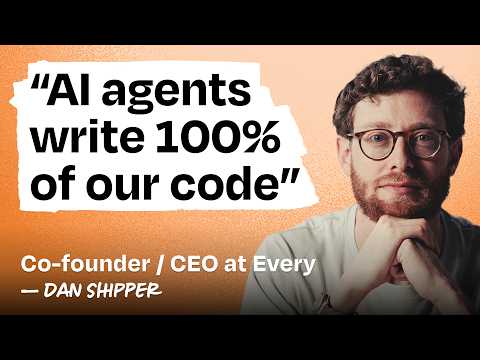
The AI-native startup: 5 products, 7-figure revenue, 100% AI-written code. | Dan Shipper (Every)
Lenny Rachitsky (host), Dan Shipper (guest), Narrator
In this episode of Lenny's Podcast, featuring Lenny Rachitsky and Dan Shipper, The AI-native startup: 5 products, 7-figure revenue, 100% AI-written code. | Dan Shipper (Every) explores inside an AI-Native Startup: Products, Processes, And People Supercharged Lenny interviews Dan Shipper, co-founder and CEO of Every, an AI-native company that runs a daily newsletter, multiple SaaS products, and a consulting arm with just 15 people. Every’s product engineers no longer hand-write code, instead orchestrating agents like Claude Code and other tools to build and ship software. Internally, they’ve restructured work around AI, including a Head of AI Operations, agent libraries, and “compounding engineering” practices that make each project faster than the last. Dan also shares his broader worldview: AI as a force for reshoring jobs, the rise of “model managers” and generalists, and concrete patterns he’s seeing inside large companies that successfully adopt AI.
Inside an AI-Native Startup: Products, Processes, And People Supercharged
Lenny interviews Dan Shipper, co-founder and CEO of Every, an AI-native company that runs a daily newsletter, multiple SaaS products, and a consulting arm with just 15 people. Every’s product engineers no longer hand-write code, instead orchestrating agents like Claude Code and other tools to build and ship software. Internally, they’ve restructured work around AI, including a Head of AI Operations, agent libraries, and “compounding engineering” practices that make each project faster than the last. Dan also shares his broader worldview: AI as a force for reshoring jobs, the rise of “model managers” and generalists, and concrete patterns he’s seeing inside large companies that successfully adopt AI.
Key Takeaways
Hire a Head of AI Operations to systematically automate work.
Every has a dedicated AI ops lead who sits with leaders weekly, identifies repetitive workflows, and turns them into prompts, agents, and automations—freeing the rest of the team from having to context-switch into ‘automation mode’ themselves.
Get the full analysis with uListen AI
Shift engineers from hand-coding to managing agents that write code.
On Every’s product team, engineers now focus on crafting PRDs, prompts, and reviews while agents like Claude Code and tools like Codex/Cursor generate and modify code; humans still review PRs and occasionally dive deeper, but typing the code is no longer the core job.
Get the full analysis with uListen AI
Practice “compounding engineering” so each task makes future tasks cheaper.
Instead of treating each feature or spec as one-off work, Every’s engineers continually build reusable prompts, slash-commands, and internal tools (e. ...
Get the full analysis with uListen AI
Use AI internally first, then unbundle successful workflows into products.
Every prototypes new ideas by aggressively using general-purpose models (ChatGPT, Claude, Gemini) for their own needs—email triage, writing, file cleanup, content automation—then spins the most valuable, repeatedly used workflows into standalone apps like Cora, Sparkle, and Spiral.
Get the full analysis with uListen AI
CEO usage of AI is the strongest predictor of company-wide adoption.
In Every’s consulting work, the organizations that see real productivity gains almost always have a CEO who personally uses ChatGPT/Claude daily, sets realistic expectations, and visibly drives the cultural shift (e. ...
Get the full analysis with uListen AI
Treat AI like a junior team you manage: delegation and feedback are core skills.
Dan’s “allocation economy” view reframes AI as something you manage—breaking down tasks, choosing tools, setting quality criteria, and giving feedback—so managing models (and people who use them) becomes a central skill, not a side activity.
Get the full analysis with uListen AI
Generalists gain leverage as AI handles deep specialization on demand.
Because models can supply domain-specific knowledge and execution across writing, coding, research, and more, people who can span disciplines, set vision, and integrate insights—like the multi-talented team at Every—can run more ambitious portfolios with far fewer people.
Get the full analysis with uListen AI
Notable Quotes
“No one is manually coding anymore.”
— Dan Shipper
“Whenever I see a kid with ChatGPT, I'm like, 'Holy shit. They're gonna go so much faster than any other person that I've worked with.'”
— Dan Shipper
“Organizations like ours—people who are playing at the edge—we're doing things that in, like, three years everybody else is gonna be doing.”
— Dan Shipper
“A good definition of AGI is when it becomes economically profitable for people to run agents indefinitely.”
— Dan Shipper
“Every time I've kind of just leaned into something that feels like the ultimate luxury of my secret desire, it's actually worked a lot better.”
— Dan Shipper
Questions Answered in This Episode
How can a non-technical team realistically start moving toward an AI-native, agent-driven development workflow without existing coding expertise?
Lenny interviews Dan Shipper, co-founder and CEO of Every, an AI-native company that runs a daily newsletter, multiple SaaS products, and a consulting arm with just 15 people. ...
Get the full analysis with uListen AI
What are the first three roles or processes a typical startup should target when hiring a Head of AI Operations?
Get the full analysis with uListen AI
Where is the line today between ‘must know how to code’ and ‘can rely on AI coding agents,’ and how might that line move over the next five years?
Get the full analysis with uListen AI
For large enterprises, how do you measure whether AI adoption is truly increasing leverage versus just adding novelty or overhead?
Get the full analysis with uListen AI
If generalists and “model managers” become more valuable, how should students and early-career professionals prioritize what to learn and how to build their careers now?
Get the full analysis with uListen AI
Transcript Preview
(instrumental music) The business you're building, the team you're building, the way you're operating is the very bleeding edge of how companies are trying to operate in this AI era.
We have a head of AI operations. She's just constantly, like, building prompts and building workflows so that I and everyone else on the team are just automating as much as possible.
What are some things that you believe about AI that most people don't?
I hate the headlines that are like, "Entry level jobs are taken away by AI." Whenever I see a kid with ChatGPT, I'm like, "Holy shit. They're gonna go so much faster than any other person that I've worked with." We have this guy, he made, like, a year's worth of progress in, like, two months, because every time I sat down with him and told him, "Okay. Here's how you tell a story. Here's how you think about a headline." Like, he recorded all of it, put it into a prompt, and he never made the same mistake twice.
There's this sense we're getting to a place where you don't have to write any code. Like, you have a product team not writing code at all.
No one is manually coding anymore. Organizations like ours, people who are playing at the edge, we're doing things that in, like, three years everybody else is gonna be doing.
Today my guest is Dan Schipper. Dan is the co-founder and CEO of Every, which is a company that is at the very bleeding edge of what is possible with AI. Their team of just 15 employees has built and shipped four different products, they publish a daily newsletter, and they have a consulting arm that helps companies adopt the latest AI best practices. On their product team, their engineers don't hand-write a single line of code, and instead use an arsenal of agents who help them craft requirements and build their products. Their editorial arm uses AI to publish better work faster. And they even have a person whose entire job is to help every employee at the company become more efficient using the latest AI workflows. In our conversation, Dan shares a bunch of tactics that they use internally to increase the leverage of their own employees, his personal AI tool stack, the one predictor that he's found for whether a company will successfully find huge productivity gains through AI, how he's building his company in a really unique way, a bunch of predictions for where AI is going, and so much more. If you enjoy this podcast, don't forget to subscribe and follow it in your favorite podcasting app or YouTube. And also, if you become an annual subscriber of my newsletter, you get a bunch of amazing products for free for one year, including Superhuman, Linear, Notion, Perplexity, Bolt, Granola and more. Check it out at lennysnewsletter.com and click bundle. With that, I bring you Dan Schipper. This episode is brought to you by CodeRabbit, the AI code review platform transforming how engineering teams ship faster with AI without sacrificing code quality. Code reviews are critical but time-consuming. CodeRabbit acts as your AI copilot, providing instant code review comments and potential impacts of every pull request. Beyond just flagging issues, CodeRabbit provides one-click fix suggestions and lets you define custom code quality rules using AST/Grep patterns, catching subtle issues that traditional static analysis tools might miss. CodeRabbit also provides free AI code reviews directly in the IDE. It's available in VSCode, Cursor, and Windsurf. CodeRabbit has so far reviewed more than 10 million PRs installed on one million repositories and is used by over 70,000 open source projects. Get CodeRabbit for free for an entire year at coderabbit.ai using code LENNY. That's coderabbit.ai. Today's episode is brought to you by Dx. If you're an engineering leader or on a platform team, at some point your CEO will inevitably ask you for productivity metrics. But measuring engineering organizations is hard, and we can all agree that simple metrics like the number of PRs or commits doesn't tell the full story. That's where Dx comes in. Dx is an engineering intelligence solution designed by leading researchers, including those behind the DORA and SPACE frameworks. It combines quantitative data from developer tools with qualitative feedback from developers to give you a complete view of engineering productivity and the factors affecting it. Learn why some of the world's most iconic companies like Etsy, Dropbox, Twilio, Vercel, and Webflow rely on Dx. Visit Dx's website at getdx.com/lenny. Dan, thank you so much for being here, and welcome to the podcast.
Install uListen to search the full transcript and get AI-powered insights
Get Full TranscriptGet more from every podcast
AI summaries, searchable transcripts, and fact-checking. Free forever.
Add to Chrome