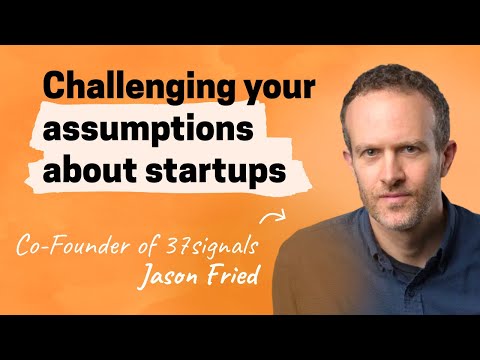
Jason Fried challenges your thinking on fundraising, goals, growth, and more
Jason Fried (guest), Lenny Rachitsky (host)
In this episode of Lenny's Podcast, featuring Jason Fried and Lenny Rachitsky, Jason Fried challenges your thinking on fundraising, goals, growth, and more explores jason Fried argues profits, constraints, and independence beat hyper-growth Jason Fried, co-founder and CEO of 37signals (Basecamp, HEY), explains why he believes most startups should avoid venture capital, stay small, and obsess over profitability rather than growth. He contrasts his 24-year, always-profitable, investor-free company with typical VC-backed software businesses that prioritize scale, headcount, and revenue over margins and sustainability.
Jason Fried argues profits, constraints, and independence beat hyper-growth
Jason Fried, co-founder and CEO of 37signals (Basecamp, HEY), explains why he believes most startups should avoid venture capital, stay small, and obsess over profitability rather than growth. He contrasts his 24-year, always-profitable, investor-free company with typical VC-backed software businesses that prioritize scale, headcount, and revenue over margins and sustainability.
Fried details 37signals’ operating system: tiny two-person product teams, six‑week development cycles with built-in cooldowns, a strong reliance on gut and intuition, and a deliberate rejection of complex planning, OKRs, and long-term roadmaps. He frames entrepreneurship as an “infinite game” and a job he wants to keep doing, not a path to an exit.
He also introduces Once, a new line of non‑SaaS business products you pay for once and host yourself, starting with a reboot of their early group chat product Campfire as a simpler, cheaper alternative to tools like Slack. Throughout, Fried argues that constraints, simplicity, and independence create better businesses, better products, and more enjoyable careers.
Key Takeaways
Bootstrapping forces you to practice the core skill: making money.
When you don’t have investor cash, you must learn early how to charge, find customers, and keep margins healthy—skills many VC-backed founders delay and then struggle to develop once profit suddenly matters.
Get the full analysis with uListen AI
Most ideas are not venture-scale, and that’s a good thing.
Fried argues that chasing unicorn outcomes eliminates the vast middle ground of viable, lucrative businesses; far more founders can succeed by aiming for a solid, enduring company than by optimizing for the tiny odds of a billion‑dollar exit.
Get the full analysis with uListen AI
Small teams and tight constraints produce faster, better product work.
At 37signals, every feature is built by one designer and one programmer in at most six weeks, with a clear “appetite” instead of estimates. ...
Get the full analysis with uListen AI
Avoid promises and long-term planning; decide close to the moment.
Promises like “by the end of the year” and multi‑year plans often lock companies into bad decisions and create stress; Fried prefers to revisit what to do every six weeks, letting current context and energy, not old commitments, drive priorities.
Get the full analysis with uListen AI
Gut and intuition are legitimate, underused tools in business decisions.
Fried insists that even so-called “data-driven” choices are ultimately judgment calls and deliberately asks his team how things feel, not just what metrics say, selecting hires partly on their taste and instinctive product sensibilities.
Get the full analysis with uListen AI
Work doesn’t need war metaphors—or a growth-at-all-costs mindset.
Language like “conquer the market” or “destroy the competition” frames business as combat; 37signals focuses instead on making great alternatives, serving small businesses well, and building a company people want to stay at for decades.
Get the full analysis with uListen AI
There’s room for non-SaaS, pay-once products in a subscription world.
With Once, 37signals is betting that some customers are tired of perpetual SaaS fees and will value owning the code, self-hosting, and paying a single up‑front price—especially for commoditized tools like group chat.
Get the full analysis with uListen AI
Notable Quotes
“The reason I think it's great for entrepreneurs to start bootstrapping is 'cause they just have more practice making money.”
— Jason Fried
“Staying is harder than starting. I'm here to celebrate stay-ups.”
— Jason Fried
“I don't plan long term because I want to do what I think, not what I thought.”
— Jason Fried
“We don't have financial goals. If we make more than we spend, the things we did this year were worth it.”
— Jason Fried
“Getting good at spending money is not as valuable a skill as getting good at making money.”
— Jason Fried
Questions Answered in This Episode
If you’re a first-time founder with limited savings, what pragmatic steps can you take in the first 6–12 months to realistically bootstrap rather than raise money?
Jason Fried, co-founder and CEO of 37signals (Basecamp, HEY), explains why he believes most startups should avoid venture capital, stay small, and obsess over profitability rather than growth. ...
Get the full analysis with uListen AI
How could a larger, venture-backed company safely experiment with Shape Up’s small teams and appetites without disrupting existing roadmaps and stakeholders?
Fried details 37signals’ operating system: tiny two-person product teams, six‑week development cycles with built-in cooldowns, a strong reliance on gut and intuition, and a deliberate rejection of complex planning, OKRs, and long-term roadmaps. ...
Get the full analysis with uListen AI
Where is the line between trusting your intuition and ignoring important data, and how do you know when your gut is leading you astray?
He also introduces Once, a new line of non‑SaaS business products you pay for once and host yourself, starting with a reboot of their early group chat product Campfire as a simpler, cheaper alternative to tools like Slack. ...
Get the full analysis with uListen AI
In what kinds of markets or product categories is the Once model—pay once, self-host—likely to fail compared to SaaS, and why?
Get the full analysis with uListen AI
How might a founder mentally shift from the default ‘exit mindset’ to Fried’s ‘infinite game’ approach if they’ve already raised venture capital?
Get the full analysis with uListen AI
Transcript Preview
The reason I think it's great for entrepreneurs to, to start bootstrapping is 'cause they just have more practice making money. They get better and better and better at the fundamental skill you need to have, ultimately, to run a successful business, which is to make money. Hopefully I don't come off as encouraging everyone to be like me. I'm not saying that at all. What I am saying is this is a way to be. It's an alternative to what you're often hearing in our industry, which is, like, go big or go home, raise a bunch of money and get huge and unicorn status and the whole thing. Like, that's a way. Just know, though, that basically almost nobody makes it that way. Like, really, almost nobody really makes it that way, and there's a lot more room to make it and to build a successful business if you throw out that outlier and look at all the other places you can land as a business.
(instrumental music) Today my guest is Jason Fried. Jason is the co-founder and CEO of 37signals, which makes Basecamp and Hey, and soon a few more products, including a competitor to Slack. 37signals is a very different type of company. They have no investors, no board. They have no plans to go public. They never want to sell their business. They've made a profit for 24 years in a row. They have over 100,000 customers and make tens of millions of dollars in profit each year, which most VC-backed companies never make a dollar of. And all of this profit filters down to the founders and employees, because they have no investors. Most founders, by default, will go down the venture route, raising money from VCs and angels, and for many types of companies, that is necessary. But it's also important to know that there is a different option available, and it can be much more fulfilling and fun, and even much more lucrative by bootstrapping your idea. In my conversation with Jason, we get into why constraints like small teams and less cash often lead to better outcomes, why gut and instinct is underappreciated as a decision-making tool, why planning long-term is often a mistake, why work doesn't have to feel like war, why we should focus on playing infinite games, when it makes sense to consider raising venture capital versus bootstrapping, how to actually bootstrap your startup, so much more. Jason is fascinating, and he's got a lot of wisdom to share. I'm excited to be able to bring you this conversation. With that, I bring you Jason Fried after a short word from our sponsors. This episode is brought to you by Coda. You've heard me talk about how Coda is the dock that brings it all together, and how it can help your team run smoother and be more efficient. I know this firsthand, because Coda does that for me. I use Coda every day to wrangle my newsletter content calendar, my interview notes for podcasts, and to coordinate my sponsors. More recently, I actually wrote a whole post on how Coda's product team operates, and within that post, they shared a dozen templates that they use internally to run their product team, including managing the roadmap, their OKR process, getting internal feedback, and essentially their whole product development process is done within Coda. If your team's work is spread out across different documents and spreadsheets and a stack of workflow tools, that's why you need Coda. Coda puts data in one centralized location, regardless of format, eliminating roadblocks that can slow your team down. Coda allows your team to operate on the same information and collaborate in one place. Take advantage of this special limited time offer just for startups. Sign up today at coda.io/lenny and get $1,000 startup credit on your first statement. That's coda.io/lenny to sign up, and get a startup credit of $1,000. Coda.io/lenny. This episode is brought to you by Sidebar. Are you looking to land your next big career move, or start your own thing? One of the most effective ways to create a big leap in your career, and something that worked really well for me a few years ago, is to create a personal board of directors, a trusted peer group where you can discuss challenges you're having, get career advice, and just kind of gut check how you're thinking about your work, your career, and your life. This has been a big trajectory changer for me, but it's hard to build this trusted group. With Sidebar, senior leaders are matched with highly vetted, private, supportive peer groups to lean on for unbiased opinions, diverse perspectives, and raw feedback. Everyone has their own zone of genius, so together we're better prepared to navigate professional pitfalls, leading to more responsibility, faster promotions. And bigger impact. Guided by world-class programming and facilitation, Sidebar enables you to get focused, tactical feedback at every step of your journey. If you're a listener of this podcast, you're likely already driven and committed to growth. A Sidebar personal board of directors is the missing piece to catalyze that journey. Why spend a decade finding your people when you can meet them at Sidebar today? Jump the growing wait list of thousands of leaders from top tech companies by visiting sidebar.com/lenny to learn more. That's sidebar.com/lenny. Jason, thank you so much for being here, and welcome to the podcast.
Install uListen to search the full transcript and get AI-powered insights
Get Full TranscriptGet more from every podcast
AI summaries, searchable transcripts, and fact-checking. Free forever.
Add to Chrome