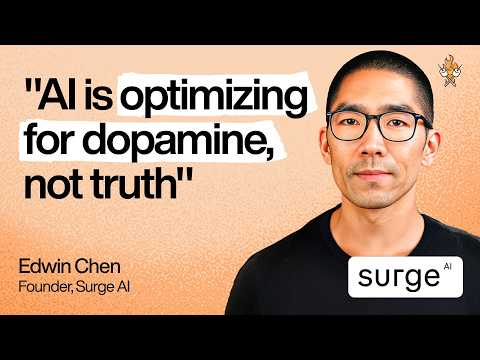
The $1B Al company training ChatGPT, Claude & Gemini on the path to responsible AGI | Edwin Chen
Lenny Rachitsky (host), Edwin Chen (guest), Narrator
In this episode of Lenny's Podcast, featuring Lenny Rachitsky and Edwin Chen, The $1B Al company training ChatGPT, Claude & Gemini on the path to responsible AGI | Edwin Chen explores bootstrapped AI Data Giant Surge Reimagines Responsible Path To AGI Founder Edwin Chen explains how Surge AI became a $1B-revenue, sub‑100‑person, fully bootstrapped company by obsessing over ultra‑high‑quality training data for frontier models like ChatGPT, Claude, and Gemini.
Bootstrapped AI Data Giant Surge Reimagines Responsible Path To AGI
Founder Edwin Chen explains how Surge AI became a $1B-revenue, sub‑100‑person, fully bootstrapped company by obsessing over ultra‑high‑quality training data for frontier models like ChatGPT, Claude, and Gemini.
He argues that most labs misunderstand data quality, over‑optimize for noisy benchmarks and engagement, and risk steering AI toward dopamine and slop instead of truth and real societal progress.
Chen outlines the evolution of post‑training—from SFT and RLHF to rubrics, verifiers, and rich RL environments—and describes how taste, values, and objective functions at each lab will increasingly differentiate models.
He also makes a broader case against the default Silicon Valley VC playbook, advocating for small elite teams, deep focus, principled research, and building the one company only you are uniquely qualified to build.
Key Takeaways
Extreme focus and tiny teams can massively outperform bloated organizations.
Surge surpassed $1B in revenue with under 100 people by deliberately avoiding the typical Silicon Valley game—no VC, minimal PR—and instead relying on a small, elite, deeply aligned team shipping a 10x better product.
Get the full analysis with uListen AI
True data quality is nuanced, subjective, and labor‑intensive to measure.
Good training data is not just ‘correct format and instructions followed’; Surge uses thousands of behavioral and performance signals to identify not just acceptable work but “best of the best” contributors for complex tasks like Nobel‑level poetry, advanced coding, and scientific reasoning.
Get the full analysis with uListen AI
Benchmarks and public leaderboards are distorting AI progress.
Many benchmarks are noisy or wrong, easy to game, and correlate poorly with real‑world capability; optimizing for them often rewards flashy, emoji‑laden, hallucination‑prone outputs that win votes but degrade truthfulness and reliability.
Get the full analysis with uListen AI
Objective functions and values will shape how different AIs behave.
Labs choose what to optimize—engagement, benchmarks, productivity, safety, taste—and those choices drive data selection, post‑training, and ultimately model personality, such as whether an assistant endlessly polishes an email or tells you, “It’s good enough, move on.”
Get the full analysis with uListen AI
Reinforcement learning in rich environments is the next big frontier.
Beyond SFT and RLHF, Surge is building simulated ‘worlds’ (e. ...
Get the full analysis with uListen AI
Founders don’t need VC or constant pivoting to build generational companies.
Chen argues against blitzscaling, growth‑at‑all‑costs, and chasing hype cycles; he advocates sticking to a deep, singular mission, hiring only highly aligned people, and building the one company that couldn’t exist without your unique expertise and obsessions.
Get the full analysis with uListen AI
Training AI is closer to raising a child than labeling cat photos.
Surge sees its work as imparting values, taste, and notions of beauty, truth, and usefulness—helping labs define rich objective functions and curating data that steers models toward advancing humanity rather than maximizing clicks or complacency.
Get the full analysis with uListen AI
Notable Quotes
“We essentially teach AI models what's good and what's bad.”
— Edwin Chen
“People think you can just throw bodies at a problem and get good data. That's completely wrong.”
— Edwin Chen
“I'm worried that instead of building AI that will actually advance us as a species, we are optimizing for AI sloth instead.”
— Edwin Chen
“You are your objective function.”
— Edwin Chen
“I would rather be Terence Tao than Warren Buffett.”
— Edwin Chen
Questions Answered in This Episode
If current leaderboards and benchmarks are so misleading, what concrete alternative evaluation frameworks should labs and buyers adopt instead?
Founder Edwin Chen explains how Surge AI became a $1B-revenue, sub‑100‑person, fully bootstrapped company by obsessing over ultra‑high‑quality training data for frontier models like ChatGPT, Claude, and Gemini.
Get the full analysis with uListen AI
How should AI companies explicitly define and document their ‘objective function’ so users can understand the values and tradeoffs embedded in each model?
He argues that most labs misunderstand data quality, over‑optimize for noisy benchmarks and engagement, and risk steering AI toward dopamine and slop instead of truth and real societal progress.
Get the full analysis with uListen AI
What governance or incentive changes would reduce pressure on labs to optimize for engagement and leaderboard position over truthfulness and societal benefit?
Chen outlines the evolution of post‑training—from SFT and RLHF to rubrics, verifiers, and rich RL environments—and describes how taste, values, and objective functions at each lab will increasingly differentiate models.
Get the full analysis with uListen AI
How can smaller startups practically adopt RL environments and trajectory‑aware training without Surge‑level resources?
He also makes a broader case against the default Silicon Valley VC playbook, advocating for small elite teams, deep focus, principled research, and building the one company only you are uniquely qualified to build.
Get the full analysis with uListen AI
For founders, what signals indicate they’re building the ‘one company only they can build’ rather than just chasing the latest hype wave?
Get the full analysis with uListen AI
Transcript Preview
You guys hit a billion in revenue in less than four years with around 60 to 70 people. You were completely bootstrapped, haven't raised any VC money. I don't believe anyone has ever done this before.
We basically never wanted to play the Silicon Valley game. That always sounds ridiculous. I used to work at a bunch of the big tech companies and I always felt that we could fire 90% of people and we would move faster because the best people wouldn't have all the distractions. So when we started Surge, we wanted to build it completely differently with a super small, super elite team.
You guys are by far the most successful data company out there.
We essentially teach AI models what's good and what's bad. People don't understand what quality even means in this space. They think you can just throw bodies at a problem and get good data. That's completely wrong.
To a regular person, it doesn't feel like these models are getting that much smarter constantly.
Over the past year, I've realized that the values that the companies have will shape the models. I was asking Claude to help me draft an email the other day and after 30 minutes, yeah, I think it really crafted me the perfect email and I sent it. But then I realized that I spent 30 minutes doing something that didn't matter at all. If you could choose the perfect model behavior, which model would you want? Do you want a model that says, "You're absolutely right. There are definitely 20 more ways to improve this email," and it continues for 50 more iterations? Or do you want a model that's optimizing for your time and productivity and just says, "No, you need to stop. Your email's great. Just send it and move on."
You have this hot take that a lot of these labs are pushing AGI in the wrong direction.
I'm worried that instead of building AI that will actually advance us as a species, curing cancer, solving poverty, understanding the universe, we are optimizing for AI sloth instead. We'll be optimizing our models for the types of people who buy tabloids at the grocery store. We're basically teaching our models to chase dopamine instead of truth.
(instrumental music) Today my guest is Edwin Chen, founder and CEO of Surge AI. Edwin is an extraordinary CEO and Surge is an extraordinary company. They're the leading AI data company powering training at every frontier AI lab. They are also the fastest company to ever hit $1 billion in revenue in just four years after launch with fewer than 100 people and also completely bootstrapped. They've never raised a dollar in VC money. They've also been profitable from day one. As you'll hear in this conversation, Edwin has a very different take on how to build an important company and how to build AI that is truly good and useful to humanity. I absolutely loved this conversation and I learned a ton. I'm really excited for you to hear it. If you enjoy this podcast, don't forget to subscribe and follow it in your favorite podcasting app or YouTube. It helps tremendously. And if you become an annual subscriber of my newsletter, you get a ton of incredible products for free for an entire year, including Devin, Lovable, Replit, Bolt, N8n, Linear, Superhuman, Descript, Whisperflow, Gamma, Perplexity, Warp, Granola, Magic Patterns, Raycast, Shipyard, Emob and Posthog and Stripe Atlas. Head on over to lennysnewsletter.com and click Product Pass. With that, I bring you Edwin Chen after a short word from our sponsors. My podcast guest and I love talking about craft and taste and agency and product market fit. You know what we don't love talking about? SOC 2. That's where Vanta comes in. Vanta helps companies of all sizes get compliant fast and stay that way with industry leading AI, automation and continuous monitoring. Whether you're a startup tackling your first SOC 2 or ISO 27001, or an enterprise managing vendor risk, Vanta's Trust Management Platform makes it quicker, easier and more scalable. Vanta also helps you complete security questionnaires up to five times faster so that you can win bigger deals sooner. The result? According to a recent IDC study, Vanta customers slashed over $500,000 a year and are three times more productive. Establishing trust isn't optional. Vanta makes it automatic. Get $1,000 off at vanta.com/lenny. Here's a puzzle for you. What do OpenAI, Cursor, Perplexity, Vercel, Plat, and hundreds of other winning companies have in common? The answer is they're all powered by today's sponsor, WorkOS. If you're building software for enterprises, you've probably felt the pain of integrating single sign-on, SKIM, RBAC, audit logs and other features required by big customers. WorkOS turns those deal blockers into drop-in APIs with a modern developer platform built specifically for B2B SaaS. Whether you're a seed stage startup trying to land your first enterprise customer or a unicorn expanding globally, WorkOS is the fastest path to becoming enterprise ready and unlocking growth. They're essentially Stripe for enterprise features. Visit workos.com to get started or just hit up their Slack support where they have real engineers in there who answer your questions super fast. WorkOS allows you to build like the best with delightful APIs, comprehensive docs and a smooth developer experience. Go to workos.com to make your app enterprise ready today. (instrumental music) Edwin, thank you so much for being here and welcome to the podcast.
Install uListen to search the full transcript and get AI-powered insights
Get Full TranscriptGet more from every podcast
AI summaries, searchable transcripts, and fact-checking. Free forever.
Add to Chrome