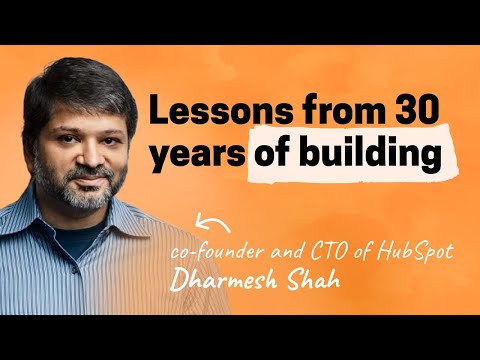
Zigging vs. zagging: How HubSpot built a $30B company | Dharmesh Shah (co-founder/CTO)
Dharmesh Shah (guest), Lenny Rachitsky (host), Narrator
In this episode of Lenny's Podcast, featuring Dharmesh Shah and Lenny Rachitsky, Zigging vs. zagging: How HubSpot built a $30B company | Dharmesh Shah (co-founder/CTO) explores dharmesh Shah on contrarian culture, simplicity, AI, and no managers HubSpot co-founder and CTO Dharmesh Shah shares how he’s deliberately built a $30B company in highly unconventional ways: no direct reports, radical transparency, and a broad all‑in‑one product from day one. He explains his systems-first approach to public speaking (including measuring laughs per minute), decision-making, and culture-building, treating culture as a product to be iterated rather than preserved. Dharmesh dives into why HubSpot stayed focused on SMB despite intense pressure to move upmarket, how to fight organizational entropy with simplicity, and how to zig when everyone else zags. He closes with his views on AI as “cognition at scale,” the future of declarative interfaces, and a practical framework for choosing what ideas to pursue.
Dharmesh Shah on contrarian culture, simplicity, AI, and no managers
HubSpot co-founder and CTO Dharmesh Shah shares how he’s deliberately built a $30B company in highly unconventional ways: no direct reports, radical transparency, and a broad all‑in‑one product from day one. He explains his systems-first approach to public speaking (including measuring laughs per minute), decision-making, and culture-building, treating culture as a product to be iterated rather than preserved. Dharmesh dives into why HubSpot stayed focused on SMB despite intense pressure to move upmarket, how to fight organizational entropy with simplicity, and how to zig when everyone else zags. He closes with his views on AI as “cognition at scale,” the future of declarative interfaces, and a practical framework for choosing what ideas to pursue.
Key Takeaways
Design your role around your strengths, not conventional expectations.
Dharmesh insisted from day one on having zero direct reports because he knows he’s bad at and dislikes management. ...
Get the full analysis with uListen AI
Treat difficult skills as acquirable systems, then measure your progress.
Public speaking didn’t come naturally to Dharmesh, so he functionally decomposed it into sub-skills (slides, stage presence, humor) and built custom software to track laughs per minute. ...
Get the full analysis with uListen AI
Culture is a product you build and iterate, not something you preserve.
Dharmesh reframed culture as “the product you build for your team. ...
Get the full analysis with uListen AI
Fight entropy by encoding simplicity into rules, not just slogans.
Recognizing that complexity inevitably grows (second law of thermodynamics), HubSpot enforced constraints like: add a knob/feature → remove one elsewhere; four equal desks + seating lottery; very broad transparency. ...
Get the full analysis with uListen AI
It can be rational to go broad early—if the true problem demands it.
While standard advice says “do one thing really well,” HubSpot intentionally launched an all‑in‑one marketing suite because SMBs’ real problem was integration and orchestration, not lack of point tools. ...
Get the full analysis with uListen AI
Make decision quality proportional to consequence, and clarify who decides.
HubSpot assigns a single DRI (directly responsible individual) for important calls, uses data as input but insists people make decisions, and follows ‘debate, decide, unite’ so teams align after a choice is made. ...
Get the full analysis with uListen AI
AI unlocks declarative interfaces and ‘cognition at scale’—build by solving real problems with it.
Dharmesh sees AI as the biggest shift since the early web, enabling users to describe desired outcomes instead of clicking through complex UIs. ...
Get the full analysis with uListen AI
Notable Quotes
“I don't want to spend N years of my life becoming passably okay at something.”
— Dharmesh Shah
“Some of the best startup advice I've heard is, startups should focus on one thing and be really world-class at that one thing. And one of our early zigs is we are going to do exactly the opposite of that.”
— Dharmesh Shah
“Culture is a product. Every company builds two products: one for its customers and one for its team.”
— Dharmesh Shah
“Over time, unless you intervene, everything goes to crap. That’s the second law of thermodynamics—and it applies to companies too.”
— Dharmesh Shah
“Success is making the people who believed in you look brilliant.”
— Dharmesh Shah
Questions Answered in This Episode
How can a founder realistically design a role with no direct reports or management responsibilities in a growing startup without creating gaps or confusion?
HubSpot co-founder and CTO Dharmesh Shah shares how he’s deliberately built a $30B company in highly unconventional ways: no direct reports, radical transparency, and a broad all‑in‑one product from day one. ...
Get the full analysis with uListen AI
If culture is a product, what are the ‘metrics’ and feedback loops you’d implement in a 20–50-person company to start iterating it intentionally?
Get the full analysis with uListen AI
Where is your organization currently succumbing to entropy and complexity, and what explicit rules or constraints could you introduce to fight it?
Get the full analysis with uListen AI
In your own product, is the real customer problem about depth in a narrow function, or about orchestration and integration across many tools like HubSpot discovered?
Get the full analysis with uListen AI
What is one concrete, high-value workflow in your job you could rebuild using AI as a declarative interface instead of traditional clicks and forms?
Get the full analysis with uListen AI
Transcript Preview
(instrumental music plays) Some of the best startup advice I've heard is, startups should focus on one thing and be really, really exceptionally world class at that one thing. And one of our early zigs is we are going to do exactly the opposite of that.
You have no direct reports and I don't believe you've ever had direct reports at HubSpot.
I could become passably okay at management with some training, with some coaching. I don't want to spend N years of my life becoming passably okay at something.
What was that process like to define the culture?
My co-founder and I were having one of our founder's meetings and he said, "Oh, Dharmesh, I hear this culture thing is really important. By the way, can you go do that?" I'm like, "Okay, Ryan, of all the people in all of
(laughs)
... company, it's like, I am like, the worst possible person. It's not that I don't like people, I just don't like being around them a whole lot.
Something that's really unique and interesting about you is you're obsessed with comedy and keynote prep.
It comes down to this metric that stand-up comedians use called LPM, laughs per minute. I have custom software that I've written that will say, "Okay, here are the points at which the audience laughed."
(instrumental music plays) Today my guest is Dharmesh Shah. Dharmesh is the co-founder and CTO of HubSpot and also one of the most fascinating and first principled thinkers I've ever met. In our conversation, we cover a lot of ground. Dharmesh's hilarious and ingenious approach to putting together a talk, including measuring laughs per minute, his biggest lessons from being a public company exec for over 10 years now, especially while being a startup guy at heart, how he approached creating and scaling the culture of HubSpot, which you'll find both hilarious and inspiring, why founders and product teams are all fighting the second law of thermodynamics, how to zig while everyone else is zagging, how and why Dharmesh leans into his strengths, including never having a single direct report during his 18 years of running HubSpot, and so much more. This episode is so fun and will expand your mind in many ways. With that, I bring you Dharmesh Shah after a short word from our sponsors. And if you enjoy this podcast, don't forget to subscribe and follow it in your favorite podcasting app or YouTube. It's the best way to avoid missing future episodes and it helps the podcast tremendously. This episode is brought to you by Explo, a game changer for customer facing analytics and data reporting. Are your users craving more dashboards, reports and analytics within your product? Are you tired of trying to build it yourself? As a product leader, you probably have these requests in your roadmap, but the struggle to prioritize them is real. Building analytics from scratch can be time-consuming, expensive and a really challenging process. Enter Explo. Explo is a fully white-labeled embedded analytic solution designed entirely with your user in mind. Getting started is easy. Explo connects to any relational database or warehouse and with its low-code functionality, you can build and style dashboards in minutes. Once you're ready, simply embed the dashboard or report into your application with a tiny code snippet. The best part? Your end users can use Explo's AI features for their own report and dashboard generation, eliminating customer data requests for your support team. Build and embed a fully white-labeled analytics experience in days. Try it for free at explo.co/lenny. That's E-X-P-L-O.co/lenny. This episode is brought to you by Vanta. When it comes to ensuring your company has top-notch security practices, things get complicated fast. Now you can assess risk, secure the trust of your customers and automate compliance for SOC 2, ISO 27001, HIPAA and more with a single platform, Vanta. Vanta's market-leading trust management platform helps you continuously monitor compliance alongside reporting and tracking risks. Plus, you can save hours by completing security questionnaires with Vanta AI. Join thousands of global companies that use Vanta to automate evidence collection, unify risk management and streamline security reviews. Get $1,000 off Vanta when you go to vanta.com/lenny. That's V-A-N-T-A.com/lenny. (instrumental music plays) Dharmesh, thank you so much for being here and welcome to the podcast.
Install uListen to search the full transcript and get AI-powered insights
Get Full TranscriptGet more from every podcast
AI summaries, searchable transcripts, and fact-checking. Free forever.
Add to Chrome