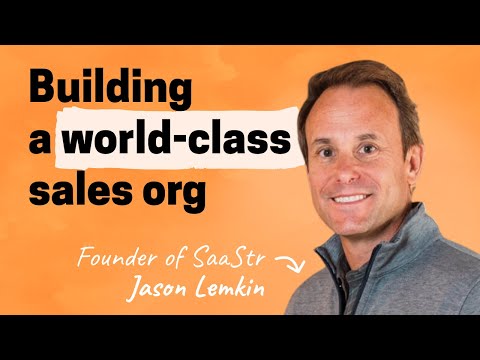
Building a world-class sales org | Jason Lemkin (SaaStr)
Jason Lemkin (guest), Lenny Rachitsky (host)
In this episode of Lenny's Podcast, featuring Jason Lemkin and Lenny Rachitsky, Building a world-class sales org | Jason Lemkin (SaaStr) explores jason Lemkin’s playbook for building and scaling B2B sales teams Jason Lemkin lays out a practical, often counterintuitive blueprint for when and how to build a B2B sales organization, starting with founders closing the first 10 customers themselves. He explains why your first two sales hires must be people you’d personally buy from, why you should delay hiring a VP of Sales until at least two reps are reliably hitting quota, and how to structure compensation so reps are accretive rather than a cash drain. The conversation dives into the critical (and tense) relationship between product and sales—how product leaders should engage in sales cycles, handle feature requests, and think about free trials and pricing. Jason also touches on event strategy, arguing that small, high‑quality customer gatherings are often more valuable than mid‑tier conferences, and urges product leaders to make this “the year of the customer.”
Jason Lemkin’s playbook for building and scaling B2B sales teams
Jason Lemkin lays out a practical, often counterintuitive blueprint for when and how to build a B2B sales organization, starting with founders closing the first 10 customers themselves. He explains why your first two sales hires must be people you’d personally buy from, why you should delay hiring a VP of Sales until at least two reps are reliably hitting quota, and how to structure compensation so reps are accretive rather than a cash drain. The conversation dives into the critical (and tense) relationship between product and sales—how product leaders should engage in sales cycles, handle feature requests, and think about free trials and pricing. Jason also touches on event strategy, arguing that small, high‑quality customer gatherings are often more valuable than mid‑tier conferences, and urges product leaders to make this “the year of the customer.”
Key Takeaways
Founders must close the first ~10 customers and be honest about their motion.
If your earliest unaffiliated customers need hand-holding, security reviews, and deployment help, you do not have a pure PLG motion—ignoring that and forcing self‑serve will likely kill the business. ...
Get the full analysis with uListen AI
Hire two AEs early, not one—and only if you’d buy from them.
You need an A/B test on humans, which means hiring two initial reps and comparing their performance and style. ...
Get the full analysis with uListen AI
Delay the VP of Sales until two reps are reliably hitting quota.
A VP of Sales’ real job is taking you from roughly 3 to 300 reps, not finding product‑market fit and being your first closer. ...
Get the full analysis with uListen AI
Structure sales comp so reps can win early, then become clearly accretive.
Pay roughly market OTE (often 50/50 base/variable), let new reps keep 100% of what they close for their first quarter to ramp, and then aim for them to close 3–5x their OTE annually depending on deal size. ...
Get the full analysis with uListen AI
Make product a core weapon in big deals and formalize sales’ roadmap influence.
Great heads of product deeply engage in sales, especially large or complex deals, where their product fluency and authority can make or break contracts. ...
Get the full analysis with uListen AI
Treat free, trials, and pricing as long-term compounding levers—not short-term tricks.
Longer trials and freemium can create better products and advocates, while heavy-handed pushes to annual contracts or price hikes that aren’t “earned” erode trust and hurt compounding revenue. ...
Get the full analysis with uListen AI
Be extremely cautious with burned-out leaders and over-weaponized functions.
Many seasoned VPs of Sales and CS are tired of actually selling or working with customers and only want to manage dashboards and process; avoid them, especially under 50–100M ARR. ...
Get the full analysis with uListen AI
Notable Quotes
“We’re not really selling in B2B. We’re solving problems.”
— Jason Lemkin
“Those first couple reps have to be people you would buy your own product from.”
— Jason Lemkin
“If you hire a VP of Sales before two reps are hitting quota, there’s approaching a 100% chance of failure.”
— Jason Lemkin
“Every time you rip a customer off, you lose compounding.”
— Jason Lemkin
“Make this the year of the customer. Ship three great things this year—great, not good.”
— Jason Lemkin
Questions Answered in This Episode
How can a founder who truly dislikes sales practically train themselves to get comfortable asking for next steps and money?
Jason Lemkin lays out a practical, often counterintuitive blueprint for when and how to build a B2B sales organization, starting with founders closing the first 10 customers themselves. ...
Get the full analysis with uListen AI
In my specific product and ACV band, what should my first two AEs’ OTE and quota realistically look like to be both attractive and accretive?
Get the full analysis with uListen AI
What lightweight, weekly mechanism can I set up between product and sales to formalize that 10% roadmap budget without bogging the team down in process?
Get the full analysis with uListen AI
Given my current trial and freemium setup, am I optimizing for long-term compounding (churn, advocacy) or for short-term revenue at the cost of trust?
Get the full analysis with uListen AI
How can I objectively assess whether a VP of Sales or CS candidate is burned out and unwilling to actually engage with customers and deals?
Get the full analysis with uListen AI
Transcript Preview
Here's the mistake that 99% of founders and sales reps make. We're not really selling in B2B. We're solving problems. Our job as sales reps in SaaS is to not sell a used car, okay? We are selling a Tesla Model 3 Performance. It has competition. I might not need it this week, okay? But it's pretty darn good. Let me help you get you into that Model 3 Performance today. And I've even got a special discount for the end of this month, and let me just help you. And I've spent four calls answering all your questions, and I've explained to you all the things and why the supercharging network is better than the regular one that doesn't really work at the charger near your house, and I've gone on Google and I've seen there's no charging network near your house. There's only supercharges. I, I, I kind of got you, don't I? And that's the job of SaaS and sales because we're not selling commodities.
(instrumental music) Today, my guest is Jason Lemkin. Jason created and runs SaaStr, the world's largest community for SaaS and B2B founders. He also runs two of the biggest tech conferences every year, one in the Bay Area, which attracts over 15,000 people, and one in Europe with over 3,000 SaaS executives, founders and entrepreneurs. Before SaaStr, Jason was the CEO and co-founder of EchoSign, which he grew to over 100 million ARR, and then sold to Adobe where he ended up as the vice president of their web services business. If you follow Jason on Twitter or LinkedIn, you know how much wisdom he has to share about all aspects of building a successful SaaS business. In our conversation, we focused on what I find most product leaders have the least experience in: building a sales team. We get very practical and tactical on how long you should wait to hire your first salesperson, what your one to two first hires should look like, why you should actually hire two salespeople, not just one initially, how to comp them, how to interview them, when it's time to hire a VP of sales, how to avoid your salespeople flaming out and burning through all your cash. We also get into how to make the product and sales relationship healthier, including how to push back on sales and feature requests, why your head of product should be super involved in your sales process, how long you should make your trials, why you should avoid annual contracts, and so much more. Jason also shares advice for running a conference, which I found super interesting. This episode went long because I just couldn't stop asking Jason questions, but as a result, I'm excited to bring you this incredibly rich episode on building your sales team. If you enjoy this podcast, don't forget to subscribe and follow this podcast in your favorite podcasting app or YouTube. This helps tremendously, and I really appreciate it. With that, I bring you Jason Lemkin after a short word from our sponsors. Let me tell you about CommandBar. If you're like me and most users I build product for, you probably find those little in-product pop-ups really annoying. “Want to take a tour?" "Check out this new feature!" And these pop-ups are becoming less and less effective since most users don't read what they say. They just want to close them as soon as possible. But every product builder knows that users need help to learn the ins and outs of your product. We use so many products every day, and we can't possibly know the ins and outs of every one. CommandBar is an AI-powered toolkit for product, growth, marketing, and customer teams to help users get the most out of your product without annoying them. They use AI to get closer to user intent, so they have search and chat products that let users describe what they're trying to do in their own words and then see personalized results, like customer walkthroughs or actions. And they do pop-ups too, but their nudges are based on in-product behaviors like confusion or intent classification, which makes them much less annoying and much more impactful. This works for web apps, mobile apps, and websites. And they work with industry-leading companies like Gusto, Freshworks, HashiCorp, and LaunchDarkly. Over 15 million end users have interacted with CommandBar. To try out CommandBar, you can sign up at commandbar.com/lenny and you can unlock an extra 1,000 AI responses per month for any plan. That's commandbar.com/lenny. This episode is brought to you by Vanta, helping you streamline your security compliance to accelerate your growth. Thousands of fast-growing companies like Gusto, Calm, Quora, and Modern Treasury trust Vanta to help build, scale, manage, and demonstrate their security and compliance programs and get ready for audits in weeks, not months. By offering the most in-demand security and privacy frameworks such as SOC 2, ISO 27001, GDPR, HIPAA, and many more, Vanta helps companies obtain the reports they need to accelerate growth, build efficient compliance processes, mitigate risks to their businesses, and build trust with external stakeholders. Over 5,000 fast-growing companies use Vanta to automate up to 90% of the work involved with SOC 2 and these other frameworks. For a limited time, Lenny's podcast listeners get $1,000 off Vanta. Go to vanta.com/lenny. That's V-A-N-T-A dot com slash Lenny to learn more and to claim your discounts. Get started today. Jason, thank you so much for being here, and welcome to the podcast.
Install uListen to search the full transcript and get AI-powered insights
Get Full TranscriptGet more from every podcast
AI summaries, searchable transcripts, and fact-checking. Free forever.
Add to Chrome