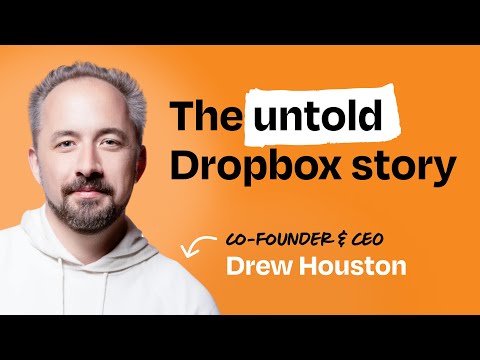
Behind the founder: Drew Houston (Dropbox)
Lenny Rachitsky (host), Drew Houston (guest)
In this episode of Lenny's Podcast, featuring Lenny Rachitsky and Drew Houston, Behind the founder: Drew Houston (Dropbox) explores dropbox’s Drew Houston on hypergrowth, near-collapse, and founder reinvention Drew Houston walks through Dropbox’s 18‑year arc in three phases: explosive early growth and product-market fit, a painful middle era of intense big-tech competition and internal stagnation, and a current phase of reinvention focused on AI, distributed work, and rebuilding the culture.
Dropbox’s Drew Houston on hypergrowth, near-collapse, and founder reinvention
Drew Houston walks through Dropbox’s 18‑year arc in three phases: explosive early growth and product-market fit, a painful middle era of intense big-tech competition and internal stagnation, and a current phase of reinvention focused on AI, distributed work, and rebuilding the culture.
He details how Apple, Google, and Microsoft slowly constricted Dropbox’s core businesses while internal complacency, talent gaps, and weak execution compounded the pressure.
Houston shares how he reset himself as a leader—through therapy, coaching, mindfulness, honest self-assessment, and deep reading—and how he rebuilt the company’s mission around “designing a more enlightened way of working.”
The conversation is both a candid postmortem of strategic missteps and a playbook for founders on navigating inflection points, retaining agency, and continuously scaling themselves ahead of their companies.
Key Takeaways
Explosive product-market fit can mask deep strategic and operational weaknesses.
Dropbox’s early viral growth, press acclaim, and soaring valuations hid the fact that the business model was exposed to platform incumbents and that internal systems, culture, and leadership maturity were not keeping pace with revenue.
Get the full analysis with uListen AI
Competition from incumbents is a slow boa constrictor, not a shotgun blast.
Apple’s iCloud, Google Drive, and later Google Photos didn’t kill Dropbox overnight; their bundling, free storage, and iterated products gradually eroded economics and position—mirroring Intel’s and Netscape’s histories that Houston studied in depth.
Get the full analysis with uListen AI
Sometimes you must deliberately kill promising products to save the company.
Guided by Andy Grove’s ‘Only the Paranoid Survive’ and Lafley/Martin’s ‘Playing to Win,’ Houston shut down Carousel and Mailbox and exited lucrative-sounding markets to concentrate on areas where Dropbox could hold a real, durable leadership position.
Get the full analysis with uListen AI
Founder self-awareness is non-negotiable; your personality scales into culture.
Using tools like the Enneagram, 360 feedback, therapy, and coaching, Houston saw how his strengths (creativity, optimism) and weaknesses (conflict avoidance, chaos, boredom with routine) had directly created cultural dysfunction and strategic drift inside Dropbox.
Get the full analysis with uListen AI
You must keep your personal growth curve ahead of your company’s growth curve.
Houston emphasizes systematic learning—voracious reading, surrounding yourself with founders a bit ahead of you, and asking “In 1/2/5 years, what will I wish I’d started learning today? ...
Get the full analysis with uListen AI
Success breeds complacency and a dangerous seniority gap if left unchecked.
As narrative turned negative, senior talent left, recruiting stalled, and internal promotions outpaced experience, creating a “seniority gap” where too many leaders were solving known problems by trial and error, without experienced mentors to guide them.
Get the full analysis with uListen AI
The future of Dropbox is solving modern “work friction,” not just file storage.
Reframing its mission as “designing a more enlightened way of working,” Dropbox is building tools like Dropbox Dash—universal search and AI over all your SaaS tools—to address fragmentation, distraction, and information overload in distributed work.
Get the full analysis with uListen AI
Notable Quotes
“We went from the company that could do no wrong to the company that could do no right.”
— Drew Houston
“Microsoft did not kill us. We killed ourselves.”
— Bill Campbell, as recounted by Drew Houston
“Our ultimate non‑renewable resource is our time and attention, and we hooked it up to a system that burns half of it off as friction.”
— Drew Houston
“You have to figure out how to keep your personal growth curve ahead of the company’s growth curve.”
— Drew Houston
“Challenge is not optional as a founder. Suffering is.”
— Drew Houston
Questions Answered in This Episode
If you could go back to 2011–2013, what concrete decisions would you change to better prepare Dropbox for the Apple/Google/Microsoft squeeze?
Drew Houston walks through Dropbox’s 18‑year arc in three phases: explosive early growth and product-market fit, a painful middle era of intense big-tech competition and internal stagnation, and a current phase of reinvention focused on AI, distributed work, and rebuilding the culture.
Get the full analysis with uListen AI
How do you now decide which markets Dropbox should explicitly avoid, even if they look large and adjacent?
He details how Apple, Google, and Microsoft slowly constricted Dropbox’s core businesses while internal complacency, talent gaps, and weak execution compounded the pressure.
Get the full analysis with uListen AI
What early warning indicators should founders watch for that they’re entering a strategic inflection point like the one Dropbox hit in 2015?
Houston shares how he reset himself as a leader—through therapy, coaching, mindfulness, honest self-assessment, and deep reading—and how he rebuilt the company’s mission around “designing a more enlightened way of working.”
Get the full analysis with uListen AI
How do you practically diagnose and repair a “seniority gap” in an organization before it stalls product velocity?
The conversation is both a candid postmortem of strategic missteps and a playbook for founders on navigating inflection points, retaining agency, and continuously scaling themselves ahead of their companies.
Get the full analysis with uListen AI
In a world where AI agents and RAG are spreading fast, what unique, durable advantage do you believe Dropbox Dash can build over the next decade?
Get the full analysis with uListen AI
Transcript Preview
(instrumental music) ... people just don't realize the wild journey that you have been on over the past 18 years building this company. It feels like there's almost been these three eras of Dropbox. The first era of you're killing it.
For the first several years, it was doubling, 10Xing every year, putting, like taping user counts that we printed out to the wall and then running out of space on the wall, having to put 100,000 users, 200,500, 500K, a million, 10 million on the ceiling.
Then there's the second era, which is I'll just say everyone's trying to kill you.
(instrumental music) We started getting, uh, all the incumbents, Apple, Microsoft, Google, all of them launched competing products. But weirdly it was sort of like, you see this, the videos where there's like the mushroom cloud in the distance. You see it, but you don't hear or notice it. But there is, it was also clear that winter was coming.
It feels like the year 2015 was a pivotal year, where things started to shift.
I'd start to hear kind of a louder set of critics inside and outside the company. Less than a year later, Google Photos launches and not only does it provide a lot of the same value, but they also gave you free unlimited storage for life. And so they just totally nuked our business model.
You end up fighting wars on three or four fronts against the big kahunas that have infinite cash and can do whatever they want.
So we killed Carousel, killed Mailbox, went all in on productivity. And I wish I could say like then everything got better. It was the opposite, actually. The, the narrative completely flipped on the company. Suddenly your employees don't want to wear your T-shirt anymore. Everybody's looking to you as wondering like how the hell did you get us in this situation.
(instrumental music) Today, my guest is Drew Houston. This may be the most interesting and most useful episode of my podcast so far, especially if you're a founder or if you someday want to be a founder. Drew shares the very real talk story of what it's been like to build Dropbox over the past 18 years, including the ups and especially the downs. He shares stories that he's never shared before, the struggles he's been through that very few people know about, what it's like to compete with big tech, how he's thinking about the future of the company, and also what he's learned about himself throughout the journey. This is a very special episode that I suspect founders will be studying for years to come. A big thank you to Drew for sharing these stories and lessons with us. If you enjoy this podcast, don't forget to subscribe and follow it in your favorite podcasting app or YouTube. It's the best way to avoid missing future episodes and it helps the podcast tremendously. With that, I bring you Drew Houston. This episode is brought to you by Paragon, the integration infrastructure for B2B SaaS companies. Is AI on your 2025 product roadmap? Whether you need to enable RAG with your user's external data like Google Drive files, Gong transcripts, or Jira tickets, or build AI agents that can automate work across your user's other tools, integrations are the foundation. But building all these integrations in-house will cost you years of engineering, time you don't have given the fast pace of AI. That's where Paragon's all-in-one integration platform comes in. Build scalable workflows to ingest all of your user's external data into your RAG pipelines and leverage Action Kit, their latest product, to instantly give your AI agents access to over 100 integrations and thousands of third party actions with a single API call. Leading AI companies like AI21, You.com, 11X and Coffee.ai are already shipping new integrations seven times faster with Paragon, keeping their engineers focused on core product development. Ready to accelerate your AI roadmap this year? Visit useparagon.com/lenny to get a free MVP of your next product integration. This episode is brought to you by Explo, a game changer for customer facing analytics and data reporting. Are your users craving more dashboards, reports, and analytics within your product? Are you tired of trying to build it yourself? As a product leader, you probably have these requests in your roadmap, but the struggle to prioritize them is real. Building analytics from scratch can be time-consuming, expensive, and a really challenging process. Enter Explo. Explo is a fully white-labeled embedded analytics solution designed entirely with your user in mind. Getting started is easy. Explo connects to any relational database or warehouse, and with its low-code functionality you can build and style dashboards in minutes. Once you're ready, simply embed the dashboard or report into your application with a tiny code snippet. The best part? Your end users can use Explo's AI features for their own report and dashboard generation, eliminating customer data requests for your support team. Build and embed a fully white-labeled analytics experience in days. Try it for free at explo.co/lenny. That's E-X-P-L-O.co/lenny. (instrumental music) Drew, thank you so much for being here, and welcome to the podcast.
Install uListen to search the full transcript and get AI-powered insights
Get Full TranscriptGet more from every podcast
AI summaries, searchable transcripts, and fact-checking. Free forever.
Add to Chrome