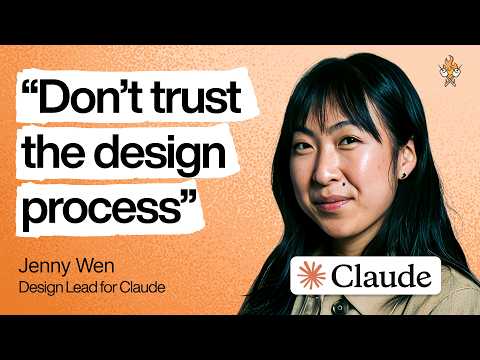
The design process is dead. Here’s what’s replacing it. | Jenny Wen (head of design at Claude)
Jenny Wen (guest), Lenny Rachitsky (host)
In this episode of Lenny's Podcast, featuring Jenny Wen and Lenny Rachitsky, The design process is dead. Here’s what’s replacing it. | Jenny Wen (head of design at Claude) explores aI-driven engineering speed is reshaping designers into decision-makers and partners Jenny argues the canonical “discover → diverge/converge → pixel-perfect mocks” design process is effectively dead, primarily because AI tooling lets engineers ship and iterate at unprecedented speed.
AI-driven engineering speed is reshaping designers into decision-makers and partners
Jenny argues the canonical “discover → diverge/converge → pixel-perfect mocks” design process is effectively dead, primarily because AI tooling lets engineers ship and iterate at unprecedented speed.
Design work is splitting into two modes: (1) hands-on implementation support—pairing with engineers to polish what’s being built in real time—and (2) setting near-term direction through prototypes and lightweight visions (3–6 months), not multi-year decks.
In AI products, you can’t pre-design every state due to non-determinism; shipping earlier and learning from real usage becomes the path to better design, with trust built through fast iteration and responsiveness.
Wen shares how she hires for this new era (block-shaped generalists, deep specialists, and “craft new grads”), why managers should return to IC work, and how to spot “illegible” frontier ideas worth making legible through UX and storytelling.
Key Takeaways
Classic, linear design rituals can’t keep up with AI-accelerated shipping.
When engineers can rapidly prototype with multiple agents, designers can’t be the bottleneck producing perfect mocks. ...
Get the full analysis with uListen AI
Design is splitting into two jobs: execution support and near-term direction-setting.
One track is partnering with engineers to refine and connect fast-moving implementation; the other is providing a coherent “north star” that’s now often a 3–6 month prototype rather than a 2–10 year vision deck.
Get the full analysis with uListen AI
In AI UX, you must test with real users because you can’t mock all states.
Model outputs are non-deterministic, so exhaustive UI state design is unrealistic. ...
Get the full analysis with uListen AI
Quality and brand can be preserved by shipping early—if you visibly iterate.
Wen distinguishes “research preview” launches (known rough edges) from brand-damaging launches where nothing improves. ...
Get the full analysis with uListen AI
Designers’ time allocation is flipping from mocks to collaboration and implementation.
Wen’s personal shift: mocking/prototyping dropped from ~60–70% to ~30–40%, replaced by ~30–40% engineer pairing plus a new slice of direct code-based polish and shipping.
Get the full analysis with uListen AI
The most valuable designers are either unusually broad, unusually deep, or unusually fast-learning.
She highlights three hiring archetypes: “block-shaped” strong generalists (80th percentile across multiple skills), deep T-shaped specialists (top ~10% in a strength like technical depth or visual craft), and “craft new grads” who learn fast without legacy process baggage.
Get the full analysis with uListen AI
Managers stay relevant by being directional and close to the work—not just people-admin.
Wen believes pure people management is less sufficient now; effective managers provide product/work direction and understand modern toolchains. ...
Get the full analysis with uListen AI
Notable Quotes
“This design process that designers have been taught…we sort of treat it as gospel…that’s basically dead.”
— Jenny Wen
“You as a designer actually…do not have the time to make these beautiful mocks anymore.”
— Jenny Wen
“A few years ago, 60 to 70% of it was mocking and prototyping, but now…I feel the mocking up part of it is 30 to 40%.”
— Jenny Wen
“At the end of the day, someone has to decide what is actually going to get built and what actually matters. Someone still needs to be accountable for the decision.”
— Jenny Wen
“The way that you really lose trust…is if you release it early and then nothing ever happens.”
— Jenny Wen
Questions Answered in This Episode
Where exactly does the “old design process” still matter (e.g., discovery/research), and what parts should teams explicitly retire first?
Jenny argues the canonical “discover → diverge/converge → pixel-perfect mocks” design process is effectively dead, primarily because AI tooling lets engineers ship and iterate at unprecedented speed.
Get the full analysis with uListen AI
How do you decide when to ship a “research preview” versus holding for craft—what signals or thresholds do you use?
Design work is splitting into two modes: (1) hands-on implementation support—pairing with engineers to polish what’s being built in real time—and (2) setting near-term direction through prototypes and lightweight visions (3–6 months), not multi-year decks.
Get the full analysis with uListen AI
What concrete practices help designers avoid becoming bottlenecks while still preventing a fragmented, inconsistent product experience?
In AI products, you can’t pre-design every state due to non-determinism; shipping earlier and learning from real usage becomes the path to better design, with trust built through fast iteration and responsiveness.
Get the full analysis with uListen AI
If vision is now 3–6 months out, how do you prevent short-term iteration from drifting into strategy-by-whim?
Wen shares how she hires for this new era (block-shaped generalists, deep specialists, and “craft new grads”), why managers should return to IC work, and how to spot “illegible” frontier ideas worth making legible through UX and storytelling.
Get the full analysis with uListen AI
What does “pairing with engineers” look like day-to-day (meetings, async feedback, PR reviews, live coding), and what’s the minimum viable version of this at non-AI companies?
Get the full analysis with uListen AI
Transcript Preview
This design process that designers have been taught, we sort of treat it as gospel, that's basically dead. You as a designer actually, like, do not have the time to make these beautiful mocks anymore.
A big part of the design role now is helping engineers and teams execute, not just telling them, "Here's the design."
A few years ago, 60 to 70% of it was mocking and prototyping, but now I feel the mocking up part of it is 30 to 40%.
You're better off not blocking that, letting them cook.
It's not just designers who are feeling like, "Oh yeah, we have to keep up with engineers." I think even engineers are like, "How do we keep up with ourselves?"
How to keep up with all our agents, our seven agents we're constantly running.
The result of engineering changing a bunch is that design is sort of forced to change. We used to go off and make this two-year, five-year, 10-year vision even. Now it becomes a vision that's three to six months out and isn't necessarily creating this beautiful deck, but sometimes just creating a prototype that points people in the right direction.
Boris on the podcast recently was saying Claude Code is now helping him come up with ideas.
We'll get better at taste and judgment and design. We might be holding onto that a little bit too much.
Where will human brains continue to be valuable?
At the end of the day, someone has to decide what is actually going to get built and what actually matters. Someone still needs to be accountable for the decision.
What do you now look for when you're hiring designers?
There's probably three archetypes of folks that are really interesting to me right now.
Today's guest is Jenny Wen. Jenny was head of design for Claude, is now leading design for Claude Cowork. Prior to that, she was director of design at Figma, where she led the design teams behind FigJam and Slides. She was also a designer at Dropbox and Square and Shopify. And what I love about this conversation is that Jenny is living in the future of where design as a profession is heading, and she's here to give us a glimpse into what that looks like and how much things are gonna be changing for designers. It is pretty wild and extremely interesting. A huge thank you to Noah Levin and Emily Lin Hasham for suggesting topics and questions for this conversation. Don't forget to check out LennysProductPass.com for an incredible set of deals available exclusively to Lenny's newsletter subscribers. Let's get into it after a short word from our wonderful sponsors. This episode is brought to you by Mercury, radically different banking loved by over 300,000 entrepreneurs, including me. I switched to Mercury from Chase over a year ago, and it is such a profoundly better experience. It's like an actual product person built a bank versus a banking person building a product. It is fast, it's elegant, it is super easy to set wires, to track my spending, to set up triggers to move money around when accounts get low. We moved all of our invoicing to Mercury, and it is such a smoother experience than anything else we've tried. It's also really easy to grant people on your team just the right amount of access to help take work off your plate. It's free to get started, no in-person visits, no minimum balances. The product also flexes to all sizes of company, from startups to large enterprises. Just visit mercury.com to learn more and apply online in minutes. Mercury is a fintech company, not an FDIC-insured bank. Banking services provided through Choice Financial Group and Columna Members FDIC. This episode is brought to you by Orkes, the company behind Open Source Conductor, the orchestration platform powering modern enterprise applications. Modern systems are built on microservices, APIs, and event-driven architectures. But legacy automation tools can't keep up. Siloed low-code platforms, outdated process management, and disconnected API tooling break down under real-world scale and constant change. Orkes Conductor provides a production-grade orchestration layer for coordinating microservices, APIs, data pipelines, human tasks, and agentic workflows with deterministic control flow, retries, observability, and governance. Built for enterprise scale, Orkes supports visual and code-first development with built-in compliance and reliability. Through a built-in MCP gateway, AI agents handle reasoning and decision-making while safely accessing existing APIs and internal systems as MCP tools. This enables agents to operate across enterprise environments and scale from demos to production, orchestrating systems, agents, and humans together to deliver smarter outcomes faster. Learn more at orkes.io/lenny. That's O-R-K-E-S dot I-O slash lenny. Jenny, thank you so much for being here, and welcome to the podcast.
Install uListen to search the full transcript and get AI-powered insights
Get Full TranscriptGet more from every podcast
AI summaries, searchable transcripts, and fact-checking. Free forever.
Add to Chrome