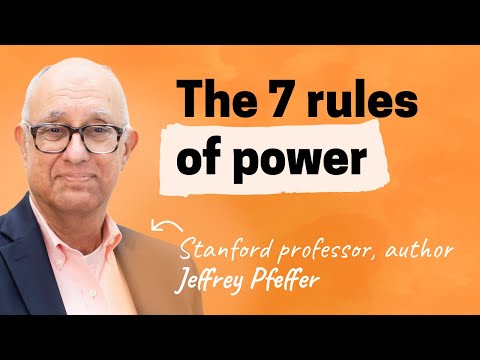
The paths to power: How to grow your influence and advance your career | Jeffrey Pfeffer (Stanford)
Lenny Rachitsky (host), Jeffrey Pfeffer (guest), Narrator
In this episode of Lenny's Podcast, featuring Lenny Rachitsky and Jeffrey Pfeffer, The paths to power: How to grow your influence and advance your career | Jeffrey Pfeffer (Stanford) explores seven surprising power rules to accelerate your career and impact Stanford professor Jeffrey Pfeffer explains that power is a neutral tool strongly correlated with higher salary, promotions, happiness at work, and lower stress, and that more "good people" need power if we want power used for good.
Seven surprising power rules to accelerate your career and impact
Stanford professor Jeffrey Pfeffer explains that power is a neutral tool strongly correlated with higher salary, promotions, happiness at work, and lower stress, and that more "good people" need power if we want power used for good.
He walks through his Seven Rules of Power—getting out of your own way, breaking rules, appearing powerful, building a brand, networking relentlessly, using power, and recognizing that success forgives most behavior—arguing these are learnable skills, not fixed personality traits.
Much of the discomfort people feel about power comes from moral narratives that don’t match how the world actually works; Pfeffer emphasizes realism over idealism, urging listeners to suspend judgment, focus on getting things done through others, and practice these skills through deliberate exercises.
He also highlights the tradeoffs of power—especially loss of autonomy and scrutiny—and suggests people consciously choose how much power they want, then systematically build the skills and support (coaches, networks, personal boards) to reach that level.
Key Takeaways
Treat power as a neutral tool, not inherently good or bad.
Like a hammer or a knife, power can harm or heal; if you want power used for good, more ethical, well‑intentioned people must be willing to gain and wield it rather than opting out on moral grounds.
Get the full analysis with uListen AI
Get out of your own way by dropping self‑limiting beliefs and apologetic behavior.
Seeing power as "dirty," suffering from imposter syndrome, and constantly apologizing or downplaying your contributions all leak a lack of confidence; others then mirror that assessment, limiting your opportunities and influence.
Get the full analysis with uListen AI
Deliberately build a personal brand so decision‑makers actually know you exist.
There are fewer roles at the top, and no one can promote or fund you if they don’t know who you are; differentiating yourself through content, visible projects, distinctive style, and clear positioning makes you memorable and selectable.
Get the full analysis with uListen AI
Network relentlessly with a spirit of generosity and become a connector.
Effective networking is about helping others—sharing opportunities, introductions, and ideas—which requires knowing many diverse people; being the broker who links people and resources increases your information advantage, reputation, and power.
Get the full analysis with uListen AI
Practice acting powerful: presence, body language, and speech are learnable skills.
People respond more to how you look and sound than to your exact words; eye contact, speaking without notes, open posture, confident volume, appropriate touch, and even humor can all be practiced to project authority and gain trust.
Get the full analysis with uListen AI
Use the power you have, because success compounds into more power and resources.
When you take initiative, mobilize resources, and get results, you attract allies, gain more responsibility, and are entrusted with bigger mandates—creating a self‑reinforcing cycle of greater influence and opportunity.
Get the full analysis with uListen AI
Recognize that success often forgives the path taken—and decide your own line.
People are drawn to money, status, and winning, and often overlook past missteps once someone is successful; understanding this realism lets you see why powerful figures endure, while still choosing your own ethical boundaries and desired power–autonomy tradeoff.
Get the full analysis with uListen AI
Notable Quotes
“If you want power to be used for good, more good people need to have power.”
— Jeffrey Pfeffer
“You are hired to get a job done, not to be liked. If you want to be liked, get a dog.”
— Jeffrey Pfeffer (quoting Gary Loveman)
“No one is going to promote you if they don’t know who the hell you are.”
— Jeffrey Pfeffer
“These are not personality traits; these are skills that can be mastered.”
— Jeffrey Pfeffer
“You can have power or you can have autonomy, but you cannot have both.”
— Jeffrey Pfeffer (quoting James G. March)
Questions Answered in This Episode
Where am I currently getting in my own way—through beliefs, language, or habits—that quietly signal I don’t deserve more responsibility or influence?
Stanford professor Jeffrey Pfeffer explains that power is a neutral tool strongly correlated with higher salary, promotions, happiness at work, and lower stress, and that more "good people" need power if we want power used for good.
Get the full analysis with uListen AI
If I defined a clear personal brand statement today, what would I want colleagues and leaders to immediately think when they hear my name?
He walks through his Seven Rules of Power—getting out of your own way, breaking rules, appearing powerful, building a brand, networking relentlessly, using power, and recognizing that success forgives most behavior—arguing these are learnable skills, not fixed personality traits.
Get the full analysis with uListen AI
How could I redesign my networking approach so it feels generous and authentic—focusing on connecting others and sharing value rather than "working the room"?
Much of the discomfort people feel about power comes from moral narratives that don’t match how the world actually works; Pfeffer emphasizes realism over idealism, urging listeners to suspend judgment, focus on getting things done through others, and practice these skills through deliberate exercises.
Get the full analysis with uListen AI
What small, 10–15% stretch behaviors could I practice this month (e.g., speaking without notes, asking for help, initiating introductions) to start building my power skills?
He also highlights the tradeoffs of power—especially loss of autonomy and scrutiny—and suggests people consciously choose how much power they want, then systematically build the skills and support (coaches, networks, personal boards) to reach that level.
Get the full analysis with uListen AI
Given the tradeoff between power and autonomy, how much power do I actually want, and what am I willing—and not willing—to do to get there?
Get the full analysis with uListen AI
Transcript Preview
We're going to be talking about how to grow your power.
The reason why you should pay attention to this is 'cause it leads to a lot of good things: salary, getting promoted, being happy in your career, being less stressed.
You're not describing how the world should work. It's... This is just how it is.
Not only is, but how it was and how it will be.
The Seven Rules of Power: Get out of your own way, break the rules, show up in a powerful fashion, create a powerful brand, network relentlessly, use your power, and understand that once you've acquired power, what you did to get there will be forgiven, forgotten, or both.
This is not about personality. These are skills that can be mastered.
People might be hearing this and they're like, "I don't want to be this person."
Well, you already have done a fabulous job of illustrating principle one. That is one way in which we get in our own way. If I think power is dirty, the first thing that's gonna happen is I'm not gonna do what I need to do to be successful in my career.
The opening quote to your book that I have here, "If you want power to be used for good, more good people need to have power."
That's exactly right.
(instrumental music)
Today my guest is Jeffrey Pfeffer. Jeffrey is a professor of organizational behavior at Stanford's Graduate School of Business and teaches one of the two most popular and oversubscribed courses in all of the MBA program called The Paths to Power. The other class, by the way, is Touchy-Feely, which we dove into last month. In his class and in his recent book, The Seven Rules of Power, Jeffrey teaches the things that you can do in your life and in your work to build your power, and through that, get things done and advance in your career. As one student described the class, "It's the cod liver oil of the graduate school of business. You know it's good for you, but you feel a little nervous about it." In our conversation, we dig into each of the seven powers, why it's important to build these skills even if you feel uncomfortable. We talk through a bunch of examples of the power in action and the impact it has had on people's lives, why it isn't as cringey or scary as you may think. I was actually nervous to have this conversation and I ended up being a huge fan of Jeffrey and the work that he does. We end the conversation with what you can start doing today to start building your own power. This podcast is basically for anyone that wants to advance in their career, whether you're an IC or a CEO, and I'm really excited to bring it to you. If you enjoy this podcast, don't forget to subscribe and follow it in your favorite podcasting app or YouTube. It's the best way to avoid missing future episodes, and it helps the podcast tremendously. With that, I bring you Jeffrey Pfeffer. Jeffrey, thank you so much for being here and welcome to the podcast.
Install uListen to search the full transcript and get AI-powered insights
Get Full TranscriptGet more from every podcast
AI summaries, searchable transcripts, and fact-checking. Free forever.
Add to Chrome