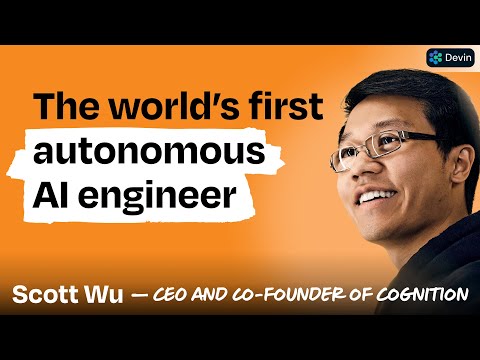
Inside Devin: The AI engineer that's set to write 50% of its company’s code this year | Scott Wu
Scott Wu (guest), Lenny Rachitsky (host), Narrator, Narrator
In this episode of Lenny's Podcast, featuring Scott Wu and Lenny Rachitsky, Inside Devin: The AI engineer that's set to write 50% of its company’s code this year | Scott Wu explores inside Devin: How AI Engineers Are Reshaping Software Teams and Workflows Cognition Labs CEO Scott Wu explains Devin, an autonomous AI software engineer that companies use like a junior remote developer via Slack, Linear, and GitHub.
Inside Devin: How AI Engineers Are Reshaping Software Teams and Workflows
Cognition Labs CEO Scott Wu explains Devin, an autonomous AI software engineer that companies use like a junior remote developer via Slack, Linear, and GitHub.
Within Cognition’s 15-person engineering team, each engineer typically runs around five Devins in parallel, and roughly a quarter of their monthly pull requests are authored by Devin—expected to exceed 50% by year-end.
Wu argues AI will shift engineers from “bricklayers” to “architects,” expanding, not shrinking, the total number of programmers by making software creation far more efficient and accessible.
The conversation also covers Devin’s origin story and pivots, its agentic product design, how it learns a codebase and supports onboarding, and broader implications of AI’s explosive, hardware‑unconstrained adoption curve.
Key Takeaways
Treat Devin like a junior engineer, not a smarter autocomplete.
Wu stresses that users get the most value when they give Devin well-scoped tasks (tickets, bugs, small features) and collaborate through reviews and clarifications, just as they would with a human junior teammate.
Get the full analysis with uListen AI
Run multiple agents asynchronously to massively increase throughput.
At Cognition, each engineer commonly runs up to five Devins in parallel, handing off different issues and features so they can focus on higher‑level design and review instead of serial implementation work.
Get the full analysis with uListen AI
Start with simple, verifiable tasks to onboard Devin into your codebase.
Successful teams first let Devin handle one‑pointers—small fixes, UI tweaks, tests, documentation—while teaching it how to run CI, linting, and local tests, then gradually scale to more complex projects.
Get the full analysis with uListen AI
Engineers will shift from ‘bricklayers’ to ‘architects,’ but coding literacy remains crucial.
Wu argues people should absolutely still learn to code: understanding abstractions, systems, and trade‑offs is what lets humans specify what to build, peel back layers when needed, and fully leverage AI capabilities.
Get the full analysis with uListen AI
AI will likely increase, not decrease, demand for software engineers.
Invoking Jevons paradox, Wu predicts that as the cost and friction of building software drop, society will find far more software to build, expanding the total amount of code and the number of people involved.
Get the full analysis with uListen AI
Agent UX and integration matter as much as raw model capability.
Half of Cognition’s effort has gone into product design—Slack/Linear/GitHub workflows, Devin Wiki, Devin Search, confidence estimates—not just model tuning, because teams must learn *how* to work with agents effectively.
Get the full analysis with uListen AI
Stickiness comes from accumulated codebase knowledge and team workflows, not hard moats.
Wu thinks defensibility is less about blocking competitors and more about making Devin increasingly valuable over time as it learns your stack, captures institutional knowledge, and becomes woven into team processes.
Get the full analysis with uListen AI
Notable Quotes
“Devin is a fully autonomous software engineer that is gonna work on tasks end-to-end.”
— Scott Wu
“Our whole team is only like 15 engineers. We use a ton of Devin when we're building Devin.”
— Scott Wu
“I really think that programming is only going to become more and more important as AI gets more powerful.”
— Scott Wu
“One of the ways that we've kind of thought about Devin is really allowing engineers to go from bricklayer to architect.”
— Scott Wu
“As it becomes easier and easier to program, I think we're gonna have a lot more programmers, not fewer.”
— Scott Wu
Questions Answered in This Episode
How should a mid-size engineering team decide which parts of their workflow to give to Devin first, and what setup steps are non‑negotiable?
Cognition Labs CEO Scott Wu explains Devin, an autonomous AI software engineer that companies use like a junior remote developer via Slack, Linear, and GitHub.
Get the full analysis with uListen AI
If Devin eventually writes the majority of a company’s code, how should teams rethink code ownership, accountability, and on‑call responsibilities?
Within Cognition’s 15-person engineering team, each engineer typically runs around five Devins in parallel, and roughly a quarter of their monthly pull requests are authored by Devin—expected to exceed 50% by year-end.
Get the full analysis with uListen AI
What new skills or career paths will emerge for engineers in a world where they primarily architect, orchestrate, and review work from fleets of AI agents?
Wu argues AI will shift engineers from “bricklayers” to “architects,” expanding, not shrinking, the total number of programmers by making software creation far more efficient and accessible.
Get the full analysis with uListen AI
How does Cognition evaluate and mitigate the risks of agent autonomy—such as bad architectural decisions, subtle bugs, or security misconfigurations—at scale?
The conversation also covers Devin’s origin story and pivots, its agentic product design, how it learns a codebase and supports onboarding, and broader implications of AI’s explosive, hardware‑unconstrained adoption curve.
Get the full analysis with uListen AI
In a landscape where many players can build coding agents on top of similar base models, what product decisions could truly differentiate Devin five years from now?
Get the full analysis with uListen AI
Transcript Preview
Our whole team is only like 15 engineers. We use a ton of Devin when we're building Devin. Most folks on the team are definitely working with up to five Devins at once. And so Devin merges like several hundred pull requests into production in the Devin code bases every month.
What percentage of your PRs are Devin versus humans right now?
It's in the neighborhood of a quarter or so.
Where do you think this will be at the end of the year?
Honestly, uh, we expect it to be a decent bit more than half.
You guys are so ahead of how companies work with AI engineers.
AI is going to be the biggest technology shift of our lives. So most of the big tech revolutions that we've had over the last 50 years like personal computer and the internet and the mobile phone, they all had this big hardware component that was a big part of the distribution. Folks who were building for those industries kind of saw their market grow and grow and grow, basically steadily year over year as the number of people with mobile phones increased, right? As the number of people connected to the internet increased. One of the things which is already I'd say different in AI is just how explosive the technology can be. There's no wait on hardware distribution. It means that the space is just growing so exponentially.
How is the act of being an engineer and building changing?
I think there's going to be way more programmers and way more engineers a few years from now. Pretty quickly the form factor of what it means to be a programmer obviously is going to change, but at the end of the day of course, the discipline is all about just being able to tell your computer what to do. And so in that lens I really think that programming is only going to become more and more important as AI gets more powerful.
Today my guest is Scott Wu. Scott is the co-founder and CEO of Cognition which makes a product called Devin, the world's first autonomous AI software engineer. Unlike other AI tools that I've highlighted on this podcast, Devin is designed to act like an actual remote engineer that you chat with like you would with any other human engineer through Slack or through its dedicated website. When Devin launched about a year ago, it was very much a junior engineer. Over the past year, they've made a lot of progress and Devin is now being used by tons of companies in production. We chat about how their engineering team of 15 uses Devins to build Devin including how every engineer uses about five Devins each to help them code and move faster, how a quarter of their pull requests today are committed by Devins, and that they expect this to be over 50% by the end of the year. We also talk about how Scott imagines software engineering is gonna look in the future, and how the role of an engineer changes from a coder to an architect. We also get into the eight pivots that they went through before landing on this path, why Scott believes AI tools like this will lead to more engineer hiring versus less, also where the name Devin comes from, and so much more. This episode is going to blow your mind. I highly recommend you listen to it if you're at all interested about where engineering, product building and AI is going. A huge thank you to Claire Vo for suggesting a bunch of great questions for this conversation. If you enjoy this podcast, don't forget to subscribe and follow it in your favorite podcasting app or YouTube. Also, if you become an annual subscriber of my newsletter, you get a year free of Linear, Superhuman, Notion, Perplexity, and Granola. Check it out at lennysnewsletter.com and click Bundle. With that I bring you Scott Wu. This episode is brought to you by Interpret. Interpret unifies all your customer interactions from Gong calls to Zendesk tickets to Twitter threads to App Store reviews and makes it available for analysis. It's trusted by leading product orgs like Canva, Notion, Loom, Linear, monday.com and Strava to bring the voice of the customer into the product development process, helping you build best in class products faster. What makes Interpret special is its ability to build and update customer-specific AI models that provide the most granular and accurate insights into your business, connect customer insights to revenue and operational data in your CRM or data warehouse, to map the business impact of each customer need and prioritize confidently, and empower your entire team to easily take action on use cases like win-loss analysis, critical bug detection, and identifying drivers of churn with Interpret's AI assistant Wisdom. Looking to automate your feedback loops and prioritize your roadmap with confidence like Notion, Canva, and Linear? Visit E-N-T-E-R-P-R-E-T.com/lenny to connect with the team and get two free months when you sign up for an annual plan. This is a limited time offer. That's interpret.com/lenny. Many of you are building AI products, which is why I'm very excited to chat with Brandon Fu, founder and CEO of Paragon. Hey, Brandon.
Install uListen to search the full transcript and get AI-powered insights
Get Full TranscriptGet more from every podcast
AI summaries, searchable transcripts, and fact-checking. Free forever.
Add to Chrome