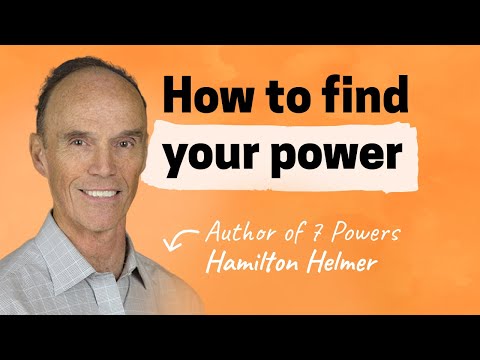
Business strategy with Hamilton Helmer (author of 7 Powers)
Lenny Rachitsky (host), Hamilton Helmer (guest)
In this episode of Lenny's Podcast, featuring Lenny Rachitsky and Hamilton Helmer, Business strategy with Hamilton Helmer (author of 7 Powers) explores hamilton Helmer Reveals How Real Power Builds Truly Durable Businesses Hamilton Helmer, author of *7 Powers*, explains how “power” — durable sources of advantage combining benefit and barrier — underpins long-term business value, strategy, and moats. He argues founders should think about power from day one, but in a lightweight, probabilistic way that guides which opportunities they pursue, not as a rigid strategic plan. For early-stage startups, he narrows the practically available powers to counter positioning, scale economies, switching costs, and network economies, warning that many founders overestimate branding, “flywheels,” data scale, and operational excellence as true moats. Helmer also discusses how AI fits into the 7 Powers framework, why operational excellence is necessary but rarely a power, macro risks like sovereign debt, and what individual product managers can do to think and act more strategically.
Hamilton Helmer Reveals How Real Power Builds Truly Durable Businesses
Hamilton Helmer, author of *7 Powers*, explains how “power” — durable sources of advantage combining benefit and barrier — underpins long-term business value, strategy, and moats. He argues founders should think about power from day one, but in a lightweight, probabilistic way that guides which opportunities they pursue, not as a rigid strategic plan. For early-stage startups, he narrows the practically available powers to counter positioning, scale economies, switching costs, and network economies, warning that many founders overestimate branding, “flywheels,” data scale, and operational excellence as true moats. Helmer also discusses how AI fits into the 7 Powers framework, why operational excellence is necessary but rarely a power, macro risks like sovereign debt, and what individual product managers can do to think and act more strategically.
Key Takeaways
Consider power from day one, but keep it lightweight and probabilistic.
Helmer has changed his view: even pre–product-market fit, founders should evaluate which ideas are more likely to lead to real power, not by writing grand strategic plans but by tilting toward propositions with better odds of building durable advantage.
Get the full analysis with uListen AI
Real power requires both a meaningful benefit and a durable barrier.
A moat (barrier) around a shack (weak benefit) is worthless; true power exists only when you combine superior economics (lower cost or higher price) with something others can’t easily imitate, sustaining that advantage over time.
Get the full analysis with uListen AI
Early-stage startups should focus on four powers: counter positioning, scale economies, switching costs, and network economies.
Branding, process power, and most resource-type powers are effectively off the table for young companies; instead, founders should start with counter positioning (a business model incumbents can’t easily copy) and then, if successful, layer in the other three as they scale.
Get the full analysis with uListen AI
Most claimed moats—especially “brand,” “data flywheels,” and generic “network effects”—are overstated.
Helmer repeatedly sees founders mislabeling brand awareness, incremental data advantages, or small network effects as powers; he stresses that unless the effect is materially large and hard to copy, it’s not a true power and won’t protect long-term margins.
Get the full analysis with uListen AI
Operational excellence is critical to win markets, but rarely a power.
Execution, UI quality, recommendation systems, and process improvements are essential to gaining share (as at Netflix) but are usually imitable—consultants, hires, and best practices can replicate them—so they put you on a treadmill you must keep running, not behind an unbreachable moat.
Get the full analysis with uListen AI
Product managers should learn the powers and explicitly discuss them inside their companies.
ICs can deepen their strategic impact by understanding their company’s actual source of power, spotting threats or opportunities at the ground level, and contributing ideas for “second acts” that could become new power bases.
Get the full analysis with uListen AI
AI doesn’t create an ‘eighth power’ but will reshape where existing powers show up.
Generative AI will likely amplify scale economies, switching costs, and potential network economies, especially in existing businesses that redesign processes around it, but it still fits within the existing 7 Powers rather than requiring a new category.
Get the full analysis with uListen AI
Notable Quotes
“Power requires a benefit and a barrier.”
— Hamilton Helmer
“You can have a moat around a very undesirable piece of property.”
— Hamilton Helmer
“Almost every startup that you want to deal with starts with counter positioning.”
— Hamilton Helmer
“Operational excellence is everything in the takeoff phase… but it’s not power.”
— Hamilton Helmer
“Action is the first principle of business. You do stuff.”
— Hamilton Helmer
Questions Answered in This Episode
How can a very early-stage founder practically evaluate whether their idea has real counter positioning versus being easily copied by incumbents?
Hamilton Helmer, author of *7 Powers*, explains how “power” — durable sources of advantage combining benefit and barrier — underpins long-term business value, strategy, and moats. ...
Get the full analysis with uListen AI
What concrete signals should a company look for to know it has crossed from mere network effects into true, material network economies?
Get the full analysis with uListen AI
How can product teams distinguish between essential but imitable operational excellence and rare, opaque process power worth aggressively protecting?
Get the full analysis with uListen AI
In an AI-first product, what design choices most strongly influence whether you end up with durable scale economies or just a temporary feature edge?
Get the full analysis with uListen AI
Given rising sovereign debt and potential future crises, how should founders adjust their financing and growth strategies to remain resilient?
Get the full analysis with uListen AI
Transcript Preview
(instrumental music) ... Warren Buffett famously said in business...
"I look for economic castles protected by unbreachable moats."
Power requires a benefit and a barrier, so he's taking care of the benefit part by saying a castle. You have to have a pretty good understanding of why it's a castle and not a shack. In a lot of decks it's like, "Oh, we have the most amazing team. We move the fastest." You mentioned how rarely is that actually a power.
You're on a treadmill, and if you stop running that treadmill, you get creamed, but it's not power. The things that drive operational excellence can be mimicked.
Let's actually talk about achieving these powers.
There's this thing called power progression. There are times when certain types of power are available. The path to power is where the rubber meets the road.
(instrumental music) Today my guest is Hamilton Helmer. Hamilton is a legend in the world of strategy. He's the author of Seven Powers, which outlines a framework for identifying and developing sustainable competitive advantage. It is widely considered to be the best book on strategy, and people like Patrick Collison, Peter Thiel, Reed Hastings, Daniel Ek, and so many more leaders credit the book and Hamilton's teachings for helping them build durable, lasting companies. In our conversation, Hamilton shares what sources of power startups can start developing early, which types of power companies often think they have but they don't, how power relates to strategy and moats, when to start thinking about power as a startup, and also what individual product managers and non-leaders can do about these insights about power, also how Hamilton sees AI impacting barriers to entry and the sources of power. He also gives a preview of his new book that he is working on currently and so much more. With that, I bring you Hamilton Helmer after a short word from our sponsors. And if you enjoy this podcast, don't forget to subscribe and follow it in your favorite podcasting app or YouTube. It's the best way to avoid missing future episodes, and it helps the podcast tremendously. This episode is brought to you by WorkOS. If you're building a SaaS app, at some point, your customers will start asking for enterprise features like SAML authentication and SCIM provisioning. That's where WorkOS comes in, making it fast and painless to add enterprise features to your app. Their APIs are easy to understand so that you can ship quickly and get back to building other features. Today, hundreds of companies are already powered by WorkOS, including ones you probably know like Vercel, Webflow, and Loom. WorkOS also recently acquired Warrant, the fine-grained authorization service. Warrant's product is based on a groundbreaking authorization system called Zanzibar, which was originally designed for Google to power Google Docs and YouTube. This enables fast authorization checks at enormous scale while maintaining a flexible model that can be adapted to even the most complex use cases. If you're currently looking to build role-based access control or other enterprise features like single sign-on, SCIM, or user management, you should consider WorkOS. It's a drop-in replacement for Auth0 and supports up to one million monthly active users for free. Check it out at workos.com to learn more. That's workos.com. This episode is brought to you by Vanta. When it comes to ensuring your company has top-notch security practices, things get complicated fast. Now you can assess risk, secure the trust of your customers, and automate compliance for SOC 2, ISO 27001, HIPAA, and more with a single platform, Vanta. Vanta's market-leading trust management platform helps you continuously monitor compliance alongside reporting and tracking risks. Plus, you can save hours by completing security questionnaires with Vanta AI. Join thousands of global companies that use Vanta to automate evidence collection, unify risk management, and streamline security reviews. Get $1,000 off Vanta when you go to vanta.com/lenny. That's vanta.com/lenny. Hamilton Helmer, thank you so much for being here. Welcome to the podcast.
Install uListen to search the full transcript and get AI-powered insights
Get Full TranscriptGet more from every podcast
AI summaries, searchable transcripts, and fact-checking. Free forever.
Add to Chrome