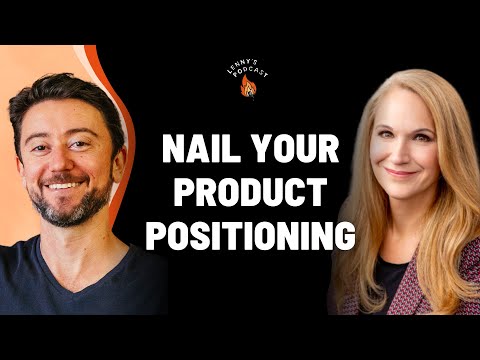
How to nail your product positioning | April Dunford (Obviously Awesome)
April Dunford (guest), Lenny Rachitsky (host), Jon (from Amplitude) (guest), Ashley (Head of Marketing at Flatfile) (guest), Narrator
In this episode of Lenny's Podcast, featuring April Dunford and Lenny Rachitsky, How to nail your product positioning | April Dunford (Obviously Awesome) explores april Dunford explains how to truly nail B2B product positioning April Dunford, author of "Obviously Awesome," breaks down a practical, step-by-step methodology for B2B product positioning and explains why weak positioning, not product quality, is often the root cause of growth problems.
April Dunford explains how to truly nail B2B product positioning
April Dunford, author of "Obviously Awesome," breaks down a practical, step-by-step methodology for B2B product positioning and explains why weak positioning, not product quality, is often the root cause of growth problems.
She emphasizes that positioning must be built collaboratively across marketing, product, sales, and leadership, and validated with real buyers—not by generic tests like "will my grandma get it?"
April walks through her five-part framework (competitive alternatives, differentiated capabilities, value, best-fit customers, and market category) and shows how it feeds directly into sales narratives and messaging.
She also clarifies the difference between positioning, messaging, branding, segmentation, and personas, and explains how and when early-stage startups should treat positioning as a flexible thesis rather than something to over-tighten.
Key Takeaways
Start positioning by identifying real competitive alternatives, including the status quo.
You must first understand what you actually need to beat to win a deal—spreadsheets, existing workflows, or incumbent tools—not just obvious direct competitors. ...
Get the full analysis with uListen AI
Build your value story from differentiated capabilities, not from internal opinions.
List what you can do that alternatives can’t, then translate those capabilities into concrete customer value (the "so what? ...
Get the full analysis with uListen AI
Define your best-fit customers based on who cares most about your differentiated value.
Not every company with the problem is ideal. ...
Get the full analysis with uListen AI
Positioning must be a cross-functional, aligned decision—it's a team sport.
Founders, product, marketing, sales, and customer success often hold slightly different mental models of what the product is and who it’s for. ...
Get the full analysis with uListen AI
Judge positioning by how qualified prospects react, not by clever copy or outsider opinions.
The only real test: when a qualified buyer hears your story, do they quickly understand it, see why it matters, and want to buy? ...
Get the full analysis with uListen AI
For early-stage startups, treat positioning as a thesis and keep it loose.
Before you have enough customers and data, over-tightening positioning can lock you into the wrong use case or segment. ...
Get the full analysis with uListen AI
Segmentation and personas are different: obsess over the champion persona and actionable segments.
In B2B, segment by company attributes and context (firmographics, tech stack, team structure), then build a deep persona primarily for the champion who drives the purchase. ...
Get the full analysis with uListen AI
Notable Quotes
“Positioning defines how your product is the best in the world at delivering some value that a well-defined set of companies care a lot about.”
— April Dunford
“If your product isn’t doing well, there’s a chance that it may not be the product that’s the problem. It may be your positioning.”
— Lenny Rachitsky
“The true test of whether the positioning’s working or not is: if I’m sitting across from a qualified prospect and I tell the story, does the prospect get excited and want to buy something?”
— April Dunford
“We lose about 40% of our deals to ‘no decision’, which actually means we lost to the spreadsheet, we lost to pen and paper, we lost to interns.”
— April Dunford
“Really great positioning feels obvious. You pitch to people and they’re like, ‘Well, of course that’s it. What else could it be?’”
— April Dunford
Questions Answered in This Episode
How would you apply April’s five-step framework to your own product today, starting with a brutally honest list of competitive alternatives and status quo?
April Dunford, author of "Obviously Awesome," breaks down a practical, step-by-step methodology for B2B product positioning and explains why weak positioning, not product quality, is often the root cause of growth problems.
Get the full analysis with uListen AI
Where do you see misalignment between how founders, product, marketing, and sales currently describe your product, and what would it take to unify that story?
She emphasizes that positioning must be built collaboratively across marketing, product, sales, and leadership, and validated with real buyers—not by generic tests like "will my grandma get it?"
Get the full analysis with uListen AI
Looking at your current customers, what common attributes define your true best-fit segment—and are you actually focusing your go-to-market efforts there?
April walks through her five-part framework (competitive alternatives, differentiated capabilities, value, best-fit customers, and market category) and shows how it feeds directly into sales narratives and messaging.
Get the full analysis with uListen AI
If you treated your current positioning as a thesis, what signals from the market suggest you should tighten, broaden, or pivot that thesis?
She also clarifies the difference between positioning, messaging, branding, segmentation, and personas, and explains how and when early-stage startups should treat positioning as a flexible thesis rather than something to over-tighten.
Get the full analysis with uListen AI
Who is the real champion persona in your deals, and how could you better arm them—through your story, materials, and product—to sell your solution internally?
Get the full analysis with uListen AI
Transcript Preview
... a lot of times people will send me a link to their homepage-
Yeah.
... and they'll say, "What do you think? Is this positioning good or not?" And the problem with B2B tech companies is like, well, unless I'm your buyer, I'm not the right person to ask, right? So you can have companies, like people will say, "Well, you know, I looked at the website and I, I, who knows what that is?" And it's like, well, it doesn't matter if I can understand what it is or not. You know, if I'm selling a deeply technical thing to deeply technical buyers, it's okay if your grandmother doesn't understand what it is when they get there. What matters is, does it resonate for your buyers? And when they land there, do they go, "Oh, yeah. I get what this is," and that staff seems like a thing I should have.
(instrumental music) If your product isn't doing well, there's a chance that it may not be the product that's the problem. It may be your positioning, and there's no one I've learned more from about how to very practically and tactically think about your positioning than from April Dunford. April is the bestselling author of the book Obviously Awesome, which many consider an industry bible on product positioning. She's also led teams at seven successful B2B startups, worked with over 200 companies helping them nail their positioning, and has almost certainly done more positioning work than any human alive. Also, April's guest post in my newsletter, A Quickstart Guide to Positioning, is still one of the most popular posts of all time in my newsletter, and one I share often with founders. I had a total blast speaking with April, and I hope you learn as much from this conversation as I did. I'm excited to chat with my friend Jon Cutler from podcast sponsor Amplitude. Hey, Jon.
Hey, Lenny. Excited to be here.
Jon, give us a behind the scenes at Amplitude. When most people think of Amplitude, they think of product analytics, but now you're getting into experimentation and even just launched a CDP. What's the thought process there?
Well, we've always thought of Amplitude as being about supporting the full product loop. Think collect data, inform bets, ship experiments, and learn. That's the heart of growth to us. So the big aha was seeing how many customers were using Amplitude to analyze experiments, use segments for outreach, and send data to other destinations. Experiment and CDP came out of listening to and observing our customers.
And supporting growth and learning has always been Amplitude's core focus, right?
Yeah. So Amplitude tries to meet customers where they are, we just launched starter templates and have a great scholarship program for startups. There's never been a more important time for growth.
Absolutely agree. Thanks for joining us, Jon. And head to amplitude.com to get started. Hey, Ashley, head of marketing at Flatfile. How many B2B SaaS companies would you estimate need to import CSV files from their customers?
Install uListen to search the full transcript and get AI-powered insights
Get Full TranscriptGet more from every podcast
AI summaries, searchable transcripts, and fact-checking. Free forever.
Add to Chrome