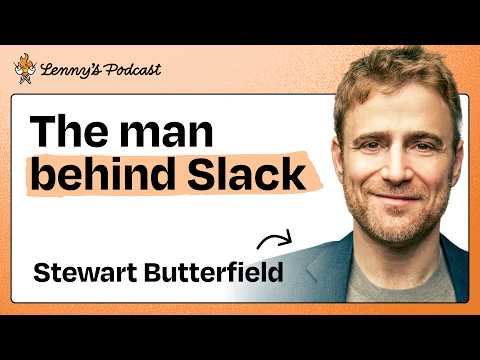
Mental models for building products people love ft. Stewart Butterfield
Stewart Butterfield (guest), Lenny Rachitsky (host), Narrator, Narrator
In this episode of Lenny's Podcast, featuring Stewart Butterfield and Lenny Rachitsky, Mental models for building products people love ft. Stewart Butterfield explores stewart Butterfield’s mental models for lovable, value-creating products Stewart Butterfield, co-founder of Flickr and Slack, unpacks the mental models and product philosophies that guided Slack’s success, from utility curves and taste to customer value and organizational discipline.
Stewart Butterfield’s mental models for lovable, value-creating products
Stewart Butterfield, co-founder of Flickr and Slack, unpacks the mental models and product philosophies that guided Slack’s success, from utility curves and taste to customer value and organizational discipline.
He argues that great products emerge from relentless dissatisfaction, deep empathy, and an obsession with reducing user thinking—not just clicks or friction.
Stewart also explores how organizations drift into fake work, why headcount naturally balloons, and how leaders must create a pipeline of truly valuable work.
Throughout, he emphasizes ethical generosity toward customers and employees, insisting that long-term success is measured by the real value you create for others.
Key Takeaways
Use utility curves to decide when a feature deserves more investment.
Features aren’t binary; they sit on an S-shaped curve where early effort yields little value, then suddenly a lot, then diminishing returns. ...
Get the full analysis with uListen AI
Optimize for comprehension and reduced thinking, not just reduced friction.
Most product problems are not about too many clicks but about users not understanding what’s happening or what to do next. ...
Get the full analysis with uListen AI
Taste and empathy are competitive advantages because most products ignore them.
Taste can be learned through practice and critique; few teams invest in it. ...
Get the full analysis with uListen AI
Friction can be a feature when it shapes behavior or improves clarity.
Adding thoughtful speed bumps—like the @everyone ‘shouty rooster’ warning—prevents abuse, educates users, and nudges healthy norms. ...
Get the full analysis with uListen AI
Beware hyper-realistic work-like activities that feel like progress but aren’t.
As companies grow, people run analyses, A/B tests, meetings, and decks whose upside is tiny compared to the cost (e. ...
Get the full analysis with uListen AI
Recognize the owner’s delusion: you are not your user.
Founders and teams overestimate how much users care or understand, designing restaurant-like “splashy” sites when visitors just want hours and address. ...
Get the full analysis with uListen AI
Long-term success is proportional to real value created for customers.
Butterfield drilled into Slack that “in the long run, the measure of our success will be the amount of value that we create for our customers. ...
Get the full analysis with uListen AI
Notable Quotes
“If you can’t see almost limitless opportunities to improve, then you shouldn’t be designing the product.”
— Stewart Butterfield
“If people could get over the idea of reducing friction as the number one goal, and instead focus on ‘How do I prevent people from having to think in order to use my software?’”
— Stewart Butterfield
“In the long run, the measure of our success will be the amount of value that we create for our customers.”
— Stewart Butterfield
“Everything is simple if you have no idea what you’re talking about.”
— Stewart Butterfield
“The world is a museum of passion projects because for anything to work at all requires an insane amount of effort.”
— Stewart Butterfield (paraphrasing Jon Collison’s framing)
Questions Answered in This Episode
How can a product team practically distinguish between a feature that’s still early on its utility curve versus one that has truly hit diminishing returns?
Stewart Butterfield, co-founder of Flickr and Slack, unpacks the mental models and product philosophies that guided Slack’s success, from utility curves and taste to customer value and organizational discipline.
Get the full analysis with uListen AI
What concrete rituals or processes can a company adopt to systematically build taste and empathy—its own version of ‘tilt your umbrella’?
He argues that great products emerge from relentless dissatisfaction, deep empathy, and an obsession with reducing user thinking—not just clicks or friction.
Get the full analysis with uListen AI
How should teams decide where to intentionally add friction for education or guardrails, versus where to ruthlessly remove it?
Stewart also explores how organizations drift into fake work, why headcount naturally balloons, and how leaders must create a pipeline of truly valuable work.
Get the full analysis with uListen AI
As organizations scale, what are early warning signs that they’re drifting into hyper-realistic work-like activities, and how should leaders intervene?
Throughout, he emphasizes ethical generosity toward customers and employees, insisting that long-term success is measured by the real value you create for others.
Get the full analysis with uListen AI
When should a founder conclude they’ve ‘exhausted the good ideas’ on their current path and seriously consider a pivot, despite the emotional cost and humiliation Stewart describes?
Get the full analysis with uListen AI
Transcript Preview
(instrumental music) This is 2014. That was the year that Slack actually launched. I was interviewed by MIT Technology Review and asked if we were working to improve Slack. I said, "I feel like what we have right now is just a giant piece of shit. It's just terrible and we should be humiliated that we offer this to the public." To me, that was like, you should be embarrassed. If you can't see almost limitless opportunities to improve then you shouldn't be designing the product.
Slack was famous for being one of the early consumerized B2B SaaS products.
At more than one company all-hands, I made everyone in the company repeat this as a chant. In the long run, the measure of our success will be the amount of value that we create for our customers. And you can put effort into demonstrating that you have created this value. It's not like that, but there's no substitute for actually having created it.
Something else I heard that you often espouse is friction in a product experience is actually often a good thing.
It, it became an assumption that you should always be trying to remove friction when the challenge is really comprehension. If your software kind of stops me and asks me to make a decision and I don't really understand it, you make me feel stupid. If people could get over the idea of reducing friction as the number one goal, or reducing the number of clicks or taps to do something, and instead focus on how can I make this simple? How do I prevent people from having to think in order to use my software?
You started two companies, both famously pivoted. I imagine many people come to you for advice on pivoting.
The decision is about like, have you exhausted the possibilities? Creating the distance so that you can make an intellectual, rational decision about it, rather than an emotional decision is essential. And the reason I say you have to be coldly rational about it is because, it's fucking humiliating.
(instrumental music) Today my guest is Stewart Butterfield, a founder and product legend who rarely does podcasts. Stewart founded Flickr and then Slack, which he sold to Salesforce in one of the biggest acquisitions in tech history at the time. There is so much product and leadership wisdom locked away in his head. I feel like our conversation just scratched the surface. We chat about utility curves, something he calls the owner's delusion, a hilarious pattern he sees at companies he calls hyper-realistic work-like activities, what he's learned about product and craft and taste and Parkinson's Law, why you need to obsess with not making your users think, the backstory on his legendary We Don't Sell Saddles Here memo, and so much more. A huge thank you to Noah Weiss, Chris Cordle, Ali Rail, and Johnny Rogers for suggesting topics and questions for this conversation. This is a really special one and I really hope to have Stewart back to delve even deeper. If you enjoy this podcast don't forget to subscribe and follow it in your favorite podcasting app or YouTube. It helps tremendously. And if you become an annual subscriber of my newsletter you get 17 incredible products for free for an entire year, including Devin, Lovable, Replit, Bolt, Innit, Linear, Superhuman, Descript, Whisperflow, Gamma, Perplexity, Warp, Granola, Magic Patterns, Raycast, Cheppi RD, and Mobbin. Head on over to lennysnewsletter.com and click Product Pass. With that, I bring you Stewart Butterfield after a short word from our sponsors. Here's a puzzle for you. What do OpenAI, Cursor, Perplexity, Vercel, Plat, and hundreds of other winning companies have in common? The answer is they're all powered by today's sponsor, WorkOS. If you're building software for enterprises you've probably felt the pain of integrating single sign-on, SKIM, RBAC, audit logs and other features required by big customers. WorkOS turns those deal blockers into drop-in APIs with a modern developer platform built specifically for B2B SaaS. Whether you're a seed stage startup trying to land your first enterprise customer or a unicorn expanding globally, WorkOS is the fastest path to becoming enterprise ready and unlocking growth. They're essentially Stripe for enterprise features. Visit workos.com to get started. Or just hit up their Slack support where they have real engineers in there who answer your questions super fast. WorkOS allows you to build like the best with delightful APIs, comprehensive docs and a smooth developer experience. Go to workos.com to make your app enterprise ready today. This episode is brought to you by Metronome. You just launched your new shiny AI product. The new pricing page looks awesome but behind it, last minute glue code, messy spreadsheets and running ad hoc queries to figure out what to bill. Customers get invoices they can't understand, engineers are chasing billing bugs, finance can't close the books. With Metronome you hand it all off to the real time billing infrastructure that just works. Reliable, flexible and built to grow with you. Metronome turns raw usage events into accurate invoices, gives customers bills they actually understand and keeps every team in sync in real time. Whether you're launching usage-based pricing, managing enterprise contracts or rolling out new AI services, Metronome does the heavy lifting so that you can focus on your product, not your billing. That's why some of the fastest growing companies in the world like OpenAI and Anthropic run their billing on Metronome. Visit metronome.com to learn more. That's metronome.com. Stewart, thank you so much for being here and welcome to the podcast.
Install uListen to search the full transcript and get AI-powered insights
Get Full TranscriptGet more from every podcast
AI summaries, searchable transcripts, and fact-checking. Free forever.
Add to Chrome