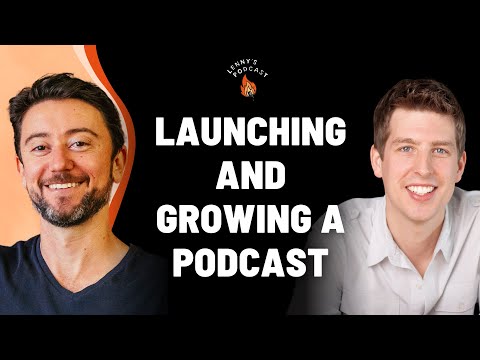
Launching and growing a podcast | Chris Hutchins (All the Hacks, Wealthfront, Google)
Chris Hutchins (guest), Lenny Rachitsky (host)
In this episode of Lenny's Podcast, featuring Chris Hutchins and Lenny Rachitsky, Launching and growing a podcast | Chris Hutchins (All the Hacks, Wealthfront, Google) explores from Idea To Top Charts: Chris Hutchins’ Podcast Growth Playbook Lenny Rachitsky interviews Chris Hutchins (All the Hacks, ex-Wealthfront/Google) about launching and growing a successful podcast, drawing on Chris’s background in product management and big-bet innovation at Wealthfront.
From Idea To Top Charts: Chris Hutchins’ Podcast Growth Playbook
Lenny Rachitsky interviews Chris Hutchins (All the Hacks, ex-Wealthfront/Google) about launching and growing a successful podcast, drawing on Chris’s background in product management and big-bet innovation at Wealthfront.
They unpack how Wealthfront built its ‘self-driving money’/Autopilot product, emphasizing customer research, internal evangelism, and the distinction between product features and the emotional vision.
The conversation then dives deep into the craft of podcasting: choosing a topic, validating interest, standing out among millions of shows, growth strategies, monetization expectations, and Chris’s detailed tech stack.
Throughout, Chris shares mindset and tactical advice—focus on impact over promotions, be someone’s favorite show (not everyone’s generic choice), experiment with formats, and only start a podcast you’d happily do for free.
Key Takeaways
Treat internal evangelism like product marketing: repeat the mission constantly.
Chris learned that simply doing customer research isn’t enough; you must relentlessly restate the product vision and why it matters at every all-hands, connecting each team’s work to the broader mission so people stay aligned and excited.
Get the full analysis with uListen AI
Big bets require both strong opinions and clear, stated intent.
Pushing for bold product ideas can be misread as ego unless you explicitly say your only goal is company impact, not personal credit—this diffuses politics and builds trust when you’re advocating for controversial changes.
Get the full analysis with uListen AI
Only start a podcast you’d gladly do for free, for a long time.
Most shows never become large or lucrative, and production is far more work than it appears, so you should either frame it as a limited experiment (e. ...
Get the full analysis with uListen AI
Aim to be someone’s favorite podcast, not everyone’s ‘pretty good’ show.
Niche, deeply resonant content creates true fans who share, review, and stick with you; broad, bland content rarely stands out in a universe of millions of podcasts and has weaker word-of-mouth.
Get the full analysis with uListen AI
Pick your topic by what people already lean in to hear from you.
Chris found his theme (All the Hacks) by noticing what friends constantly asked him about at dinners—travel points, money hacks, optimization—and then naming and structuring the show around that existing pull.
Get the full analysis with uListen AI
Early growth comes from consistent quality and smart distribution, not virality.
Podcast platforms lack built-in discovery; growth typically comes from great episodes, appearing on other shows, leveraging any existing audience (newsletters, friends lists), engaging in relevant communities, and experimenting with clips on TikTok/YouTube and targeted Overcast ads.
Get the full analysis with uListen AI
A simple, modern tool stack can dramatically reduce friction.
Chris records on Riverside, edits in Descript, hosts on Simplecast, uses Podpage for his website, and Chartable for analytics—plus solid but not insane hardware—so he can focus energy on content quality rather than technical overhead.
Get the full analysis with uListen AI
Notable Quotes
“If you just do an episode a week for 10 weeks, you're now in the top 4% of all podcasts that anyone has created.”
— Chris Hutchins
“If you don't already have a massive platform, it is unlikely statistically that this thing is going to work. So absolutely do not start the podcast if you wouldn't do it for free.”
— Chris Hutchins
“Don't try to be everyone's okay podcast—try to be someone's favorite.”
— Chris Hutchins
“You think that customer research is all you need to build a product, but the end of it is creating this compelling vision for what you're building and bringing people along with you.”
— Chris Hutchins
“The last thing you want to do is create a job for yourself that you hate.”
— Lenny Rachitsky
Questions Answered in This Episode
How can you practically assess whether your podcast concept is strong enough before investing months into it?
Lenny Rachitsky interviews Chris Hutchins (All the Hacks, ex-Wealthfront/Google) about launching and growing a successful podcast, drawing on Chris’s background in product management and big-bet innovation at Wealthfront.
Get the full analysis with uListen AI
What are the first three distribution channels or tactics you’d prioritize if you were launching a new show today with zero audience?
They unpack how Wealthfront built its ‘self-driving money’/Autopilot product, emphasizing customer research, internal evangelism, and the distinction between product features and the emotional vision.
Get the full analysis with uListen AI
How do you balance optimizing for podcast growth (guests, topics, SEO) with staying true to what you personally find interesting?
The conversation then dives deep into the craft of podcasting: choosing a topic, validating interest, standing out among millions of shows, growth strategies, monetization expectations, and Chris’s detailed tech stack.
Get the full analysis with uListen AI
What specific signals would tell you it’s time to pivot your show’s topic, format, or positioning versus doubling down?
Throughout, Chris shares mindset and tactical advice—focus on impact over promotions, be someone’s favorite show (not everyone’s generic choice), experiment with formats, and only start a podcast you’d happily do for free.
Get the full analysis with uListen AI
How can product managers apply the ‘be someone’s favorite’ principle to features and products, not just content?
Get the full analysis with uListen AI
Transcript Preview
Yes, there are four billion podcasts. However, there are only about 150,000 podcasts that have had 10 episodes and have published in the last 10 days. So, the easiest way to be in that top 5% ish, I don't know, I don't know what the math there is, about 3, 4%, is to just stick to it. Like if you just do an episode a week for 10 weeks, you're now in the top 4% of all podcasts that anyone has created.
(instrumental music) Welcome to Lenny's Podcast. I'm Lenny, and my goal here is to help you get better at the craft of building and growing products. Today, my guest is Chris Hutchins. Chris is not only a former product manager, founder, and investor, he just this month went full-time on his podcast and the independent creator path. When I was looking for advice on how to build a podcast, Chris shared this awesome deck with a ton of great advice that he's built throughout his journey. And so, I thought it'd be fun to spend an episode talking about all the things that you should know about launching and growing a podcast. Chris's podcast is called All the Hacks, covers all the ways to financially optimize your life, and it's one of the biggest business podcasts in the world. Chris has also been on the Tim Ferriss Show, actually interviewing Tim Ferriss. He's also head of new product strategy at Wealthfront, where he took some big bold bets within the company, which we talk about. Chris is awesome, and I am excited for you to learn from him. I bring you Chris Hutchins after a short word from our wonderful sponsors. This episode is brought to you by Notion. If you haven't heard of Notion, where have you been? I use Notion to coordinate this very podcast, including my content calendar, my sponsors, and prepping guests for launch of each episode. Notion is an all-in-one team collaboration tool that combines note-taking, document sharing, wikis, project management, and much more into one space that's simple, powerful, and beautifully designed. And not only does it allow you to be more efficient in your work life, but you can easily transition to using it in your personal life, which is another feature that truly sets Notion apart. The other day, I started a home project and immediately opened up Notion to help me organize it all. Learn more and get started for free at notion.com/lennyspod. Take the first step towards an organized happy team today, again at notion.com/lennyspod. This episode is brought to you by Vanta, helping you streamline your security compliance to accelerate growth. If your business stores any data in the cloud, then you've likely been asked or you're gonna be asked about your SOC 2 compliance. SOC 2 is a way to prove your company's taking proper security measures to protect customer data, and builds trust with customers and partners, especially those with serious security requirements. Also, if you wanna sell to the enterprise, proving security is essential. SOC 2 can either open the door for bigger and better deals, or it can put your business on hold. If you don't have a SOC 2, there's a good chance you won't even get a seat at the table. But getting a SOC 2 report can be a huge burden, especially for startups. It's time-consuming, tedious, and expensive. Enter Vanta. Over 3,000 fast-growing companies use Vanta to automate up to 90% of the work involved with SOC 2. Vanta can get you ready for security audits in weeks instead of months, less than a third of the time that it usually takes. For a limited time, Lenny's Podcast listeners get $1,000 off Vanta. Just go to vanta.com/lenny. That's V-A-N-T-A dot com slash Lenny to learn more and to claim your discount. Get started today. Chris, welcome to the podcast.
Install uListen to search the full transcript and get AI-powered insights
Get Full TranscriptGet more from every podcast
AI summaries, searchable transcripts, and fact-checking. Free forever.
Add to Chrome