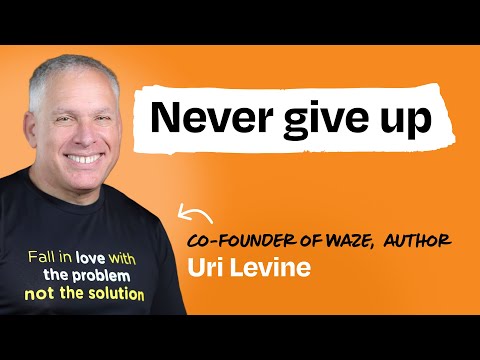
A founder’s guide to crisis management | Uri Levine (Waze co-founder, serial entrepreneur)
Lenny Rachitsky (host), Uri Levine (guest), Narrator, Narrator
In this episode of Lenny's Podcast, featuring Lenny Rachitsky and Uri Levine, A founder’s guide to crisis management | Uri Levine (Waze co-founder, serial entrepreneur) explores waze co-founder explains surviving startup crises, from cash to pivoting Uri Levine, co-founder of Waze and serial entrepreneur, breaks down startup crises into two existential types: cash crises and loss-of–product-market-fit crises.
Waze co-founder explains surviving startup crises, from cash to pivoting
Uri Levine, co-founder of Waze and serial entrepreneur, breaks down startup crises into two existential types: cash crises and loss-of–product-market-fit crises.
He argues founders should assume full responsibility, act extremely fast, and communicate with radical transparency, especially when cutting burn or changing direction.
Uri stresses that building a startup is inherently a continuous journey from one major crisis to the next, where the CEO’s two critical behaviors are never giving up and making decisions with conviction.
He shares concrete stories from Waze and other companies about COVID, regulatory shocks, competitive threats, pivots, and how to keep teams and investors aligned through severe turbulence.
Key Takeaways
Classify the crisis first: is it about cash or product–market fit?
Before reacting, determine whether the existential threat is a cash shortfall (runway jeopardized) or a loss of relevance (value proposition no longer works). ...
Get the full analysis with uListen AI
In a cash crisis, act immediately to preserve optionality.
Ask three questions—what exactly is impacted, how long will it last, and how much runway remains—then adjust burn and plans now. ...
Get the full analysis with uListen AI
Never give up and decide with conviction, especially in hard times.
Uri argues the two defining traits of successful startup CEOs are persistence and making clear, confident decisions; without conviction, teams won’t follow, and without persistence, the company dies at the first major shock.
Get the full analysis with uListen AI
Take full responsibility for outcomes, regardless of external conditions.
Even when crises stem from macro events or regulation, assuming responsibility (“I control my destiny”) increases the odds of finding solutions; blaming the environment doesn’t help the company survive.
Get the full analysis with uListen AI
In a PMF crisis, be willing to go back to square one—or shut down.
When product–market fit disappears (due to regulation, competition, or structural change), previous learnings can become irrelevant. ...
Get the full analysis with uListen AI
Lead with transparency and generosity to keep your team onboard.
During crises, people already know something is wrong; hiding reality erodes trust. ...
Get the full analysis with uListen AI
You can’t avoid crises, but you can cushion them with runway.
Uri is explicit: every startup will face multiple crises; the best preparation is to keep ample cash in the bank (ideally ~18–24 months) so you have time to analyze, adapt, and execute when disruption hits.
Get the full analysis with uListen AI
Notable Quotes
“Building a startup is a journey from one crisis to the next.”
— Uri Levine
“Never give up is the most important behavior of successful CEOs of startups.”
— Uri Levine
“When you assume responsibility, you’re basically saying, ‘You know what? I control my own destiny.’”
— Uri Levine
“If you don’t make decisions with conviction, then the team is not going to follow.”
— Uri Levine
“If you have shorter period of time, then you don’t have enough time to execute—you need to focus on fundraising all the time.”
— Uri Levine
Questions Answered in This Episode
How can a founder distinguish between a temporary setback and a true loss of product–market fit that warrants a full pivot?
Uri Levine, co-founder of Waze and serial entrepreneur, breaks down startup crises into two existential types: cash crises and loss-of–product-market-fit crises.
Get the full analysis with uListen AI
When facing a severe cash crunch, how should a CEO choose among layoffs, salary cuts, leadership pay sacrifices, or down rounds?
He argues founders should assume full responsibility, act extremely fast, and communicate with radical transparency, especially when cutting burn or changing direction.
Get the full analysis with uListen AI
What are practical ways to build the kind of trust and leadership capital before a crisis that make employees willing to stay through unpaid or underpaid periods?
Uri stresses that building a startup is inherently a continuous journey from one major crisis to the next, where the CEO’s two critical behaviors are never giving up and making decisions with conviction.
Get the full analysis with uListen AI
How do you balance the ‘never give up’ mindset with the rational decision to shut down and preserve your and your team’s energy for the next venture?
He shares concrete stories from Waze and other companies about COVID, regulatory shocks, competitive threats, pivots, and how to keep teams and investors aligned through severe turbulence.
Get the full analysis with uListen AI
What frameworks can help founders regularly ask, “If I were starting today, what would I do differently?” and actually act on the answers?
Get the full analysis with uListen AI
Transcript Preview
Let's talk about crisis. I think it might be helpful to do a quick taxonomy of the types of crisis founders face.
So two, abstractly-
Yeah.
... two types of crisis. One is, I would call that a cash crisis. All of a sudden your cash program or plan is being jeopardized. You know, losing a customer, disappearing investor. And the other one is lose of product market fit. When product market fit disappear, you actually need to go back to square one, and you basically say, "Everything that I know so far is irrelevant anymore."
You also talk along these lines of never give up, in a crisis and throughout your journey.
Always keep on looking for ways to make it work. Never give up is the most important behavior of successful CEOs of startup. The second one, by the way, is making decisions with conviction. If you don't make them with conviction then the team is not going to follow. If the team is not going to follow then you're not going to be successful.
A core part of your advice on crisis, it's always the founder's fault if things don't work out.
At the end of the day, you cannot rely on someone else. You have only one company. You need to make sure that this company is successful. When you assume responsibility, you're basically saying, "You know what? I control my own destiny."
Any advice for how to avoid falling into a crisis as a founder?
Number one answer is no. Don't worry, you will face crisis.
(instrumental music) Today my guest is Uri Levine. Uri is the co-founder of Waze, along with nine other companies. He sold two companies for over a billion dollars. He's been on 20 different startup boards, has been an advisor to over 50 different startups, and even more impressively, this is his second time on the podcast. In our first conversation, we walked through the biggest lessons that he's learned over the course of working with all of these different startups that he chronicled in his beloved book, Fall in Love with the Problem, Not the Solution. In this conversation, we go deep on one very specific topic: crisis. As Uri shares in his book, building a startup is a journey from one crisis to the next, and my goal with this conversation is to give you tools to handle the next crisis, and the next crisis, and the next crisis that you face as a founder. This topic is so important that Uri decided to update and re-release his book with a whole new chapter dedicated to managing crisis, and this new edition is actually gonna launch right around the time this episode launches. If you enjoy this podcast, don't forget to subscribe and follow it in your favorite podcasting app or YouTube. It's the best way to avoid missing future episodes and it helps the podcast tremendously. With that, I bring you Uri Levine. This episode is brought to you by WorkOS. If you're building a SaaS app, at some point your customers will start asking for enterprise features like SAML authentication and SCIM provisioning. That's where WorkOS comes in, making it fast and painless to add enterprise features to your app. Their APIs are easy to understand so that you can ship quickly and get back to building other features. Today, hundreds of companies are already powered by WorkOS, including ones you probably know like Vercel, Webflow, and Loom. WorkOS also recently acquired Warrant, the fine-grained authorization service. Warrant's product is based on a groundbreaking authorization system called Zanzibar, which was originally designed for Google to power Google Docs and YouTube. This enables fast authorization checks at enormous scale while maintaining a flexible model that can be adapted to even the most complex use cases. If you're currently looking to build role-based access control or other enterprise features like single sign-on, SCIM, or user management, you should consider WorkOS. It's a drop-in replacement for Auth0 and supports up to one million monthly active users for free. Check it out at workos.com to learn more. That's workos.com. This episode is brought to you by Rippling, a single platform to build and scale your startup on. Rippling handles all the can't get it wrong admin work of payroll and benefits, giving you back hours every week, but it does a lot more than that. Rippling is a game changer for the entire company, with tools for HR, IT, and spend, all built from the ground up and designed to work together seamlessly. Just hired someone? Rippling makes onboarding easy, whether your new hire's sitting next to you or halfway across the world. In just a few clicks, Rippling automatically generates an offer letter, ships a laptop with the necessary apps and permissions, and even delivers a corporate card. An employee needs to update their benefits contribution? When they do it in Rippling, the change automatically syncs to payroll. CTO forgot her laptop in an Uber? Lock it remotely with Rippling. Many startups I've invested in like Sprig, Elemee, and ClassDojo use Rippling because it's a force multiplier for lean teams, helping them eliminate major headaches and operate their business more efficiently. For a limited time, Rippling is giving Lenny's listeners three months off. To redeem, visit rippling.com/lenny. That's rippling.com/lenny. Uri, thank you so much for being here, and welcome to the podcast.
Install uListen to search the full transcript and get AI-powered insights
Get Full TranscriptGet more from every podcast
AI summaries, searchable transcripts, and fact-checking. Free forever.
Add to Chrome