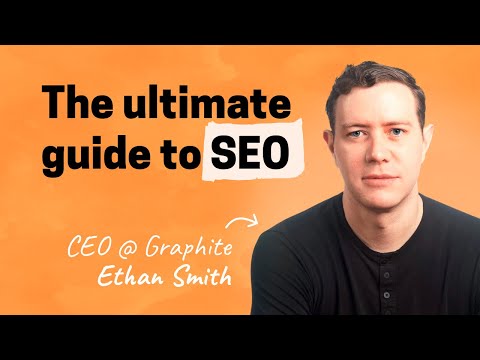
The ultimate guide to SEO | Ethan Smith (Graphite)
Ethan Smith (guest), Lenny Rachitsky (host), Narrator
In this episode of Lenny's Podcast, featuring Ethan Smith and Lenny Rachitsky, The ultimate guide to SEO | Ethan Smith (Graphite) explores demystifying SEO: Strategic, Product-Led Playbook From Graphite’s Ethan Smith Ethan Smith, CEO of growth agency Graphite, breaks down SEO as a product and growth discipline rather than a bag of technical tricks. He explains when SEO is worth investing in, how to assess your addressable search market and authority, and why most companies dramatically under-resource SEO relative to paid acquisition. The conversation dives into programmatic vs. editorial vs. technical SEO, the importance of topics and topical authority, internal linking, and how to structure an SEO team and workflow. Throughout, Ethan emphasizes rigorous competitive analysis, testing, and execution as the real drivers of SEO success.
Demystifying SEO: Strategic, Product-Led Playbook From Graphite’s Ethan Smith
Ethan Smith, CEO of growth agency Graphite, breaks down SEO as a product and growth discipline rather than a bag of technical tricks. He explains when SEO is worth investing in, how to assess your addressable search market and authority, and why most companies dramatically under-resource SEO relative to paid acquisition. The conversation dives into programmatic vs. editorial vs. technical SEO, the importance of topics and topical authority, internal linking, and how to structure an SEO team and workflow. Throughout, Ethan emphasizes rigorous competitive analysis, testing, and execution as the real drivers of SEO success.
Key Takeaways
Don’t invest heavily in SEO until you have basic authority signals.
Ethan recommends reaching roughly 1,000 non-search visits per day and ~1,000 referring domains before treating SEO as a primary growth channel; Google wants to rank credible brands, not pure SEO plays.
Get the full analysis with uListen AI
Evaluate SEO by addressable market and channel tradeoffs, not hype.
Use tools like Similarweb, Ahrefs, and Semrush to size the total search opportunity, compare potential SEO conversions to paid and other channels, and decide if SEO is the best use of marginal resources right now.
Get the full analysis with uListen AI
Think in topics, not single keywords.
A single page typically ranks for 200–2,000 related queries; clustering these into topics gives a truer sense of search volume, avoids redundant pages, and ensures content covers all key sub-intents (e. ...
Get the full analysis with uListen AI
Match your page type to what already ranks for your queries.
Reverse-engineer Google’s intent: for a target query, look at the dominant page types (articles, category grids, product/“item” pages, tools, etc. ...
Get the full analysis with uListen AI
Editorial SEO is often the highest-leverage strategy; programmatic is specialized.
Most companies can and should win with editorial SEO (high-quality articles, guides, listicles), while programmatic SEO (Zillow-, eBay-style database-driven pages) requires deeper technical and product expertise and is applicable to fewer models.
Get the full analysis with uListen AI
Topical authority beats raw domain authority in many niches.
Google increasingly rewards sites that are disproportionately known for a narrow area (e. ...
Get the full analysis with uListen AI
Internal link architecture is a huge, underused growth lever.
Most sites have a power-law distribution of internal links—few pages get most links and many get almost none; systematically spreading body links so each important page has ~5–10 internal links can drive 25–100% traffic uplift.
Get the full analysis with uListen AI
Notable Quotes
“If you're gonna spend $100 million on ads, why would you spend $50,000 on SEO? That doesn't make sense.”
— Ethan Smith
“The way that you grow is with programmatic and with editorial SEO… technical SEO is mostly internal link architecture and a few other things, but that's not how you grow.”
— Ethan Smith
“Google doesn't want you to just be an SEO site. They want you to be a credible domain before they rank you.”
— Ethan Smith
“Testing validates a hypothesis, but the hypotheses come from analyzing other people's sites and analyzing my own site. That's where the valuable hypotheses come from.”
— Ethan Smith
“This is probably the most important, least understood part of SEO: it's not your total domain authority, it's what you're known for.”
— Ethan Smith
Questions Answered in This Episode
How can an early-stage startup with low authority meaningfully accelerate the timeline to SEO impact without over-investing too soon?
Ethan Smith, CEO of growth agency Graphite, breaks down SEO as a product and growth discipline rather than a bag of technical tricks. ...
Get the full analysis with uListen AI
What concrete steps should a product team take to make SEO truly product-led rather than a side-channel fighting for engineering resources?
Get the full analysis with uListen AI
How do you decide the cutoff for when a topic deserves its own page versus being a sub-section within a broader topic page?
Get the full analysis with uListen AI
In practice, how often should a company revisit and re-cluster its topics as search behavior, competition, and its own product evolve?
Get the full analysis with uListen AI
Given the risks of factual errors, what is the most responsible, high-ROI way to leverage AI within an editorial SEO workflow today?
Get the full analysis with uListen AI
Transcript Preview
I think people under-resource SEO a lot of times, and over-resource ads. So if you're Zillow, you're gonna spend tens of millions of dollars on ads, or if you're eBay, you're gonna spend tens of millions of dollars on ads. Why would you not have a really great SEO team? W- like, the amount of traffic you get is probably equal to that, so if you're gonna spend $100 million on ads, why would you spend $50,000 on SEO? That doesn't make sense.
(instrumental music) Welcome to Lenny's Podcast. I'm Lenny, and my goal here is to help you get better at the craft of building and growing products. I interview world-class product leaders and growth experts to learn from their hard-won experiences building and scaling today's most successful companies. Today, my guest is Ethan Smith. Ethan is possibly the smartest person on SEO you will find. Ethan has worked with companies like MasterClass, Thumbtack, Robinhood, Medium, and Honey to develop and execute their SEO strategies. One of my goals with this podcast is to give you tactical and actionable advice for how to build and grow your own product, and SEO is one of the most powerful and least-understood growth levers. This episode contains more advice, tools, tactics, and guidance on how to win at SEO than anything I have ever come across, and I suspect it will blow your mind. We talk about when to focus on SEO, whether you ever should, talk about all the things you need to get right to win at SEO, when to hire, who to hire, the most useful tools, and so much more. I will now stop talking and get right into it. And with that, I bring you Ethan Smith. This episode is brought to you by Coda. Coda's an all-in-one doc that combines the best of documents, spreadsheets, and apps in one place. I actually use Coda every single day. It's my home base for organizing my newsletter writing. It's where I plan my content calendar, capture my research, and write the first drafts of each and every post. It's also where I curate my private knowledge repository for paid newsletter subscribers, and it's also how I manage the workflow for this very podcast. Over the years, I've seen Coda evolve from being a tool that makes teams more productive to one that also helps bring the best practices across the tech industry to life with an incredibly rich collection of templates and guides in the Coda doc gallery, including resources from many guests on this podcast, including Shreyas, Gokul, and Shishir, the CEO of Coda. Some of the best teams out there, like Pinterest, Spotify, Square, and Uber, use Coda to run effectively and have published their templates for anyone to use. If you're ping-ponging between lots of documents and spreadsheets, make your life better and start using Coda. You can take advantage of a special limited time offer just for startups. Head over to coda.io/lenny to sign up and get $1,000 credit on your first statement. That's coda.io/lenny to sign up and get $1,000 in credit on your account. This episode is brought to you by Mixpanel, offering powerful self-serve product analytics. If you listen to this podcast, you know that it's really hard to build great product without making compromises. And when it comes to using data, a lot of teams think that they only have two choices: make quick decisions based on gut feelings or make data-driven decisions at a snail's pace. But that's a false choice. You shouldn't have to compromise on speed to get product answers that you can trust. With Mixpanel, there are no trade-offs. Get deep insights at the speed of thought at a fair price that scales as you grow. Mixpanel builds powerful and intuitive product analytics that everyone can trust, use, and afford. Explore plans for teams of every size and see what Mixpanel can do for you at mixpanel.com. And while you're at it, they are hiring. Check out mixpanel.com to learn more. Ethan, welcome to the podcast.
Install uListen to search the full transcript and get AI-powered insights
Get Full TranscriptGet more from every podcast
AI summaries, searchable transcripts, and fact-checking. Free forever.
Add to Chrome